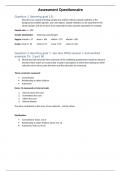
Assessment Questionnaire
Question 1 (learning goal 13)
Describe your sample including sample size and the relevant sample statistics of the
background variables (gender, year and region). Sample statistics can be reported for the
whole sample, and do not have to be reported for boys and girls separately for example.
Sample size: n = 500
Gender distribution: •244 boys and 256 girls
Region: •North = 57 •East = 106 •West = 237 •South = 100
Grade: •Year 5= 92 •Year 6=79 •Year 7=97 •Year 8= 232
Question 2 (learning goal 7, see also SPSS session 1 and worked
example Ch. 3 part III)
a) Shortly describe what the three subscales of the wellbeing questionnaire intend to measure
and how these scales are constructed. Include a description of which items belong to which
subscale and on what scales the items and the subscales are measured.
Three constructs measured:
• Commitment
• Relationship to other children
• Autonomy
Items: 16 measured on interval scale:
1. «Almost never the case»
2. «Sometimes the case»
3. «Often the case»
4. «Almost always»
One item contributes to the score of one subscale – not the others
Distribution:
• Commitment: items 1 to 8
• Relationship to other children: items 9 to 12
• Autonomy: items 13 to 16
Question 1 (learning goal 13)
Describe your sample including sample size and the relevant sample statistics of the
background variables (gender, year and region). Sample statistics can be reported for the
whole sample, and do not have to be reported for boys and girls separately for example.
Sample size: n = 500
Gender distribution: •244 boys and 256 girls
Region: •North = 57 •East = 106 •West = 237 •South = 100
Grade: •Year 5= 92 •Year 6=79 •Year 7=97 •Year 8= 232
Question 2 (learning goal 7, see also SPSS session 1 and worked
example Ch. 3 part III)
a) Shortly describe what the three subscales of the wellbeing questionnaire intend to measure
and how these scales are constructed. Include a description of which items belong to which
subscale and on what scales the items and the subscales are measured.
Three constructs measured:
• Commitment
• Relationship to other children
• Autonomy
Items: 16 measured on interval scale:
1. «Almost never the case»
2. «Sometimes the case»
3. «Often the case»
4. «Almost always»
One item contributes to the score of one subscale – not the others
Distribution:
• Commitment: items 1 to 8
• Relationship to other children: items 9 to 12
• Autonomy: items 13 to 16