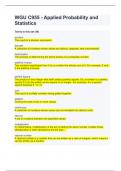
WGU C955 - Applied Probability and Statistics
WGU C955 - Applied Probability and Statistics Terms in this set (49) quotient The result of a division expression. discrete A collection of numbers whose values are distinct, separate, and unconnected. factorization The process of determining the prime factors of a composite number. additive inverse Two numbers equidistant from 0 on a number line whose sum is 0. For example, 3 and - 3 are additive inverses. perfect square The product of any integer with itself yields a perfect square. So, a number is a perfect square if it can be written as the square of an integer. For example, 9 is a perfect square because 3 * 3 = 9. sum The result of multiple numbers being added together. addition Finding the total of two or more values. continuous A collection of numbers whose values are not dividable into distinct units. interval A set of numbers between two specified values. multiplication In mathematics, multiplication is the act of adding the same number multiple times. Multiplication is often denoted by the dot sign, ·. rational number A rational number is a number that can be written as a ratio of integers, which means it can be written as a fraction. subtraction Taking one or more values away from another. factor tree A graphical method used to identify the prime factorization of an integer. set In mathematics: a collection of numbers. multiplicative inverse The multiplicative inverse of a number x is the number you must multiply x by to get 1. For example, 5 and 1/5 are multiplicative inverses. order of operations A set of rules that defines the order in which mathematical operations should be performed prime factorization Determining the set of prime numbers whose product is the original integer. parentheses In mathematics, parentheses () are used to separate operations within an expression. Any operations that lie within parentheses should be performed first. integer A number, (positive, negative, or zero), that can be represented without a fractional or a decimal component. prime number A number with only two factors: one and itself. identity property The property that 0 can be added to any number without changing the value of the number. Likewise, 1 can be multiplied by any number without changing the value of that number. radical sign The symbol which indicates to take the square root of the number that follows. factor An integer that divides another integer. We say an integer, x, is a factor of another integer, y, if the quotient y/x is also equal to an integer. Fundamental Theorem of Arithmetic A concept which states that any integer greater than 1 is either prime or is the product of a unique set of prime numbers
Escuela, estudio y materia
- Institución
- WGU C955
- Grado
- WGU C955
Información del documento
- Subido en
- 20 de marzo de 2024
- Número de páginas
- 4
- Escrito en
- 2023/2024
- Tipo
- Examen
- Contiene
- Preguntas y respuestas
Temas
-
wgu c955
-
wgu c955 applied probability and statistics

Documento también disponible en un lote