Macbeth Literary Essay
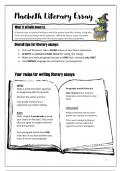
What it all boils down to:
A literary essay is a piece of writing in which the author identifies a theme, or big idea,
from a text by generating a thesis statement. Within the literary essay, the author
uses several pieces of evidence from the text to support the thesis statement.
Overall tips for literary essays:
• First and foremost, take a CLEAR stance in your thesis statement.
• ALWAYS use present simple tense (He walks. She reads.)
• Make sure each paragraph focuses on ONE idea- seriously only ONE!
• Use FORMAL language (no contractions- no exceptions)
Your recipe for writing literary essays:
INTRO
Make a statement either agreeing Paragraphs should follow the
or disagreeing with the question. PEEL method (Point, Evidence,
Mention the author and text. Explanation and Link back to main
topic)
Very briefly mention the 3
arguments you will be making.
CONCLUSION
BODY Briefly summarise how you have
Write roughly 3 paragraphs proving proven your opinion or statement.
your stance on the topic. This proves This is your moment to drop an
why you agree or disagree with the insightful comment about the
with the question. argument and tie it all together.
Each paragraph should have ONE
main idea. If you have another idea,
move it to the next paragraph.
1
, NB! NB! NB! NB! NB! NB! NB! NB! NB! NB! NB! NB! NB! NB! NB! NB!
You DO NOT WRITE a literary essay- you CRAFT an essay.
This means that you need to carefully consider all aspects of
the question and carefully construct the perfect essay with
a clear argument.
Understanding the specific [ P E E L ] method
for literary essays.
A literary essay is basically three PEE methods in one big essay. You will have to have a CORE
argument and then three paragraphs which prove this main argument. Each essay will
require three body paragraphs which follow the PEE method. Think of it as answering a
question in three different ways using the PEE method as guidance. In literary essays we add
a “Link” which means that at the end of each PEE paragraph you need to link it to your main
argument.
Breakdown of the method:
Point This is your overall response sentence to the question. It can be
referred to as the topic sentence. You either agree or disagree with
the question and make a clear statement or core argument.
Evidence After you have made a very clear statement, you need to provide
evidence which substantiates or supports your argument. You can do
this by paraphrasing (when you restate a quote in your own words) or
you can do this by integrated quoting.
Explanation Perhaps the most important part of the PEE method is being able to
explain WHY exactly the quote proves your statement or argument
to be valid. This explanation will prove to the reader that you know
what is going on because your arguments are well substantiated.
Link After you have crafted the perfect PEE paragraph, you need to link it
back to your MAIN or OVERALL core argument in the beginning.
Remember the three paragraphs are substantiations in itself for the
main argument.
2
What it all boils down to:
A literary essay is a piece of writing in which the author identifies a theme, or big idea,
from a text by generating a thesis statement. Within the literary essay, the author
uses several pieces of evidence from the text to support the thesis statement.
Overall tips for literary essays:
• First and foremost, take a CLEAR stance in your thesis statement.
• ALWAYS use present simple tense (He walks. She reads.)
• Make sure each paragraph focuses on ONE idea- seriously only ONE!
• Use FORMAL language (no contractions- no exceptions)
Your recipe for writing literary essays:
INTRO
Make a statement either agreeing Paragraphs should follow the
or disagreeing with the question. PEEL method (Point, Evidence,
Mention the author and text. Explanation and Link back to main
topic)
Very briefly mention the 3
arguments you will be making.
CONCLUSION
BODY Briefly summarise how you have
Write roughly 3 paragraphs proving proven your opinion or statement.
your stance on the topic. This proves This is your moment to drop an
why you agree or disagree with the insightful comment about the
with the question. argument and tie it all together.
Each paragraph should have ONE
main idea. If you have another idea,
move it to the next paragraph.
1
, NB! NB! NB! NB! NB! NB! NB! NB! NB! NB! NB! NB! NB! NB! NB! NB!
You DO NOT WRITE a literary essay- you CRAFT an essay.
This means that you need to carefully consider all aspects of
the question and carefully construct the perfect essay with
a clear argument.
Understanding the specific [ P E E L ] method
for literary essays.
A literary essay is basically three PEE methods in one big essay. You will have to have a CORE
argument and then three paragraphs which prove this main argument. Each essay will
require three body paragraphs which follow the PEE method. Think of it as answering a
question in three different ways using the PEE method as guidance. In literary essays we add
a “Link” which means that at the end of each PEE paragraph you need to link it to your main
argument.
Breakdown of the method:
Point This is your overall response sentence to the question. It can be
referred to as the topic sentence. You either agree or disagree with
the question and make a clear statement or core argument.
Evidence After you have made a very clear statement, you need to provide
evidence which substantiates or supports your argument. You can do
this by paraphrasing (when you restate a quote in your own words) or
you can do this by integrated quoting.
Explanation Perhaps the most important part of the PEE method is being able to
explain WHY exactly the quote proves your statement or argument
to be valid. This explanation will prove to the reader that you know
what is going on because your arguments are well substantiated.
Link After you have crafted the perfect PEE paragraph, you need to link it
back to your MAIN or OVERALL core argument in the beginning.
Remember the three paragraphs are substantiations in itself for the
main argument.
2