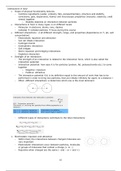
Interactions in food
• Scope of physical functionality lectures
- Combine ingredients (water, proteins, fats, polysaccharides), structure and stability
(emulsions, gels, dispersions, foams) and macroscopic properties (viscosity, elasticity, yield
stress) together
o Stability depends on interaction between particles
• Interactions in food many types on different levels
- Molecular electrons, atoms, ions, dipoles
- Colloidal colloidal particles focus during this course
• Different interactions: all different strength, range, and properties (dependence on T, pH, salt
concentration)
- Electrostatic repulsion and attraction
- Van der Waals interaction
- Hydrogen bonds
- Hydrophobic interaction
- Salt bridges
- Steric repulsion and bridging interactions
- Depletion interaction
• Strength of an interaction:
- The strength of an interaction is related to the interaction force, which is also called the
interaction potential
- Interaction potential: how easy it is for particles (protein, fat, polysaccharide etc.) to come
together
o Negative: repulsive
o Positive: attractive
- The interaction potential V(r) is by definition equal to the amount of work that has to be
performed in order to bring two particles, that are initially infinitely far apart, to a distance r
- Often: different interactions determine which one is the most dominant
- Different types of interactions contribute to the total interactions:
1. Electrostatic repulsion and attraction
- Within food, the interactions between charged molecules are
very important
- Electrostatic interactions occur between particles, molecules
or groups of molecules that contain a charge (+ or -)
- Repulsive when charged are the same (- and – or + and +)
10
,- Attractive when the charges are opposite (- and
+)
- How do particles get charged in solution?
Mainly through the presence of acid/base groups
on the surface (pH dependent) have a charge
o pH affects the charge of the particles in
food
o pH of common foods most foods acidic
- Charge of proteins
o Dissociation/association of acid/base
groups:
▪ Amide groups (acid) and carboxyl groups (basic)
o Proteins have both groups: Can be positively or
negatively charged depending on pH
▪ IEP: the pH at which the net charge on the
amino acid is 0 average/total charge is
neutral/0
➢ Affects how many positive and
negative groups are available
affects charge of protein
➢ pH above IEP = negative
➢ pH below IEP = positive
▪ Low IEP in higher pH → negatively charged
▪ High IEP in lower pH → positively charged
▪ Protein the same load reject no
clumping
▪ Proteins no charge binding coagulation
(agglomeration)
o pH 7 some proteins positive charge, and some proteins
negative charge pH in food really important determines
the sign of the charge and amount of charge
- Charge of polysaccharides
o Mostly carboxyl groups can only become negatively charged
o Basic pH negative charge
o Not the ability to have a positive charge
o How much groups become charged and at which pH depends on the type of groups
o Other groups come from stronger acids dissociate easier into charged group
at low and basic pH
▪ SO42- (sulphates groups) (carrageenan)
▪ PO43- (phosphate groups)
o Example
▪ Pectin: has a lot of carboxyl groups that can be negatively charged
11
, ▪ So pectins are in general negatively charged pectin is an exception has
amide and carboxyl group possibility for positive and negative charge
act as polysaccharide
- Amount of charged groups
o Possible to calculate amount of
negative/positive charge
o Amount of charged groups can be calculated for each pH value and are related by the
pKa of the polysaccharide
▪ At pKa: amount of charged (+ or -) groups (A-) and neutral groups (HA) are
equal
o Depends on type protein/polysaccharides/available groups and available amount of
those groups
▪ Polysaccharides with low pKa have a lot of negative charges at low pH
▪ Polysaccharides with high pKa have a little negative charges at a low pH
- Summary
o pH and chemical composition are very dependent on the charge and therefore have
an effect on electrostatic interactions
o Proteins
▪ NH2 and COOH groups
▪ Charge depends on pI
▪ Positive below pI
▪ Negative above pI
o Polysaccharides
▪ COOH, SO42-, PO43- groups
▪ Charge depends on pKa
▪ Low charge close to pKa
▪ High charge above pKa
- Electrostatic interaction
o In this case: repulsion Attraction just the opposite
o The amount of charge will depend how much repulsion will be present and will
therefore determine the distance between particles
12
• Scope of physical functionality lectures
- Combine ingredients (water, proteins, fats, polysaccharides), structure and stability
(emulsions, gels, dispersions, foams) and macroscopic properties (viscosity, elasticity, yield
stress) together
o Stability depends on interaction between particles
• Interactions in food many types on different levels
- Molecular electrons, atoms, ions, dipoles
- Colloidal colloidal particles focus during this course
• Different interactions: all different strength, range, and properties (dependence on T, pH, salt
concentration)
- Electrostatic repulsion and attraction
- Van der Waals interaction
- Hydrogen bonds
- Hydrophobic interaction
- Salt bridges
- Steric repulsion and bridging interactions
- Depletion interaction
• Strength of an interaction:
- The strength of an interaction is related to the interaction force, which is also called the
interaction potential
- Interaction potential: how easy it is for particles (protein, fat, polysaccharide etc.) to come
together
o Negative: repulsive
o Positive: attractive
- The interaction potential V(r) is by definition equal to the amount of work that has to be
performed in order to bring two particles, that are initially infinitely far apart, to a distance r
- Often: different interactions determine which one is the most dominant
- Different types of interactions contribute to the total interactions:
1. Electrostatic repulsion and attraction
- Within food, the interactions between charged molecules are
very important
- Electrostatic interactions occur between particles, molecules
or groups of molecules that contain a charge (+ or -)
- Repulsive when charged are the same (- and – or + and +)
10
,- Attractive when the charges are opposite (- and
+)
- How do particles get charged in solution?
Mainly through the presence of acid/base groups
on the surface (pH dependent) have a charge
o pH affects the charge of the particles in
food
o pH of common foods most foods acidic
- Charge of proteins
o Dissociation/association of acid/base
groups:
▪ Amide groups (acid) and carboxyl groups (basic)
o Proteins have both groups: Can be positively or
negatively charged depending on pH
▪ IEP: the pH at which the net charge on the
amino acid is 0 average/total charge is
neutral/0
➢ Affects how many positive and
negative groups are available
affects charge of protein
➢ pH above IEP = negative
➢ pH below IEP = positive
▪ Low IEP in higher pH → negatively charged
▪ High IEP in lower pH → positively charged
▪ Protein the same load reject no
clumping
▪ Proteins no charge binding coagulation
(agglomeration)
o pH 7 some proteins positive charge, and some proteins
negative charge pH in food really important determines
the sign of the charge and amount of charge
- Charge of polysaccharides
o Mostly carboxyl groups can only become negatively charged
o Basic pH negative charge
o Not the ability to have a positive charge
o How much groups become charged and at which pH depends on the type of groups
o Other groups come from stronger acids dissociate easier into charged group
at low and basic pH
▪ SO42- (sulphates groups) (carrageenan)
▪ PO43- (phosphate groups)
o Example
▪ Pectin: has a lot of carboxyl groups that can be negatively charged
11
, ▪ So pectins are in general negatively charged pectin is an exception has
amide and carboxyl group possibility for positive and negative charge
act as polysaccharide
- Amount of charged groups
o Possible to calculate amount of
negative/positive charge
o Amount of charged groups can be calculated for each pH value and are related by the
pKa of the polysaccharide
▪ At pKa: amount of charged (+ or -) groups (A-) and neutral groups (HA) are
equal
o Depends on type protein/polysaccharides/available groups and available amount of
those groups
▪ Polysaccharides with low pKa have a lot of negative charges at low pH
▪ Polysaccharides with high pKa have a little negative charges at a low pH
- Summary
o pH and chemical composition are very dependent on the charge and therefore have
an effect on electrostatic interactions
o Proteins
▪ NH2 and COOH groups
▪ Charge depends on pI
▪ Positive below pI
▪ Negative above pI
o Polysaccharides
▪ COOH, SO42-, PO43- groups
▪ Charge depends on pKa
▪ Low charge close to pKa
▪ High charge above pKa
- Electrostatic interaction
o In this case: repulsion Attraction just the opposite
o The amount of charge will depend how much repulsion will be present and will
therefore determine the distance between particles
12