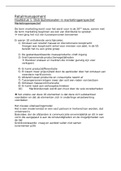
McMaster Bio 1M03: Exam 2024/2025 Questions with all the correct Answers (Real Actual Exam).
McMaster Bio 1M03: Exam 2024/2025 Questions with all the correct Answers (Real Actual Exam). Why might Pasteur's experiment be inconclusive? - ANS - The swan-necked flask broth may not support cell growth, or the broth was poisoned. Experiment did not confirm hypothesis that all cells come from pre-existing cells Why are replicates important in experiments? - ANS - To ensure that results were not achieved by random chance What is the definition of a replicate? - ANS - Unit that shares a common thing (4 mice in one cage = 1 replicate) What does the law of succession suggest? - ANS - As one species disappears, a similar one appears. Suggests ancestors and descendants What is the difference between vestigial traits and transitional features? - ANS - vestigial - useless features similar to useful features in related species (eg, coccyx in humans, tail in monkeys) transitional - intermediate feature seen in fossil species, between ancestral and descended species (eg, aquatic animal fins, tetrapod limbs) List potential outcomes of the bottleneck effect - ANS - - Potential high frequency of deleterious alleles that were previously at low frequency in source population - Different allele frequencies from source population, could lead to speciation - Strong genetic drift due to small population size Explain how the tuberculosis bacteria underwent natural selection during and after drug therapy - ANS - Variation: different strains → some resistant to drugs, some died Heritability: drug-resistant bacteria passed drug-resistant gene to daughter cells Differential fitness: bacteria that survived produced offspring Selection: drug-resistant allele had higher chance of survival through drug therapy Give three types of homologies. Provide an example for each - ANS - Genetic: similarity in RNA, DNA, amino acids (eg, AUG start codon shared with many living organisms) Developmental: similarities in embryonic form or developmental processes (eg, embryos of human, chicken, cat) Structural: similarity in adult features (eg, neck bone structure shared between giraffes and humans) McMaster Bio 1M03: Exam 2024/2025 Questions with all the correct Answers (Real Actual Exam). What is the difference between acclimatization and adaptation? - ANS - Acclimatization: organism's response to the environment Adaptation: heritable trait that increases the fitness of an individual. Acclimatization does not change alleles, therefore it is not heritable. How are the Galapagos finches an example of directly observed evolution? - ANS - Beak morphology and body size is heritable, and changes due to the environment. Since evolution = ∆ in allele frequencies, selection for deeper beaks kills medium beaks. ∆ in food source selects for smaller beaks, which changes allele frequencies again. How does the Galapagos finches exhibit non-Lamarckian evolution? - ANS - Lamarckian evolution says evolution is goal directed. Bidirectional evolution (deeper to smaller) goes against this; if it was goal, it would've gone in a single direction. `Provide examples where evolution is not goal-directed - ANS - - Parasites lose complex digestive systems - Finch beaks get larger, then smaller Why can humans not fly? What constraints are in place? - ANS - - Historical constraints: since all traits come from previous traits, if we don't have a prior trait for flying, we won't develop flight - Genetic: we lack the necessary genes that would give us wings, flight, etc. Individuals with genotype XX have same phenotype as genotype XY. Which allele is dominant, and what are individuals with intermediate phenotypes called? - ANS - X is dominant, Y is recessive. Incompletely dominant. What is evolution driven by? Of the four, which one introduces new alleles? - ANS - Natural selection, gene flow, genetic drift, mutation. Mutation is the only one that introduces new alleles into populations (other than gene flow) For a given population, there is more observed heterozygotes than predicted in HWE. What are some reasons this might occur? - ANS - - Non-random mating → subconsciously prefer heterozygotes - Natural selection → heterozygotes have an advantage over homozygotes (higher fitness) In order for HWE to proceed, what assumptions must be made? - ANS - - random mating → gametes combine randomly - no natural selection → parent generation survives and donates gametes - no genetic drift → population is infinitely large **why does genetic drift affect small populations? - no gene flow → no alleles lost by migration - no mutation → no new alleles.
Escuela, estudio y materia
- Institución
- McMaster
- Grado
- McMaster
Información del documento
- Subido en
- 18 de marzo de 2024
- Número de páginas
- 20
- Escrito en
- 2023/2024
- Tipo
- Examen
- Contiene
- Preguntas y respuestas
Temas
-
mcmaster bio 1m03 exam real actual exam
-
mcmaster bio 1m03 exam questions and answers
-
mcmaster bio 1m03 questions and answers
-
mcmaster bio 1m03 exam latest update
-
mcmaster bio 1m03 questions and answer