CPU Question With Answers 2024
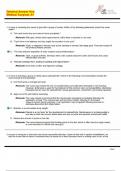
1. Explain the functions of the CU and ALU in the CPU of a computer. Answer: CU-Control Unit, charge of all the operations being carried out, responsible to direct the system to execute instructions and work as a communicator between the memory and the arithmetic logical unit. ALU - Arithmetic and Logic Unit, responsible for performing all logical and arithmetic operations. Some of the arithmetic operations are as follows: addition, subtraction, multiplication and division. 2. Briefly explain the types of data storage and its relation with the CPU. Answer: Primary /Temporary/Volatile storage: This type of storage is primarily used to store information temporarily. The CPU does not directly access the secondary memory; instead it always relies on the primary memory. Secondary/Permanent/Non-Volatile storage: This type of storage is primarily used to store data for long periods. This type of memory is stored in external devices such as hard drives etc. 3. Explain what you understand by registers, briefly explain the various types of registers. – CPU Answer: CPU registers perform a variety of functions, a primary one of which is to offer temporary storage for the CPU to access information stored on the hard drive. Every CPU register has a distinct function and the registers are essential components of CPU commonly recognized for memory allocation purposes. Instruction Register (IR): The instruction register holds the instruction currently being executed. Memory Data Register (MDR): The memory data register (also known as the memory buffer register or data buffer) holds the piece of data that has been fetched from memory. Memory Address Register (MAR): The memory address register holds the address of the next piece of memory to be fetched. Program Counter (PC): The program counter holds the location of the next instruction to be fetched from memory. It is automatically incremented between supplying the address of the next instruction and the instruction being executed. Accumulator: The accumulator is an internal CPU register used as the default location to store any calculations performed by the arithmetic and logic unit. 4. What are the different ways in which data can be represented? – CPU
Escuela, estudio y materia
- Institución
- CPU
- Grado
- CPU
Información del documento
- Subido en
- 16 de marzo de 2024
- Número de páginas
- 8
- Escrito en
- 2023/2024
- Tipo
- Examen
- Contiene
- Preguntas y respuestas
Temas
-
cpu question with answers 2024