CHEM 104: General Chemistry II MODULE 1 Exam Questions And Answers Latest Updated 2024/2025
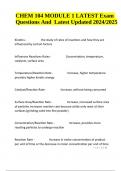
CHEM 104: General Chemistry II MODULE 1 Exam Questions And Latest Updated 2024/2025. Temperature/Reaction Rate - Increase, higher temperature provides higher kinetic energy Catalyst/Reaction Rate - Increase, without being consumed Surface Area/Reaction Rate - Increase, increased surface area of particles increases reaction rate because solids only react at their surfaces (grinding solid into fine powder) Concentration/Reaction Rate - Increase, provides more reacting particles to undergo reaction Reaction Rate - Increase in molar concentration of product per unit of time or the decrease in molar concentration per unit of time CHEM 104 MODULE 1 LATEST Exam Questions And Latest Updated 2024/2025 P a g e 2 | 15 Reaction Rate Units - moles per liter per second (mol/L*s) Reaction Rate Equation - Change in concentration/change in time (products=positive, reactants=add negative sign) Average Rate - Determined by using initial and final concentrations and initial and final times so that the result measures the rate over the entire reaction Instantaneous Rate - The change in concentration of reactants (or products) divided by a very short period of time Instantaneous Rate Decreases... - Decreases, as reaction proceeds, concentration of reactant becomes smaller due to consumption of reactants as reaction takes place Early Instantaneous Rate - The change in concentration of reactants (or products) divided by a very short period of time near the beginning of the reaction P a g e 3 | 15 Late Instantaneous Rate - The change in concentration of reactants (or products) divided by a very short period of time at the end of the reaction Relative Values of Average Rate, Early Instantaneous Rate, and Late Instantaneous Rate - The early instantaneous rate will be greater (most reactant) than the late instantaneous rate or the average rate. The late instantaneous rate will be smaller (less reactant) than the early instantaneous rate or the average rate. Rate Law - Mathematical equation that describes the dependence of the reaction rate on the concentrations of some of the reactants Equation for Rate Law - rate = k [A]^x[B]^y K - rate constant order with respect to a reactant - Exponent of concentration in rate law P a g e 4 | 15 Zero Order - Rate does not change if the concentration of that reactant is changed (uncommon) Experimentally - How rate law must be determined To Compare Rates - rate1 / rate2 = k[A1]^x[B1}^y / k[A2]^x[B2]^y First Order - Rate is directly proportional to the concentration of one of the reactants Second Order - Rate is proportional to the square of the concentration of one of the reactants Zero Order Reaction Rate Law & Units - r = k, mol/L*s
Información del documento
- Subido en
- 14 de marzo de 2024
- Número de páginas
- 16
- Escrito en
- 2023/2024
- Tipo
- Examen
- Contiene
- Preguntas y respuestas