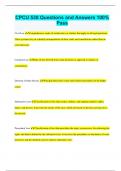
CPCU 530 Questions and Answers 100% Pass
CPCU 530 Questions and Answers 100% Pass Civil Law Comprehensive codes of written laws or statutes that apply to all legal questions. These systems rely on scholarly interpretations of their codes and constitutions rather than on court decisions Common Law Body of law derived from court decisions as opposed to statutes or constitutions. Doctrine of Stare Decisis Principle that lower courts must follow precedents set by higher courts Substantive Law Classification of law that creates, defines, and regulates parties' rights, duties, and powers. It governs the merits of the case, which are based on the facts giving rise to the lawsuit. Procedural Law Classification of law that prescribes the steps, or processes, for enforcing the rights and duties defined by the substantive law. It involves the procedures or mechanics of court processes and the methods used to enforce substantive law. Executive Branch Led by president on federal level and governors on state level; Has power to recommend, approve, or veto laws and to administer and carry out many laws through administrative agencies. Its checks on the other two branches include the power to appoint judges and the power to veto laws passed by the legislative branch. Legislative Branch Federal congress and state legislatures; has power to pass laws. Branch's check on the other two branches include its power to approve or deny many executive's appointments, and its ability to pass constitutional laws negating judicial opinions. Judicial Branch The courts; interpret, affirm, or negate laws. Checks on the other two branches include the power to declare laws, and sometimes actions or regulations of the executive branch unconstitutional or unlawful Writ of certiorari An appellate courts order directing a lower court to deliver its record in a case for appellate review Rules of evidence It must be relevant, material, and competent Administrative agencies have two main functions Rulemaking and adjudication Admin. Agencies three types of rules Legislative, interpretative, and procedural Valid assignment Requires neither formality nor writing, Any words or actions that indicate the assignor's intention to transfer contractual rights effects a valid assignment Contract must have 4 elements Agreement, capacity to contract, consideration, and legal purpose Executed contract Contract that has been completely performed by both parties Executory contract A contract that has not been completely performed by one or both of the parties Implied contract A contract whose terms and intentions are indicated by the actions of the parties to the contract and the surrounding
Escuela, estudio y materia
- Institución
- CPCU 530
- Grado
- CPCU 530
Información del documento
- Subido en
- 13 de marzo de 2024
- Número de páginas
- 62
- Escrito en
- 2023/2024
- Tipo
- Examen
- Contiene
- Preguntas y respuestas
Temas
-
cpcu 530 questions and answers 100 pass

Documento también disponible en un lote