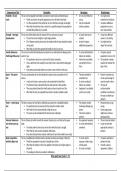
Operations Management & Logistics
Lecture 1, Chapter 1 & 2
Chapter 1, Introduction
Identify the elements and the relevance of operations and supply chain management (OSCM)
Operations = the transformation of inputs (material, human and asset resources) into outputs
(products).
- Services: people are part of process. Not a physical process of materials, but a process with
people.
Operations involve the workflow ordering of activities to produce the product.
➔ Materials come in, then go to the 1st, 2nd and 3rd workshop, and then leave as product.
Devision of labour to make it more efficient. Robots. How to coordinate?
The materials and products need to be physically moved, warehoused and stored → Logistics
- Services: no materials and products to be stored. So logistics not so important.
Supply chain refers to the processes that move information and material to and from firms, ranging
from raw materials to consumers
Different chains, from raw material to consumer. As auto manufacturer you need to give attention to
logistics of input and output.
,Operations and logistics are considered primary (production process) activities as part of a value
chain within an organization
➔ Value chain. Primary Activities, supported by Support Activities.
➔ Supply chain may consist of multiple value chains.
The success of producing at low costs while meeting (mass) customer demand
depends on clever integration of…
- a great operations-related strategy,
- the processes to produce and deliver products and services, and
- analytics to support the decisions needed to manage the firm.
The design of transformation processes is guided by basic principles
- How different types of processes are organized
- How to determine the capacity of a process
- How long it should take to make a unit
- How the quality of a process is monitored
- How information is used to make decisions
Voorbeeld vliegtuigmaatschappij: handbagage is goedkoper, dit kost weinig tijd om in het vliegtuig te
laden. Grotere bagage het vliegtuig in laden kost meer tijd, dit kost meer, dus hier moet je meer voor
betalen.
But the improvement of the processes and systems that create and deliver the firm’s primary
products and services is also part of Operations & Supply Chain Management (OSCM)
- Change of OSC strategies
- New production technologies and modes of transport
- Optimizing the processes of production and logistics activities
- Improvements in data analytics and how to use them in decision making
,Designing and improving operations often requires changes in workflow ordering and
organizational structure
Operations and Supply Chain (OSC) Processes are interlinked so require analytics (based on metrics
to steer)
Producing and delivering goods is different compared with services
, The various Operations & Supply Chain (OSC) processes reflect different job positions and career
perspectives
Various OSCM concepts have become popular through time
Current Issues in operations and supply chain management
- Coordinating the relationships between mutually supportive but separate organizations
- Optimizing global supplier, production, and distribution networks
- Managing customer touch points
- Raising senior management awareness of OSCM as a significant competitive weapon
- Uncertainty in global tariffs and regulations. Bijv. oorlog in Oekraine.
- Difficulty in hiring and keeping employees. Bijv. werknemerstekort.
- Adapting to change in business technology and infrastructure
- Sustainability and the triple bottom line (Life cycle analysis)
- Servitization, digitalization, BIG data, Artificial Intelligence (Industry 4.0)
Lecture 1, Chapter 1 & 2
Chapter 1, Introduction
Identify the elements and the relevance of operations and supply chain management (OSCM)
Operations = the transformation of inputs (material, human and asset resources) into outputs
(products).
- Services: people are part of process. Not a physical process of materials, but a process with
people.
Operations involve the workflow ordering of activities to produce the product.
➔ Materials come in, then go to the 1st, 2nd and 3rd workshop, and then leave as product.
Devision of labour to make it more efficient. Robots. How to coordinate?
The materials and products need to be physically moved, warehoused and stored → Logistics
- Services: no materials and products to be stored. So logistics not so important.
Supply chain refers to the processes that move information and material to and from firms, ranging
from raw materials to consumers
Different chains, from raw material to consumer. As auto manufacturer you need to give attention to
logistics of input and output.
,Operations and logistics are considered primary (production process) activities as part of a value
chain within an organization
➔ Value chain. Primary Activities, supported by Support Activities.
➔ Supply chain may consist of multiple value chains.
The success of producing at low costs while meeting (mass) customer demand
depends on clever integration of…
- a great operations-related strategy,
- the processes to produce and deliver products and services, and
- analytics to support the decisions needed to manage the firm.
The design of transformation processes is guided by basic principles
- How different types of processes are organized
- How to determine the capacity of a process
- How long it should take to make a unit
- How the quality of a process is monitored
- How information is used to make decisions
Voorbeeld vliegtuigmaatschappij: handbagage is goedkoper, dit kost weinig tijd om in het vliegtuig te
laden. Grotere bagage het vliegtuig in laden kost meer tijd, dit kost meer, dus hier moet je meer voor
betalen.
But the improvement of the processes and systems that create and deliver the firm’s primary
products and services is also part of Operations & Supply Chain Management (OSCM)
- Change of OSC strategies
- New production technologies and modes of transport
- Optimizing the processes of production and logistics activities
- Improvements in data analytics and how to use them in decision making
,Designing and improving operations often requires changes in workflow ordering and
organizational structure
Operations and Supply Chain (OSC) Processes are interlinked so require analytics (based on metrics
to steer)
Producing and delivering goods is different compared with services
, The various Operations & Supply Chain (OSC) processes reflect different job positions and career
perspectives
Various OSCM concepts have become popular through time
Current Issues in operations and supply chain management
- Coordinating the relationships between mutually supportive but separate organizations
- Optimizing global supplier, production, and distribution networks
- Managing customer touch points
- Raising senior management awareness of OSCM as a significant competitive weapon
- Uncertainty in global tariffs and regulations. Bijv. oorlog in Oekraine.
- Difficulty in hiring and keeping employees. Bijv. werknemerstekort.
- Adapting to change in business technology and infrastructure
- Sustainability and the triple bottom line (Life cycle analysis)
- Servitization, digitalization, BIG data, Artificial Intelligence (Industry 4.0)