2018 Exam Prep
Combrink recommends that teachers go through eight phases when teaching poetry. Menton
these phases and briefy exppain what each phase entaips.
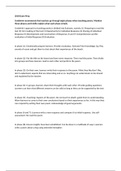
Combrink’s approach to teaching poetry is divided into 8 phases, namely: (1) Preparing to read the
text (2) First reading of the text (3) Opportunity for Individual Response (4) Sharing of Individual
Response (5) Development and Constructon of Response, (6 and 7) Comprehension and Re-
evaluaton of Inital Response (8) vvaluaton.
In phase (1): vmotonally prepare learners. Provide vocabulary. Actvate Prior Knowledge. vg: Play
sounds of ocean and get them to chat about their experiences of the beach.
In phase (2): Put the ttle on the board and have some response. Then read the poem. Then divide
into groups and have learners read to each other and perform the poem.
In phase (3): On their own, learners write their response to the poem. What they like/don’t like,
don’t understand, aspects that are interestng and so on. Anything not understood can be shared
and explained by the teacher.
In phase (4): In groups, learners share their thoughts with each other. Provide guiding questons.
Learners can learn that diferent answers can be valid as long as they can be supported by the text
In phase (5): /teaching/ Aspects of the poem. Do not teach to death: guide them to understanding.
Allow learners to come to their own conclusions based on their experiences so far. In this way they
can respond by writng their own poem. Acknowledge all good arguments.
In phase (6 and 7): Learners write a new response and compare it to inital response. Use self-
assessment. Re read the poem
In phase (8): vnsure insights have been established. Can be done in a multtude of ways. Learners
write a poem about a dog using extended metaphor.
Combrink recommends that teachers go through eight phases when teaching poetry. Menton
these phases and briefy exppain what each phase entaips.
Combrink’s approach to teaching poetry is divided into 8 phases, namely: (1) Preparing to read the
text (2) First reading of the text (3) Opportunity for Individual Response (4) Sharing of Individual
Response (5) Development and Constructon of Response, (6 and 7) Comprehension and Re-
evaluaton of Inital Response (8) vvaluaton.
In phase (1): vmotonally prepare learners. Provide vocabulary. Actvate Prior Knowledge. vg: Play
sounds of ocean and get them to chat about their experiences of the beach.
In phase (2): Put the ttle on the board and have some response. Then read the poem. Then divide
into groups and have learners read to each other and perform the poem.
In phase (3): On their own, learners write their response to the poem. What they like/don’t like,
don’t understand, aspects that are interestng and so on. Anything not understood can be shared
and explained by the teacher.
In phase (4): In groups, learners share their thoughts with each other. Provide guiding questons.
Learners can learn that diferent answers can be valid as long as they can be supported by the text
In phase (5): /teaching/ Aspects of the poem. Do not teach to death: guide them to understanding.
Allow learners to come to their own conclusions based on their experiences so far. In this way they
can respond by writng their own poem. Acknowledge all good arguments.
In phase (6 and 7): Learners write a new response and compare it to inital response. Use self-
assessment. Re read the poem
In phase (8): vnsure insights have been established. Can be done in a multtude of ways. Learners
write a poem about a dog using extended metaphor.