Strategy for the corporate level
Chapter 1. Strategy for the corporate level: summary of the main messages
Business/ portfolio strategy What businesses or markets should a company invest in,
including decisions about diversifying into adjacent activities, about selling businesses, about
entering new geographies or markets and about how much money to commit to each area of
business?
Parenting/ management strategy How should the group of businesses be managed,
including how to structure the organisation into divisions or units or subsidiaries, how to guide
each division, how to manage the links and synergies between divisions, what activities to
centralize or decentralize and how to select and guide the managers of these divisions?
Portfolio Strategy
How should managers make decisions about which businesses, markets or geographies to invest
in and which to avoid, harvest or sell? There are three logics that guide these decisions:
1. Business logic concerns the sector or market each business competes in and the strength of
its competitive position. Is the market attractive or unattractive and does the business have a
competitive advantage or competitive disadvantage? The attractiveness of a market can be
assessed by calculating the average profitability of the competitors in the market (market
profitability). If average profitability is significantly above the cost of capital, the market is
attractive. Michael Porter, the Harvard Business School strategy guru, developed a framework –
the 5-Forces framework – that summarises the factors that drive average profitability. He
identified competitive rivalry, the power of customers, the threat of substitutes, the power of
suppliers and the threat of new entrants as the five. Furthermore, market growth and market size
are also measures of attractiveness. The other dimension, competitive advantage, can be
assessed using relative profitability: the profitability of your business versus the average
competitor in the market. Competitive advantage may be created by many factors, such as
technology or customer relationships. Relative profitability captures the result of all these factors.
2. Added value/ parenting logic concerns the ability of corporate-level managers to add value to
a business. Is this business one that corporate-level managers feel able to improve or create
synergy with other businesses, or is it one that corporate level managers may misjudge and
damage? There are two kinds of added value. Added value can come from the relationship
1
,between the business and its parent company – hence the term “parenting”. But value is also
created or destroyed as a result of the relationship between the sister businesses. The first type
we can think of as vertical added value and the second type as horizontal added value. Together
they make up added value. Added value can come from wise guidance from headquarters
managers or from a broad range of other sources, such as a parent company brand, the technical
know-how of a central technology unit, relationships with important stakeholders, financial
strength, etc. The potential for added value and the risk of subtracted value can be combined
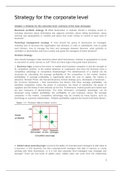
form a matrix – the Heartland matrix.
If the risk of subtracted value is low and the potential for added value is low, the business is
“ballast”. The danger here is that the business will consume the scarce time of headquarters
managers without resulting in any extra value. Unless headquarters managers can find ways to
add value, these businesses are candidates for selling; but can easily be retained until an
opportune moment arrives. The advantage of ballast businesses is that they are usually stable
and reliable. They provide solidity and bulk to the larger company.
If the risk of subtracted value is high and the potential for added value is high, the business is a
“value trap”: the subtracted value may well outweigh the added value. It is normally best to exit
these businesses unless managers at the group level can find ways to reduce the risks of
subtracted value,
3. Capital markets logic concerns the state of the capital markets. Are prices for businesses of
this kind inflated and hence likely to be higher than the net present value of future cash flows, or
depressed and hence likely to sell at less than net present value? As a result of market trends,
businesses can have market values that differ from the discounted value of expected future cash
flows. A difference between market value and discounted value happens partly because some
buyers or sellers are not knowledgeable about likely cash flows or appropriate discount rates, and
partly because cash flows are not the only factor influencing decisions to buy or sell. Managers
can have “strategic” reasons for buying or selling that cause them to pay a price or accept a price
that is above or below the discounted cash flow value (net present value). Figure 1.4 plots the
market value against the net present value (NPV) of owning the business. If the two values
diverge outside of a corridor where market value and NPV are approximately equal, there are
important consequences for portfolio decisions. When the market value is significantly above the
NPV companies should avoid buying and considering selling, even if you believe it to be ttractive
and you are convinced you would be a good owner. When the market value is significantly below
2
, NPV, companies should consider buying and avoid selling, even if you believe that the business
is unattractive and you are not the best owner.
Management or (parenting) strategy
Once portfolio decisions have been made (which businesses to invest in and how much to invest
in each), managers at the corporate level need to decide how to manage the resulting portfolio.
They need to decide how to structure the organisation into business divisions, what functions and
decisions to centralise at the corporate level, who to appoint to the top jobs in the divisions and
what guidance to give these managers in the form of strategic targets and controls. The main
logic that guides all of these decisions is the logic of added value . All these decisions should be
guided by the objective of maximising the additional value created from owning multiple business
divisions and minimizing the negative aspects of creating layers of management above the level
of the divisions. Of course there is also a governance and compliance logic that determines the
existence of some activities, like financial controls and tax management. These activities must be
carried out at the corporate level in any responsible company.
Typically, a corporate group will have three to seven major sources of corporate added value.
This list will then guide all of the difficult decisions about what to centralize, how to organize, who
to appoint and how to design group-level processes.
Minor source of added value should be included in the management strategy with reluctance.
There are often a large number of other activities where small gains in performance can be
achieved by some limited centralization or standardization. The problem is that activities that
distract attention from the major sources can easily generate opportunity costs that are greater
than the benefits. The more activities that are centralised, the more initiatives that are led by
headquarters managers and the more headquarters managers “interfere”, the higher the risk of
subtracted value. As a result, it is important to challenge all minor sources of added value, and
only include them in the management strategy if the risk of value destruction, whether from
opportunity costs or other sources, is low.
One way to keep a check on the build-up of bureaucracy at corporate levels is to challenge all
new corporate-level initiatives against three hurdles. If the initiative fails all three hurdles, it should
be rejected:
1. Is the initiative a necessary part of governance or compliance?
2. If not, is the initiative a necessary part of some major source of corporate added value?
3. If not, does the initiative clearly add some value and have low risk of negative side effects?
3
Chapter 1. Strategy for the corporate level: summary of the main messages
Business/ portfolio strategy What businesses or markets should a company invest in,
including decisions about diversifying into adjacent activities, about selling businesses, about
entering new geographies or markets and about how much money to commit to each area of
business?
Parenting/ management strategy How should the group of businesses be managed,
including how to structure the organisation into divisions or units or subsidiaries, how to guide
each division, how to manage the links and synergies between divisions, what activities to
centralize or decentralize and how to select and guide the managers of these divisions?
Portfolio Strategy
How should managers make decisions about which businesses, markets or geographies to invest
in and which to avoid, harvest or sell? There are three logics that guide these decisions:
1. Business logic concerns the sector or market each business competes in and the strength of
its competitive position. Is the market attractive or unattractive and does the business have a
competitive advantage or competitive disadvantage? The attractiveness of a market can be
assessed by calculating the average profitability of the competitors in the market (market
profitability). If average profitability is significantly above the cost of capital, the market is
attractive. Michael Porter, the Harvard Business School strategy guru, developed a framework –
the 5-Forces framework – that summarises the factors that drive average profitability. He
identified competitive rivalry, the power of customers, the threat of substitutes, the power of
suppliers and the threat of new entrants as the five. Furthermore, market growth and market size
are also measures of attractiveness. The other dimension, competitive advantage, can be
assessed using relative profitability: the profitability of your business versus the average
competitor in the market. Competitive advantage may be created by many factors, such as
technology or customer relationships. Relative profitability captures the result of all these factors.
2. Added value/ parenting logic concerns the ability of corporate-level managers to add value to
a business. Is this business one that corporate-level managers feel able to improve or create
synergy with other businesses, or is it one that corporate level managers may misjudge and
damage? There are two kinds of added value. Added value can come from the relationship
1
,between the business and its parent company – hence the term “parenting”. But value is also
created or destroyed as a result of the relationship between the sister businesses. The first type
we can think of as vertical added value and the second type as horizontal added value. Together
they make up added value. Added value can come from wise guidance from headquarters
managers or from a broad range of other sources, such as a parent company brand, the technical
know-how of a central technology unit, relationships with important stakeholders, financial
strength, etc. The potential for added value and the risk of subtracted value can be combined
form a matrix – the Heartland matrix.
If the risk of subtracted value is low and the potential for added value is low, the business is
“ballast”. The danger here is that the business will consume the scarce time of headquarters
managers without resulting in any extra value. Unless headquarters managers can find ways to
add value, these businesses are candidates for selling; but can easily be retained until an
opportune moment arrives. The advantage of ballast businesses is that they are usually stable
and reliable. They provide solidity and bulk to the larger company.
If the risk of subtracted value is high and the potential for added value is high, the business is a
“value trap”: the subtracted value may well outweigh the added value. It is normally best to exit
these businesses unless managers at the group level can find ways to reduce the risks of
subtracted value,
3. Capital markets logic concerns the state of the capital markets. Are prices for businesses of
this kind inflated and hence likely to be higher than the net present value of future cash flows, or
depressed and hence likely to sell at less than net present value? As a result of market trends,
businesses can have market values that differ from the discounted value of expected future cash
flows. A difference between market value and discounted value happens partly because some
buyers or sellers are not knowledgeable about likely cash flows or appropriate discount rates, and
partly because cash flows are not the only factor influencing decisions to buy or sell. Managers
can have “strategic” reasons for buying or selling that cause them to pay a price or accept a price
that is above or below the discounted cash flow value (net present value). Figure 1.4 plots the
market value against the net present value (NPV) of owning the business. If the two values
diverge outside of a corridor where market value and NPV are approximately equal, there are
important consequences for portfolio decisions. When the market value is significantly above the
NPV companies should avoid buying and considering selling, even if you believe it to be ttractive
and you are convinced you would be a good owner. When the market value is significantly below
2
, NPV, companies should consider buying and avoid selling, even if you believe that the business
is unattractive and you are not the best owner.
Management or (parenting) strategy
Once portfolio decisions have been made (which businesses to invest in and how much to invest
in each), managers at the corporate level need to decide how to manage the resulting portfolio.
They need to decide how to structure the organisation into business divisions, what functions and
decisions to centralise at the corporate level, who to appoint to the top jobs in the divisions and
what guidance to give these managers in the form of strategic targets and controls. The main
logic that guides all of these decisions is the logic of added value . All these decisions should be
guided by the objective of maximising the additional value created from owning multiple business
divisions and minimizing the negative aspects of creating layers of management above the level
of the divisions. Of course there is also a governance and compliance logic that determines the
existence of some activities, like financial controls and tax management. These activities must be
carried out at the corporate level in any responsible company.
Typically, a corporate group will have three to seven major sources of corporate added value.
This list will then guide all of the difficult decisions about what to centralize, how to organize, who
to appoint and how to design group-level processes.
Minor source of added value should be included in the management strategy with reluctance.
There are often a large number of other activities where small gains in performance can be
achieved by some limited centralization or standardization. The problem is that activities that
distract attention from the major sources can easily generate opportunity costs that are greater
than the benefits. The more activities that are centralised, the more initiatives that are led by
headquarters managers and the more headquarters managers “interfere”, the higher the risk of
subtracted value. As a result, it is important to challenge all minor sources of added value, and
only include them in the management strategy if the risk of value destruction, whether from
opportunity costs or other sources, is low.
One way to keep a check on the build-up of bureaucracy at corporate levels is to challenge all
new corporate-level initiatives against three hurdles. If the initiative fails all three hurdles, it should
be rejected:
1. Is the initiative a necessary part of governance or compliance?
2. If not, is the initiative a necessary part of some major source of corporate added value?
3. If not, does the initiative clearly add some value and have low risk of negative side effects?
3