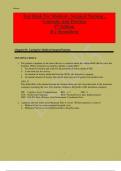
Test Bank For Medical - Surgical Nursing : Concepts And Practice 5th Edition By Stromberg Q&A Complete Guide
Chapter 01: Caring for Medical-Surgical Patients MULTIPLE CHOICE 1.The patient complains to the nurse that he is confused about his ―deductible‖ that he owes the hospital. Which statement accurately explains a deductible? a. An amount of money put aside for the payment of future medical bills b. A one-time fee for service c. An amount of money deducted from the bill by the insurance company d. An annual amount of money the patient must pay out-of-pocket for medical care ANS: D The deductible is the annual amount the insured must pay out-of-pocket prior to the insurance company assuming the cost. This practice improves the profit of the insurance company. DIF: Cognitive Level: Comprehension REF: p. 7 OBJ: 9 TOP: Health Care Financing KEY: Nursing Process Step: Implementation MSC: NCLEX: Safe, Effective Care Environment: Coordinated Care 2.A patient asks the nurse what Medicare Part A covers. Which response is correct? a. Medicare Part A covers inpatient hospital costs. b. Medicare Part A covers reimbursement to the physician. c. Medicare Part A covers outpatient hospital services. d. Medicare Part A covers ambulance transportation. ANS: A Medicare Part A covers inpatient hospital expenses, drugs, x-rays, laboratory work, and intensive care. Medicare Part B pays the physician, ambulance transport, and outpatient services. DIF: Cognitive Level: Comprehension REF: p. 8, Box 1-4 OBJ: 9 TOP: Government-Sponsored Health Insurance KEY: Nursing Process Step: Implementation MSC: NCLEX: Safe, Effective Care Environment: Coordinated Care 3.Which is the main cost-containment component of diagnosis-related groups (DRGs)? a. Hospitals focus only on the specific diagnosis. b. Hospitals treat and discharge patients quickly. c. Reduced cost drugs are ordered for specific diagnoses. d. Diagnostic group classification streamlines care. ANS: B DRGs are a prospective payment plan in which hospitals receive a flat fee for each patient’s diagnostic category regardless of the length of time in the hospital. If hospitals can treat and discharge patients before the allotted time, hospitals get to keep the excess payment; cost is contained, and the patient is discharged sooner. DIF: Cognitive Level: Comprehension REF: p. 8 OBJ: 9 TOP: Government-Sponsored Health Insurance KEY: Nursing Process Step: Implementation MSC: NCLEX: Safe, Effective Care Environment: Coordinated Care 4.The nurse is assessing a group of patients. Which patient would most likely qualify for Medicaid? a. A 35-year-old unemployed single mother with diabetes b. A 70-year-old Medicare recipient with retirement income who needs to be in a long-term care facility c. An 80-year-old blind woman living in her own home who has inadequate private insurance d. A 67-year-old stroke victim with Medicare Part A and an income from investments ANS: A Medicaid is a joint effort of federal and state governments geared primarily for low-income people with no insurance. DIF: Cognitive Level: Application REF: p. 8, Box 1-5 OBJ: 9 TOP: Government-Sponsored Health Insurance—Medicaid KEY: Nursing Process Step: Assessment MSC: NCLEX: Safe, Effective Care Environment: Coordinated Care 5.Which area is the major focus of Healthy People 2020 and the primary mechanism through which to improve the health of Americans in the second decade of the century? a. Research funding b. Health information distribution c. Healthy lifestyle encouragement d. Health improvement program designs ANS: C Healthy People 2020 focuses on expanding ongoing programs to include support and information to reduce infant mortality, cancer, cardiovascular disease, and HIV/AIDS, and to increase effective immunizations, healthy eating habits, and healthy weight. DIF: Cognitive Level: Comprehension REF: p. 6 OBJ: 7 TOP: Healthy People 2020 KEY: Nursing Process Step: Implementation MSC: NCLEX: Safe, Effective Care Environment: Coordinated Care 6.Which term explains the type of care that addresses interventions for all dimensions of a patient’s life? a. Focused care b. General care c. Directed care d. Holistic care ANS: D Holistic care addresses the physiologic, psychological, social, cultural, and spiritual needs of the patient. DIF: Cognitive Level: Comprehension REF: p. 9 OBJ: 8 TOP: Holistic Care KEY: Nursing Process Step: Planning MSC: NCLEX: Psychosocial Integrity: Coping and Adaptation 7.A patient furiously says, ―My doctor was so busy giving me instructions that he didn’t hear what I was trying to ask him!‖ Which response is most empathetic? a. ―When people ignore me, I really get mad.‖ b. ―I’m sure that the doctor was rushed and unaware of your needs.‖ c. ―That sounds really frustrating.‖ d. ―Take a deep breath and plan what you will say to him tomorrow.‖ ANS: C Empathy demonstrates that the nurse perceives the patient’s feelings but does not share the emotion. Belittling the patient’s feelings, showing sympathy, or defending the doctor makes the patient feel devalued. DIF: Cognitive Level: Analysis REF: p. 10 OBJ: 10 TOP: Nurse-Patient Relationship KEY: Nursing Process Step: Implementation MSC: NCLEX: Psychosocial Integrity 8.The nurse is explaining differences in a therapeutic relationship and a social relationship to a patient. Which information about therapeutic relationships is most important for the nurse to include in the explanation? a. Therapeutic relationships lack formal boundaries. b. Therapeutic relationships are goal directed. c. Therapeutic relationships meet the needs of each person in the relationship. d. Therapeutic relationships extend past the hospitalization period. ANS: B The therapeutic relationship is focused on the patient and is goal directed and designed to meet only the needs of the patient and does not extend past the period of hospitalization. DIF: Cognitive Level: Comprehension REF: p. 9 OBJ: 10 TOP: Therapeutic Relationship KEY: Nursing Process Step: Implementation MSC: NCLEX: Psychosocial Integrity 9.The nurse is caring for a patient who has been on antidepressants for 3 days. The patient tearfully says, ―I still feel terrible. I don’t think anything can help how I feel.‖ Which response is best? a. ―I will tell the charge nurse how you are feeling.‖ b. ―You just need to be patient and give your medicine some time to work.‖ c. ―Look how much you have improved since you were admitted to the facility.‖ d. ―It must be frustrating to be going through this difficult time.‖ ANS: D This response is an empathetic response that allows for further exploration of the patient’s feelings. The other responses will block communication with this patient. DIF: Cognitive Level: Application REF: p. 9 OBJ: 10 TOP: Therapeutic Communication KEY: Nursing Process Step: Implementation MSC: NCLEX: Psychosocial Integrity 10.An overweight male patient rips off his hospital gown, throws it out the door, and shouts, ―I’m not wearing this stupid gown! It is too small, too short, and exposes my backside to the world!‖ Which response is most appropriate? a. Remind patient of the need to wear the gown for convenience in care. b. Confer with the patient for methods to acquire a larger gown. c. Replace the torn gown with another. d. Inform the charge nurse of the hostile behavior. ANS: B Allowing hostile patients to make reasonable requests defuses the anger and allows patients to vent their feelings. DIF: Cognitive Level: Application REF: p. 10 OBJ: 10 TOP: Hostile Behavior KEY: Nursing Process Step: Implementation MSC: NCLEX: Psychosocial Integrity: Coping and Adaptation 11.The nurse is caring for a patient who states, ―You are the only nurse who understands about my pain. Can’t you give me an extra dose of pain medication?‖ How should the nurse respond to the patient’s request? a. Explain that dosage schedules are by physician’s orders. b. Ignore the request. c. Tell the patient that his behavior is manipulative. d. Agree to give an extra dose of pain medication. ANS: A A matter-of-fact response to a manipulative request limits the effect of the manipulation, thereby helping the nurse to avoid becoming defensive or being swayed by flattery. DIF: Cognitive Level: Application REF: p. 10 OBJ: 10 TOP: Manipulative Behavior KEY: Nursing Process Step: Implementation MSC: NCLEX: Psychosocial Integrity
Libro relacionado
- Desconocido
- 9780323810234
- Desconocido
Escuela, estudio y materia
- Institución
- Medical-Surgical Nursing
- Grado
- Medical-Surgical Nursing
Información del documento
- Subido en
- 9 de marzo de 2024
- Número de páginas
- 436
- Escrito en
- 2023/2024
- Tipo
- Examen
- Contiene
- Preguntas y respuestas
Temas
-
chapter 01 caring for medical surgical

Documento también disponible en un lote