Chemistry of Life exam study guide questions and answers
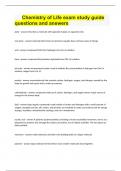
polar describes a molecule with opposite charges on opposite ends non-polar molecule that shares its electrons equally; does not have areas of charge acid compound that forms hydrogen ions (H+) in solution base compound that produces hydroxide ions (OH-) in solution pH scale measurement system used to indicate the concentration of hydrogen ions (H+) in solution; ranges from 0 to 14 protein macromolecule that contains carbon, hydrogen, oxygen, and nitrogen; needed by the body for growth and repair and to make up enzymes carbohydrate compound made up of carbon, hydrogen, and oxygen atoms; major source of energy for the human body lipid large organic compounds made mostly of carbon and hydrogen with a small amount of oxygen; examples are fats, oils, waxes, and steroids; are insoluble in water and used by cells for energy storage, insulation, and protective coatings, such as in membranes nucleic acid A polymer (polynucleotide) consisting of many nucleotide monomers; serves as a blueprint for proteins and, through the actions of proteins, for all cellular activities. The two types are DNA and RNA. monomer small molecular unit that is the building block of a larger molecule polymer large molecule formed when many smaller molecules bond together enzyme protein that acts as a biological catalyst activation energy the minimum amount of energy required to start a chemical reaction adhesion an attraction between molecules of different substances cohesion attraction between molecules of the same substance atom the smallest component of an element having the chemical properties of the element molecule smallest unit of most compounds specific heat the heat required to raise the temperature of one gram of a substance one degree centigrade temperature a measure of how hot or cold something is inorganic relating or belonging to the class of compounds not having a carbon basis organic relating or belonging to the class of chemical compounds having a carbon basis catalyst a substance that initiates or accelerates a chemical reaction without itself being affected macromolecule a polymer within organisms where there are four main group: carbohydrates, lipids, proteins and nucleic acids dehydration synthesis a chemical reaction in which monomers are linked together by removing one water molecule from each linked pair of monomers to form polymers hydrolysis a chemical reaction in which chemical bonds in polymers are broken through the addition of water, decomposing polymers into simpler units substrate a substance on which an enzyme acts
Escuela, estudio y materia
- Institución
- Chemistry of Life
- Grado
- Chemistry of Life
Información del documento
- Subido en
- 5 de marzo de 2024
- Número de páginas
- 3
- Escrito en
- 2023/2024
- Tipo
- Examen
- Contiene
- Preguntas y respuestas
Temas
-
chemistry of life exam study guide

Documento también disponible en un lote