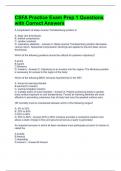
CSFA Practice Exam Prep 1 Questions with Correct Answers
CSFA Practice Exam Prep 1 Questions with Correct Answers Which of the following positions is used for an LAVH? A.reverse Trendelenburg B.supine C.lateral recumbent D.lithotomy - Answer-D. The lithotomy position allows for access to the pelvic and abdominal cavities simultaneously. Which of the following types of positioning injury occurs when underlying tissue is stationary while the skeletal structure moves? A.friction injury B.pressure injury C.shear injury D.negativity injury - Answer-Shear injury Which of the following patient positions would be MOST likely to cause an obturator nerve injury? A.lateral B.prone C.lithotomy D.semi-Fowler's - Answer-C. The lithotomy position requires the legs to be positioned in stirrups which, if done incorrectly, can cause stress to the obturator nerve. obturator nerve - Answer-The obturator nerve is derived from L2-4 and travels along the medial border of the psoas muscle; it is both a motor and a sensory nerve. It travels through the obturator foramen with the obturator artery and vein into the thigh. The obturator nerve divides into anterior and posterior branches. Folwer's position - Answer-upright seated position When the surgeon incises tissue, the surgical first assistant usually provides a clear field by A.light adjustment. B.clamping. C.retraction. D.cauterizing. - Answer-C retraction 5. Which of the following is known as a Kelly procedure? A.anterior colporrhaphy B.cervical conization
Escuela, estudio y materia
- Institución
- CSFA
- Grado
- CSFA
Información del documento
- Subido en
- 5 de marzo de 2024
- Número de páginas
- 23
- Escrito en
- 2023/2024
- Tipo
- Examen
- Contiene
- Preguntas y respuestas
Temas
-
csfa practice exam prep 1 questions with correct a
-
a complication of steep reverse trendelenburg posi
-
positions should be utilized for posterior colpoto
-
positions is used for an lavh

Documento también disponible en un lote