TASK 1: RESPONSE TIME AND COGNITIVE
ARCHITECTURE
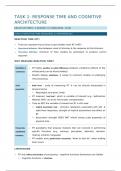
REACTION TIMES: A READER 2.0 (SMULDERS, 2020)
HOW IS REACTION TIME MEASURED & INTERPRETED?
REACTION TIME (RT)
Trials are repeated many times to get reliable mean RT (mRT)
Operational definition: time between onset of stimulus & the response to that stimulus
Theoretical definition: minimum of time needed by participant to produce correct
response
WHY MEASURE REACTION TIME?
Reliability & RT highly sensitive to subtle differences between conditions (effects of few
orderliness milliseconds can be found reliably)
Results display orderliness easier to construct models of underlying
info processing
Scale Ratio level – scale of measuring RT can be directly interpreted in
properties physical sense
Meaningful zero-point, linear
RT measure “real time”, which is variable of interest (e.g., Subtraction
Method, AFM, car driver hits brakes unexpectedly)
Time as NOT the variable of interest but RT is still used
Implicit Association Task – stimulus categories associated with left- &
right-hand responses; strength of implicit associations has effect on
RT
Association strength DOES NOT inherit strong scale properties of
physical time
Measuring RT paradigms that propose modules that are involved in performing
established specific functions (e.g., memory, perception, attention, decision-
functions making, emotion, language)
RT models have guided brain researchers “what to look for” when making
brain scans
LIMITATIONS
RT only reflects end product of processing – cognitive functions themselves are hidden
Cognitive functions = black box
, Can only make inferences about what happens between manipulation of input and
observed effect on output
RT mostly used in simple tasks – easier to study than complex ones
Complex tasks may lead to more different strategies used by participants
experimental noise
Individual differences in how tasks are carried out
THE ANALYSIS OF RT AT 2 LEVELS
First level Aim: obtain for each participant one / few summary statistics per condition
(mRT, proportion of accurate responses)
Accuracy Throw out trials from practice blocks & warm-up trials
Remainder of trials sorted & counted according to condition
Number of correct responses in each condition counted +
proportion of accurate responses computed
Reaction Delete practice, warm-up & error trials
time Inspect distribution of RTs for each participant & condition to
identify outliers
Long responses – inattentiveness
Fast responses – respond before (fully) analysing stimulus;
guess after failing to reach a decision
Removing outliers
Median – bias if observation number small & different
across conditions
Trimmed mean – take out e.g., fastest & slowest 10%, then
take mean of the rest
C standard deviations – first compute mean & SD for each
participant, then delete RTs that deviate more than C (C
= 2.5) SDs from mean
Fixed criterion – delete all RTs exceeding some value &
compute mean of the rest (could lead to bias & loss of
statistical power)
Do nothing – should be a conscious choice
Outliers & cognitive neuroscience
Removing trials with RT-outliers from neuroimaging data
Deleting RTs from trials that are rejected from EEG / fMRI
because of method-specific artifacts
ARCHITECTURE
REACTION TIMES: A READER 2.0 (SMULDERS, 2020)
HOW IS REACTION TIME MEASURED & INTERPRETED?
REACTION TIME (RT)
Trials are repeated many times to get reliable mean RT (mRT)
Operational definition: time between onset of stimulus & the response to that stimulus
Theoretical definition: minimum of time needed by participant to produce correct
response
WHY MEASURE REACTION TIME?
Reliability & RT highly sensitive to subtle differences between conditions (effects of few
orderliness milliseconds can be found reliably)
Results display orderliness easier to construct models of underlying
info processing
Scale Ratio level – scale of measuring RT can be directly interpreted in
properties physical sense
Meaningful zero-point, linear
RT measure “real time”, which is variable of interest (e.g., Subtraction
Method, AFM, car driver hits brakes unexpectedly)
Time as NOT the variable of interest but RT is still used
Implicit Association Task – stimulus categories associated with left- &
right-hand responses; strength of implicit associations has effect on
RT
Association strength DOES NOT inherit strong scale properties of
physical time
Measuring RT paradigms that propose modules that are involved in performing
established specific functions (e.g., memory, perception, attention, decision-
functions making, emotion, language)
RT models have guided brain researchers “what to look for” when making
brain scans
LIMITATIONS
RT only reflects end product of processing – cognitive functions themselves are hidden
Cognitive functions = black box
, Can only make inferences about what happens between manipulation of input and
observed effect on output
RT mostly used in simple tasks – easier to study than complex ones
Complex tasks may lead to more different strategies used by participants
experimental noise
Individual differences in how tasks are carried out
THE ANALYSIS OF RT AT 2 LEVELS
First level Aim: obtain for each participant one / few summary statistics per condition
(mRT, proportion of accurate responses)
Accuracy Throw out trials from practice blocks & warm-up trials
Remainder of trials sorted & counted according to condition
Number of correct responses in each condition counted +
proportion of accurate responses computed
Reaction Delete practice, warm-up & error trials
time Inspect distribution of RTs for each participant & condition to
identify outliers
Long responses – inattentiveness
Fast responses – respond before (fully) analysing stimulus;
guess after failing to reach a decision
Removing outliers
Median – bias if observation number small & different
across conditions
Trimmed mean – take out e.g., fastest & slowest 10%, then
take mean of the rest
C standard deviations – first compute mean & SD for each
participant, then delete RTs that deviate more than C (C
= 2.5) SDs from mean
Fixed criterion – delete all RTs exceeding some value &
compute mean of the rest (could lead to bias & loss of
statistical power)
Do nothing – should be a conscious choice
Outliers & cognitive neuroscience
Removing trials with RT-outliers from neuroimaging data
Deleting RTs from trials that are rejected from EEG / fMRI
because of method-specific artifacts