Sociology 200 Final Exam Study Questions and Answers Graded A 2024
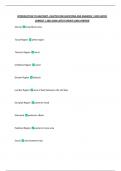
Auguste Comte - Father of sociology Sociological imagination - The ability to see how history and biography-together-influence our lives Structural Functional Theory - The theory that societies contain certain interdependence structures, each of which performs certain functions for the maintenance of society Conflict Theory - A social theory that views conflict as inevitable and natural and as a significant cause of social change Symbolic Interaction - The social theory stressing interactions between people and the social processes that occur within the individual that are made possible by language and internalized meaning Manifest Function - The intended consequences of a social system Latent Function - The unintended consequences of a social system Reliability - The extent to which repeated observations of the same phenomena yield similar results Validity - The extent to which observations actually measure what they are supposed to measure Survey Research - A quantitative research technique that involves asking people questions about the subject being studied Informed Consent - When the researchers have explained all the possible risks involved and the participant consents to do the study Dyad - A social group with two members Primary Group - A small, informal group of people who interact in a personal, direct, and intimate way Secondary Group - A group in which people physically or socially interact Ascribed Status - A status that is acquired at birth such as race, age or sex Achieved Status - A status that you voluntarily choose or attain through effort and ability Master Status - A particular status in one's status set that takes priority over the others Role Conflict - A situation that exists when differing expectations are associated with the same role or when two or more of an individual's roles have differing expectations Role Strain - A situation that occurs when differing and incompatible roles are associated with the same status Norms - Formal and informal rules of conduct and social expectations for behavior Folkways - Norms of conduct of everyday life that bring only mild censure or punishment if they are violated Mores - Norms of conduct associated with strong feelings of right or wrong, violations of which bring intense reaction and some type of punishment Language - The systematized use of speech and hearing to communicate feelings and ideas Material Culture - The physical things created by members of a society Cultural Lag - The tendency for non-material culture to lag behind material culture Ideal Culture - The norms and values that people profess to follow Real Culture - The norms and values that people actually follow and practice, which may or may not be the same as the ideal culture Ethnocentrism - The belief that one's own culture is superior to others and should be used as the standard against which other cultures are judged Subculture - Group of people who share in the main culture of a society but also have their own distinct values, norms, and lifestyles Counterculture - A subculture that adheres to a set of norms and values that sharply contradict the dominant norms and values of the society of which that group is a part Charles Horton Cooley - Theorized that the idea of the self devolves in a process that requires reference to other people Looking Glass Self - A process occurring in social interaction and having three components; developed by Charles Cooley Agents of Socialization - Family, Peers, School, Mass Media
Escuela, estudio y materia
- Institución
- Sociology 200
- Grado
- Sociology 200
Información del documento
- Subido en
- 5 de marzo de 2024
- Número de páginas
- 8
- Escrito en
- 2023/2024
- Tipo
- Examen
- Contiene
- Preguntas y respuestas
Temas
-
sociology 200 final exam
-
sociology 200
-
sociology 200 final exam study questions and ans
-
sociology 200 final exam study