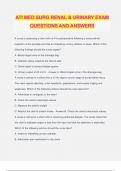
ATI MED SURG RENAL & URINARY EXAM QUESTIONS AND ANSWERS
ATI MED SURG RENAL & URINARY EXAM QUESTIONS AND ANSWERS A nurse is assessing a client who is 4 hr postoperative following a transurethral resection of the prostate and has an indwelling urinary catheter in place. Which of the following findings should the nurse expect? A. Blood-tinged urine in the drainage bag B. Catheter tubing coiled at the client's side C. Client report of severe bladder spams D. Urinary output of 20 mL/hr - Answer-A. Blood-tinged urine in the drainage bag A nurse is caring for a client who is in the oliguric-anuric stage of acute kidney injury. The client reports diarrhea, a dull headache, palpitations, and muscle tingling and weakness. Which of the following actions should the nurse take first? A. Administer an analgesic to the client B. Check the client's electrolyte values C. Measure the client's weight D. Restrict the client's protein intake - Answer-B. Check the client's electrolyte values A nurse is caring for a client who is receiving peritoneal dialysis. The nurse notes that the client's dialysate output is less than the input and that his abdomen is distended. Which of the following actions should the nurse take? A. Insert an indwelling urinary catheter B. Administer pain medication to the client C. Change the client's position D. Place the drainage bag above the client's abdomen - Answer-C. Change the client's position A nurse is teaching a newly licensed nurse about caring for a client who has a new left arteriovenous fistula. Which of the following statements should the nurse make? A. "Check the fistula site daily for a vibration." B. "Instruct the client to restrict movement of his left arm." C. "Avoid taking a blood pressure on the client's left arm." D. "Instruct the client to sleep on his left side." - Answer-C. "Avoid taking a blood pressure on the client's left arm." A nurse is teaching a client who has acute pyelonephritis. Which of the following instructions should the nurse include in the teaching? A. "You should complete the entire cycle of antibiotic therapy." B. "You should maintain complete bed rest until manifestations decrease." C. "You should drink 1,000 mL of fluid per day." D. "You should avoid using NSAIDs for pain." - Answer-A. "You should complete the entire cycle of antibiotic therapy." A nurse is caring for a client who has chronic glomerulonephritis with oliguria. For which of the following electrolyte imbalances should the nurse monitor? A. Hypercalcemia B. Hyperkalemia C. Hypomagnesemia D. Hypophosphatemia - Answer-B. Hyperkalemia A nurse is reviewing the laboratory report of a client who has chronic kidney disease (CKD). The nurse finds the following laboratory test results: potassium 6.8 mEq/L, calcium 7.4 mg/dL, hemoglobin 10.2 g/dL, and phosphate 4.8 mg/dL. Which finding is the priority for the nurse to report to the provider? A. Hypocalcemia B. Hyperkalemia C. Anemia D. Hypoalbuminemia - Answer-B. Hyperkalemia
Escuela, estudio y materia
- Institución
- ATI MED SURG
- Grado
- ATI MED SURG
Información del documento
- Subido en
- 27 de febrero de 2024
- Número de páginas
- 15
- Escrito en
- 2023/2024
- Tipo
- Examen
- Contiene
- Preguntas y respuestas
Temas
-
ati med surg renal urinary exam questions and an

Documento también disponible en un lote