Cells & Immunity
Week 2
Phil Dash
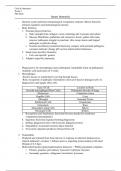
Innate Immunity
- Immune system performs immunological recognition/ immune effector function/
immune regulation and immunological memory.
- Body defenses;
1. External physical barriers;
a. Skin; strength from collagen/ sweat containing salt/ lysosome and sebum
b. Mucous Membrane; epithelium and connective tissue/ goblet cells make
mucous/ pathogens struggle to penetrate/ cilia sweep mucus and trapped
pathogens or particles along.
c. Normal microbiota [commensal bacteria]; compete with potential pathogens/
consume nutrients/ change pH/ secrete antimicrobial substances.
2. Innate [non-specific] immunity;
o Fast, non-specific/ generic
3. Adaptive [specific] immunity;
- Phagocytosis; by macrophages [sense pathogens]/ neutrophils [clear up pathogens]/
/dendritic cells [activation of T-cells]
1. Macrophages;
-fixed in tissues or wandering by moving through tissues.
-Role; recognition of pathogen/ elimination/ removal of dead or damaged cells via
phagocytosis and signals other cells.
Type of Cell Location in Body
Alveolar macrophages [Dust Cells] Pulmonary alveolus of lungs
Histiocytes Connective tissue
Kupffer Cells Liver
Microglia Neuronal Tissue
Epithelioid Cells Granulomas
Osteoclasts Bone
Sinusoidal Lining Cells Spleen
Mesangial Cells Kidney
a. Recognition and Attachment; bacterium become attached to membrane
evaginations [pseudopodia]
b. Ingestion; bacterium ingested forming phagosome
c. Killing; phagosome fuses with lysosome [phagolysosome]
d. Degradation; lysosomal enzymes digest material
e. Exocytosis; digestion produces released from cell.
2. Neutrophils;
- Produced and released from bone marrow in response to infection [leukocytosis –
clinical indicator]/ circulate 7-10hours prior to migrating [extravasation] with short
lifespan of 2-3 days.
- Multi-lobed nucleus [polymorphonuclear leukocyte = PMN] granulated cytoplasm.
o Primary granules; peroxidases/ lysosome/ hydrolytic enzymes
o Secondary granules; collagenase/ lactoferrin/ lysosome.
Week 2
Phil Dash
Innate Immunity
- Immune system performs immunological recognition/ immune effector function/
immune regulation and immunological memory.
- Body defenses;
1. External physical barriers;
a. Skin; strength from collagen/ sweat containing salt/ lysosome and sebum
b. Mucous Membrane; epithelium and connective tissue/ goblet cells make
mucous/ pathogens struggle to penetrate/ cilia sweep mucus and trapped
pathogens or particles along.
c. Normal microbiota [commensal bacteria]; compete with potential pathogens/
consume nutrients/ change pH/ secrete antimicrobial substances.
2. Innate [non-specific] immunity;
o Fast, non-specific/ generic
3. Adaptive [specific] immunity;
- Phagocytosis; by macrophages [sense pathogens]/ neutrophils [clear up pathogens]/
/dendritic cells [activation of T-cells]
1. Macrophages;
-fixed in tissues or wandering by moving through tissues.
-Role; recognition of pathogen/ elimination/ removal of dead or damaged cells via
phagocytosis and signals other cells.
Type of Cell Location in Body
Alveolar macrophages [Dust Cells] Pulmonary alveolus of lungs
Histiocytes Connective tissue
Kupffer Cells Liver
Microglia Neuronal Tissue
Epithelioid Cells Granulomas
Osteoclasts Bone
Sinusoidal Lining Cells Spleen
Mesangial Cells Kidney
a. Recognition and Attachment; bacterium become attached to membrane
evaginations [pseudopodia]
b. Ingestion; bacterium ingested forming phagosome
c. Killing; phagosome fuses with lysosome [phagolysosome]
d. Degradation; lysosomal enzymes digest material
e. Exocytosis; digestion produces released from cell.
2. Neutrophils;
- Produced and released from bone marrow in response to infection [leukocytosis –
clinical indicator]/ circulate 7-10hours prior to migrating [extravasation] with short
lifespan of 2-3 days.
- Multi-lobed nucleus [polymorphonuclear leukocyte = PMN] granulated cytoplasm.
o Primary granules; peroxidases/ lysosome/ hydrolytic enzymes
o Secondary granules; collagenase/ lactoferrin/ lysosome.