Birds
Week 7
Chris Foster
Breeding Biology
1. Raising Young;
- Reproductive strategies; constrained with tradeoffs: high
breed effort t= lower survival [foraging costs/ defending
territory/ physiological costs/ parental care]
- Survival Rates;
o Larger bird = higher survival // tropical = higher
survival // immature= lower survival
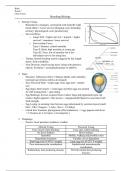
o Survivorship Curve;
Type I: Humans, control mortality
Type II: Birds, high mortality at young age
Type III; Trees, lots of mortality but a few
individuals survive for along time.
- Timing; limited breeding season/ triggered by day length/
factor: food availability.
- Nest Diversity; mud/weaving nests/ lining with attractive
objects. Evolution = extended phenotype of mtDNA.
2. Eggs;
- Structure; Albumen [white] / Chalazae [holds yolk centrally] /
Germinal spot [where embryo developed]
- Size; Precocial birds = larger eggs/ more eggs laid = smaller
size.
- Egg shape; Hole nesters = round eggs/ pyriform eggs are pointed
for cliff nesting birds = stop rolling
- Egg Markings; diverse/ acquired from oviduct/ large and pigmented [open cup
nesters=higher pigment // hole nesters = unpigmented] Pigment is associated with
shell strength.
- Egg Laying; in morning/ time between eggs determined by secretion layers [small
bird = 24hr / Penguin = 3-6dys / Kiwi = 14-30dys]
- Clutch Size Variation; phylogenetic effect [tubenoses = 1 egg/ pigeons and doves
= 2/ Oscines are 2 in tropics, 6 in temperate.]
3. Fledglings;
- Factors; food/ parasites/ predators/ weather
Altricial Young Precocial Young
Eyes closed whilst hatching Eyes open whilst hatching
No down feathers Down feathers
Immobile Mobile, walking and possibly swim
Dependent on parents Variable, not so dependent.
Small egg size [4-10% F weight] Large egg size [9-25% F weight]
Poor neuromuscular coordination Sophisticated neuromuscular
coordination
Rudimentary heat producing muscles Well developed heat producing
muscles.
Week 7
Chris Foster
Breeding Biology
1. Raising Young;
- Reproductive strategies; constrained with tradeoffs: high
breed effort t= lower survival [foraging costs/ defending
territory/ physiological costs/ parental care]
- Survival Rates;
o Larger bird = higher survival // tropical = higher
survival // immature= lower survival
o Survivorship Curve;
Type I: Humans, control mortality
Type II: Birds, high mortality at young age
Type III; Trees, lots of mortality but a few
individuals survive for along time.
- Timing; limited breeding season/ triggered by day length/
factor: food availability.
- Nest Diversity; mud/weaving nests/ lining with attractive
objects. Evolution = extended phenotype of mtDNA.
2. Eggs;
- Structure; Albumen [white] / Chalazae [holds yolk centrally] /
Germinal spot [where embryo developed]
- Size; Precocial birds = larger eggs/ more eggs laid = smaller
size.
- Egg shape; Hole nesters = round eggs/ pyriform eggs are pointed
for cliff nesting birds = stop rolling
- Egg Markings; diverse/ acquired from oviduct/ large and pigmented [open cup
nesters=higher pigment // hole nesters = unpigmented] Pigment is associated with
shell strength.
- Egg Laying; in morning/ time between eggs determined by secretion layers [small
bird = 24hr / Penguin = 3-6dys / Kiwi = 14-30dys]
- Clutch Size Variation; phylogenetic effect [tubenoses = 1 egg/ pigeons and doves
= 2/ Oscines are 2 in tropics, 6 in temperate.]
3. Fledglings;
- Factors; food/ parasites/ predators/ weather
Altricial Young Precocial Young
Eyes closed whilst hatching Eyes open whilst hatching
No down feathers Down feathers
Immobile Mobile, walking and possibly swim
Dependent on parents Variable, not so dependent.
Small egg size [4-10% F weight] Large egg size [9-25% F weight]
Poor neuromuscular coordination Sophisticated neuromuscular
coordination
Rudimentary heat producing muscles Well developed heat producing
muscles.