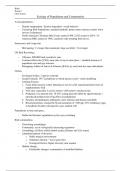
Birds
Week 9
Chris Foster
Ecology of Populations and Communities
Avian populations;
- Density independent / density dependent / social behavior
- Censusing Bird Populations; standard methods/ point counts/ transect counts/ more
surveys [volunteers]
- North American Christmas Bird Count, started 1990/ 2,585 counts in 2018 // N.
American BBS, started in 1966, continent wide breeding bird survey.
Senescence and Longevity;
- Bird ageing; 3 x longer than mammals, large sea birds = live longer
UK Bird Recording;
- 100years, 900,000 birds recorded a year
- Constant effort sites [CES]; same nets set up in same place = standard measure of
population size and age structure
- Retrapping Adults for Survival Schemes [RAS]; try and catch the same individuals.
Niches;
- Ecological niches; 2 species coincide
- Joseph Grinnell, 1917 [conditions in which species exist] = niche modelling
- Limiting Factors;
1. Food; birds increase winter fattening to survive cold/ experimental provision of
supplementary food
2. Nest sites; especially in cavity nesters/ cliff nesters/ restricted sites.
3. Predation; ever present risk/ 18-34% young great tits killed by sparrowhawks //
introduced predators have big effect on populations
4. Parasites and pathogens; pathogens cause sickness and disease and death
5. Brood parasitism; conspecific brood parasitism in >200 spp, 36% Goldeneye eggs
in Southern Sweden/ interspecific cases studied well
Populations in time and space;
- Stable but fluctuate/ population cycles/ prey switching
Bird communities;
- Classifying assemblages
- Community; set of ecologically interacting organisms
- Assemblage; all those which inhabit a place [biomes and Life zones]
- Latitudinal pattern of diversity;
o Stable tropical environment
o Sedentary lifestyle = lower gene flow
o Ecological factors; higher diversity near equator
- Habitat change;
o Predictable changes/ communities of modified habitats
Week 9
Chris Foster
Ecology of Populations and Communities
Avian populations;
- Density independent / density dependent / social behavior
- Censusing Bird Populations; standard methods/ point counts/ transect counts/ more
surveys [volunteers]
- North American Christmas Bird Count, started 1990/ 2,585 counts in 2018 // N.
American BBS, started in 1966, continent wide breeding bird survey.
Senescence and Longevity;
- Bird ageing; 3 x longer than mammals, large sea birds = live longer
UK Bird Recording;
- 100years, 900,000 birds recorded a year
- Constant effort sites [CES]; same nets set up in same place = standard measure of
population size and age structure
- Retrapping Adults for Survival Schemes [RAS]; try and catch the same individuals.
Niches;
- Ecological niches; 2 species coincide
- Joseph Grinnell, 1917 [conditions in which species exist] = niche modelling
- Limiting Factors;
1. Food; birds increase winter fattening to survive cold/ experimental provision of
supplementary food
2. Nest sites; especially in cavity nesters/ cliff nesters/ restricted sites.
3. Predation; ever present risk/ 18-34% young great tits killed by sparrowhawks //
introduced predators have big effect on populations
4. Parasites and pathogens; pathogens cause sickness and disease and death
5. Brood parasitism; conspecific brood parasitism in >200 spp, 36% Goldeneye eggs
in Southern Sweden/ interspecific cases studied well
Populations in time and space;
- Stable but fluctuate/ population cycles/ prey switching
Bird communities;
- Classifying assemblages
- Community; set of ecologically interacting organisms
- Assemblage; all those which inhabit a place [biomes and Life zones]
- Latitudinal pattern of diversity;
o Stable tropical environment
o Sedentary lifestyle = lower gene flow
o Ecological factors; higher diversity near equator
- Habitat change;
o Predictable changes/ communities of modified habitats