2024 EMT JBL Module 5 Practice Exam New Full Exam Questions and Answers ( Included ) 100% Correct
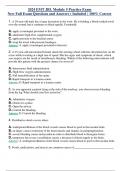
2024 EMT JBL Module 5 Practice Exam New Full Exam Questions and Answers ( Included ) 100% Correct 1. A 20-year-old male has a large laceration to his wrist. He is holding a blood-soaked towel over the wound, but it continues to bleed rapidly.Youshould: A. apply a tourniquet proximal to the wrist. B. administer high-flow supplemental oxygen. C. apply pressure to the brachial artery. D. wrap the towel with pressure bandages. Answer: A. apply a tourniquet proximal to thewrist. 2. A 25-year-old unrestrained female struck the steering wheel with her chestwhen her car hit a tree while traveling at a high rate of speed. She has signs and symptoms of shock, which you suspect are the result of intrathoracic bleeding. Which of the following interventions will provide this patient with the greatest chance for survival? A. Intravenous fluid administration B. High-flow oxygen administration C. Full immobilization of her spine D. Rapid transport to a trauma center Answer: D. Rapid transport to a trauma center 3. As you approach a patient lying at the side of the roadway, you observesevere bleeding from the leg.What should your first action be? A. Administer oxygen. B. Check for a pulse. C. Open the airway. D. Control the bleeding. Answer: D. Control the bleeding 4. Distributive shock occurs when: A. widespread dilation of the blood vessels causes blood to pool in thevascular beds. B. an injury causes restriction of the heart muscle and impairs its pumpingfunction. C. severe bleeding causes tachycardia in order to distribute blood to theorgans faster. D. temporary but severe vasodilation causes a decrease in blood supply to the brain. Answer: A. widespread dilation of the blood vessels causes blood to pool in thevascular beds. 5. Foods, medications, and insects are common causes of . A. neurogenic shock B. psychogenic shock C. septic shock D. anaphylactic shock Answer: D. anaphylactic shock
Información del documento
- Subido en
- 24 de febrero de 2024
- Número de páginas
- 39
- Escrito en
- 2023/2024
- Tipo
- Examen
- Contiene
- Preguntas y respuestas