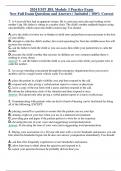
2024 EMT JBL Module 3 Practice Exam New Full Exam Questions and Answers ( Included ) 100% Correct
2024 EMT JBL Module 3 Practice Exam New Full Exam Questions and Answers ( Included ) 100% Correct 1. A 4-year-old boy had an apparent seizure. He is conscious and calm and issitting on his mother's lap. His father is sitting in a nearby chair. The child's mothersuddenly begins crying uncontrollably,which causesthe child to startcrying.You should: A. give the child a favorite toy or blanket to hold onto and perform yourassessment to the best of your ability. B. attempt to calm the child's mother, but avoid separating her from her childbecause this will increase her anxiety. C. ask the father to hold the child so you can assess him while your partnertries to calm the mother. D. reassure the child's mother that seizures in children are very common andthat there is nothing to worry about. Answer: C. ask the father to hold the child so you can assess him while your partner tries to calm the mother. 2. As you are wheeling your patient through the emergency department doors,you receive another call for a major motor vehicle crash.You should: A. place the patient in a high-visibility area and then respond to the call. B. respond only after giving a verbal patient report to a nurse or physician. C. leave a copy of the run form with a nurse and then respond to the call. D. inform the admissions clerk of the situation and then respond at once. Answer: B.respond only after giving a verbal patient report to a nurse or physician. 3. Communicating with patients who are deaf or hard-of-hearing can be facilitated by doing all of the following, EXCEPT: A. placing yourself in a position to ensure that the patient can see your lips. B. shining a light on your face when you are in a darkened environment. C. providing pen and paper if the patient prefers to write his or her response. D. elevating the tone of your voice and exaggerating word pronunciation. Answer: D.elevating the tone of your voice and exaggerating word pronunciation. 4. During your assessment of a 20-year-old man with a severe headache and nausea, you ask him when his headache began, but he does not answer yourquestion immediately.You should: A. ask him if he frequently experiences severe headaches and nausea. B. allow him time to think about the question and respond to it. C. repeat your question because he probably did not hear you. D. tell him that you cannot help him unless he answers your questions. Answer: B.allow him time to think about the question and respond to it
Información del documento
- Subido en
- 24 de febrero de 2024
- Número de páginas
- 22
- Escrito en
- 2023/2024
- Tipo
- Examen
- Contiene
- Preguntas y respuestas