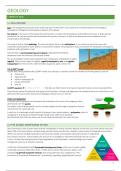
GEOLOGY
1 WHAT IS SOIL
1.1 SOIL DEFINED
Soil is the biologically active part of the outermost layer of the Earth’s crust found at the interface between the biological,
hydrological, lithological and atmospheric spheres of the planet.
Soil science is the science of the properties and functions, as well as the development and distribution of soils. It deals with the
possibilities for soil use and the risks associated with misuse by humans, as well as the prevention and remediation of soil
contamination and damage.
The study of soils is called pedology. The soil covering the Earth is the pedosphere. It is a continuous zone that covers the
continents and the beds of water bodies on land and the seabed. The pedosphere exists everywhere the lithosphere, atmosphere,
biosphere and hydrosphere meet.
Soils develop in unconsolidated parent material, originated from bedrock,
weathered under the influence of biota and climate.
The unconsolidated material and weathered rock resting upon solid bedrock is called
regolith. There are two types of regolith: regolith developed in-situ, and regolith
transported from the site of its initial formation by gravity, water, wind or ice.
The CLORPT model
In 1941 Hans Jenny published the CLORPT model: any soil type is a function of the five variable soil-forming factors, that are:
• climate (CL)
• organisms (O)
• relief or topography (R)
• parent material (P)
• time (T)
CLORPT equation à S = 𝑓 (CL, O, R, P, T . . . ). The dots are other factors that may be important locally, but not universally (fire).
These factors control the direction and speed of soil formation. Climate and organisms are considered the more active factors and
determine the rate at which chemical and biological reactions occur in the soil.
Pedon and polypedon
To classify soils is necessary to characterize the individual soil in terms of an imaginary three-
dimensional unit: the pedon.
The pedon is the smallest spatial unit of a soil that displays the full range of properties that are
characteristic for a particular soil.
A solid unit in a landscape usually consists of a group of very similar pedons: a polypedon, which is
recognized as a landscape component large enough to be called a soil individual.
Soil individuals that share the same suite of soil properties belong to the same soil type.
1.2 THE GLOBAL SIGNIFICANCE OF SOIL
Soils contribute to basic human needs and the sustainability of human societies depends on the wise use of the natural resources.
About 50% of the land surface is already being used by humans and this has resulted in many threats to the global environment.
Within one century the global population will more than double, increasing the demand for products originating
from natural resources. Unfortunately, the amount of soil available to meet these demands will not increase –
in fact, it is likely decreasing because of land degradation and urbanization. Understanding how to better
manage soil resources is therefore essential.
In 2015 the UN developed the 17 Sustainable Development Goals, which aim to create a global
sustainable society by 2030. Most of the 17 SDGs have no direct link with soils. Rather, soils
contribute to general ecosystem services, that are grouped into four categories by “The
Economics of Ecosystems & Biodiversity”: provisioning, regulating, supporting and cultural.
1
, 2 GEOLOGICAL PROCESSES, PARENT MATERIALS AND LANDSCAPES
2.1 ORIGIN AND COMPOSITION OF THE EARTH’S CRUST
2.1.1 The Earth’s crust
The crust consists of solid rock that floats on the molten liquid rock (magma) in the interior of the Earth. The
Earth's crust splits up into crustal plates that float at speeds in the order of 2–10 cm per year and that may
disappear again. The Earth's crust is divided in two crusts:
> Oceanic crust, formed by magma rising to the surface in the oceans floor
• 5-10 km thick
• Common rock type: basalt (dark, iron-rich rock)
• When colliding with continental crust, the oceanic crust subducts because it’s heavier.
As temperature rises the subducted rocks melt and rise along zones of weakness (faults) and are at the origin
of igneous rocks, which are divided in:
- volcanic rocks: formed when magma reaches the Earth’s
surface where it is erupted in the form of lava or volcanic
ash and solidifies.
- plutonic rocks: magma remains in the continental crust
and gradually solidifies.
> Continental crust:
• 5-50km thick: thickness depends on the activity of collision
• Consists of igneous, sedimentary and metamorphic rocks
• Common rock type: granite, which has less iron, so is lighter than basalt in the ocean crust.
2.1.2 Minerals
A mineral is a solid with a specific chemical composition and specific physical properties. Rocks are aggregates of minerals.
Five most important rock-forming minerals:
> Light colouring:
• Quartz: consist of pure silica (SiO2)
• Feldspar: SiO2 oxide with aluminium + potassium+ sodium + calcium
> Dark colouring
• Mica: SiO2 + potassium + magnesium + iron
• Amphiboles: SiO2 + calcium + sodium + magnesium + iron
• Olivine: SiO2 + magnesium + iron
The chemical composition of these minerals is largely based on silica (SiOx)
Crystalline versus amorphus
> Crystalline: it’s the regular arrangement of atoms in a fixed, repetitive pattern. These materials are strong and dense.
> Amorphus: the atoms don’t have a regular order. These materials are relatively weak.
2.1.3 Rocks of the Earth
• Igneous rocks: originate from liquid magma that solidifies
• Sedimentary rocks: originate from sediments created by weathering and erosion
• Metamorphic rocks: originate from rocks that are exposed to great pressure and high temperatures
2.1.4 Igneous rocks
All rocks that are originated from the cooling of liquid magma are called igneous rocks. Two subgroups:
> Plutonic rocks: massive rocks that are formed by magma that remains in the Earth’s crust and solidifies slowly. Their
mineralogic composition depends on the chemical composition of the magma. All
minerals are nicely crystalline, of the same size and clearly visible (1-5 mm).
Examples: granite, diorite, gabbro.
> Volcanic rocks: originated by magma that reaches the Earth’s surface and solidifies
quickly. These rocks have no time to crystallize and thus form an amorphous mass,
containing some crystals called phenocrysts that have already formed before the
volcanic eruption due to higher melting temperatures. These rocks are often porous,
due to cavities previously occupied by gasses. Examples: rhyolite, andesite, basalt.
2
1 WHAT IS SOIL
1.1 SOIL DEFINED
Soil is the biologically active part of the outermost layer of the Earth’s crust found at the interface between the biological,
hydrological, lithological and atmospheric spheres of the planet.
Soil science is the science of the properties and functions, as well as the development and distribution of soils. It deals with the
possibilities for soil use and the risks associated with misuse by humans, as well as the prevention and remediation of soil
contamination and damage.
The study of soils is called pedology. The soil covering the Earth is the pedosphere. It is a continuous zone that covers the
continents and the beds of water bodies on land and the seabed. The pedosphere exists everywhere the lithosphere, atmosphere,
biosphere and hydrosphere meet.
Soils develop in unconsolidated parent material, originated from bedrock,
weathered under the influence of biota and climate.
The unconsolidated material and weathered rock resting upon solid bedrock is called
regolith. There are two types of regolith: regolith developed in-situ, and regolith
transported from the site of its initial formation by gravity, water, wind or ice.
The CLORPT model
In 1941 Hans Jenny published the CLORPT model: any soil type is a function of the five variable soil-forming factors, that are:
• climate (CL)
• organisms (O)
• relief or topography (R)
• parent material (P)
• time (T)
CLORPT equation à S = 𝑓 (CL, O, R, P, T . . . ). The dots are other factors that may be important locally, but not universally (fire).
These factors control the direction and speed of soil formation. Climate and organisms are considered the more active factors and
determine the rate at which chemical and biological reactions occur in the soil.
Pedon and polypedon
To classify soils is necessary to characterize the individual soil in terms of an imaginary three-
dimensional unit: the pedon.
The pedon is the smallest spatial unit of a soil that displays the full range of properties that are
characteristic for a particular soil.
A solid unit in a landscape usually consists of a group of very similar pedons: a polypedon, which is
recognized as a landscape component large enough to be called a soil individual.
Soil individuals that share the same suite of soil properties belong to the same soil type.
1.2 THE GLOBAL SIGNIFICANCE OF SOIL
Soils contribute to basic human needs and the sustainability of human societies depends on the wise use of the natural resources.
About 50% of the land surface is already being used by humans and this has resulted in many threats to the global environment.
Within one century the global population will more than double, increasing the demand for products originating
from natural resources. Unfortunately, the amount of soil available to meet these demands will not increase –
in fact, it is likely decreasing because of land degradation and urbanization. Understanding how to better
manage soil resources is therefore essential.
In 2015 the UN developed the 17 Sustainable Development Goals, which aim to create a global
sustainable society by 2030. Most of the 17 SDGs have no direct link with soils. Rather, soils
contribute to general ecosystem services, that are grouped into four categories by “The
Economics of Ecosystems & Biodiversity”: provisioning, regulating, supporting and cultural.
1
, 2 GEOLOGICAL PROCESSES, PARENT MATERIALS AND LANDSCAPES
2.1 ORIGIN AND COMPOSITION OF THE EARTH’S CRUST
2.1.1 The Earth’s crust
The crust consists of solid rock that floats on the molten liquid rock (magma) in the interior of the Earth. The
Earth's crust splits up into crustal plates that float at speeds in the order of 2–10 cm per year and that may
disappear again. The Earth's crust is divided in two crusts:
> Oceanic crust, formed by magma rising to the surface in the oceans floor
• 5-10 km thick
• Common rock type: basalt (dark, iron-rich rock)
• When colliding with continental crust, the oceanic crust subducts because it’s heavier.
As temperature rises the subducted rocks melt and rise along zones of weakness (faults) and are at the origin
of igneous rocks, which are divided in:
- volcanic rocks: formed when magma reaches the Earth’s
surface where it is erupted in the form of lava or volcanic
ash and solidifies.
- plutonic rocks: magma remains in the continental crust
and gradually solidifies.
> Continental crust:
• 5-50km thick: thickness depends on the activity of collision
• Consists of igneous, sedimentary and metamorphic rocks
• Common rock type: granite, which has less iron, so is lighter than basalt in the ocean crust.
2.1.2 Minerals
A mineral is a solid with a specific chemical composition and specific physical properties. Rocks are aggregates of minerals.
Five most important rock-forming minerals:
> Light colouring:
• Quartz: consist of pure silica (SiO2)
• Feldspar: SiO2 oxide with aluminium + potassium+ sodium + calcium
> Dark colouring
• Mica: SiO2 + potassium + magnesium + iron
• Amphiboles: SiO2 + calcium + sodium + magnesium + iron
• Olivine: SiO2 + magnesium + iron
The chemical composition of these minerals is largely based on silica (SiOx)
Crystalline versus amorphus
> Crystalline: it’s the regular arrangement of atoms in a fixed, repetitive pattern. These materials are strong and dense.
> Amorphus: the atoms don’t have a regular order. These materials are relatively weak.
2.1.3 Rocks of the Earth
• Igneous rocks: originate from liquid magma that solidifies
• Sedimentary rocks: originate from sediments created by weathering and erosion
• Metamorphic rocks: originate from rocks that are exposed to great pressure and high temperatures
2.1.4 Igneous rocks
All rocks that are originated from the cooling of liquid magma are called igneous rocks. Two subgroups:
> Plutonic rocks: massive rocks that are formed by magma that remains in the Earth’s crust and solidifies slowly. Their
mineralogic composition depends on the chemical composition of the magma. All
minerals are nicely crystalline, of the same size and clearly visible (1-5 mm).
Examples: granite, diorite, gabbro.
> Volcanic rocks: originated by magma that reaches the Earth’s surface and solidifies
quickly. These rocks have no time to crystallize and thus form an amorphous mass,
containing some crystals called phenocrysts that have already formed before the
volcanic eruption due to higher melting temperatures. These rocks are often porous,
due to cavities previously occupied by gasses. Examples: rhyolite, andesite, basalt.
2