Exam 1: Angina & MI (NCLEX) Questions and Answers 100% Pass
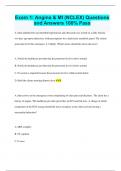
Exam 1: Angina & MI (NCLEX) Questions and Answers 100% Pass A client admitted for uncontrolled hypertension and chest pain was started on a daily diuretic two days ago upon admission, with prescriptions for a daily basic metabolic panel. The clients potassium level this morning is 2.7 mEq/L. Which action should the nurse take next? A. Notify the healthcare provider that the potassium level is above normal B. Notify the healthcare provider that the potassium level is below normal C. No action is required because the potassium level is within normal limits D. Hold the clients morning diuretic dose B A client arrives at the emergency room complaining of chest pain and dizziness. The client has a history of angina. The healthcare provider prescribes an ECG and lab tests. A change in which component of the ECG tracing should the nurse recognize as the client actively having a myocardial infarction? A. QRS complex B. ST segment C. P wave D. R wave B A client who had a MI receives 15 mg of morphine sulfate for chest pain. 15 minutes after receiving the drug, The client complains of feeling dizzy. What action should the nurse take? A. Determine if this is an allergic reaction B. Place the client in the supine position and take the vital signs C. Elevate the clients head and keep the extremities warm D. Tell the client that this is not a typical sensation after receiving morphine sulfate B A client admitted to the hospital for chest pain is diagnosed with angina. The nurse should teach the client that the most common characteristic of anginal pain is that it is: A. Relieved by rest B. Precipitated by light activity C. Described by sharp or knifelike D. Unaffected by the administration of vasodilators A Anginal pain is commonly relieved by immediate rest because rest decreases the cardiac workload. Angina is usually precipitated by exertion, emotion, or a heavy meal. anginal pain is usually described as tightness, or heaviness. Nitroglycerin dilates coronary arteries which increases oxygen to the myocardium, decreasing the pain. The healthcare provider prescribes Nitroglycerin ointment to be applied topically every 8 hours for a client who was admitted for chest pain and a MI. Which statement, if made by the client, would indicate understanding of the side effects of nitroglycerin ointment? "I may experience: A. A headache B. Increased BP readings C. A slow Pulse rate D. Confusion A The most common SE of Nitro is a headache. Additional cardio SE are tachycardia, hypotension and dizziness not confusion. A client is admitted to the ER with crushing chest pain. A diagnosis of acute coronary syndrome is suspected. The nurse expects that the client's initial treatment will include which medication? A. Gabapentin B. Midazolam C. Alprazolam D. Aspirin D Early administration of aspirin in the setting of acute MI has been demonstrated to significantly reduce mortality. Aspirin inhibits
Escuela, estudio y materia
- Institución
- Angina & MI
- Grado
- Angina & MI
Información del documento
- Subido en
- 21 de febrero de 2024
- Número de páginas
- 53
- Escrito en
- 2023/2024
- Tipo
- Examen
- Contiene
- Preguntas y respuestas
Temas
-
exam 1 angina mi nclex questions and answers

Documento también disponible en un lote