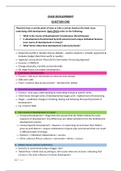
CHILD DEVELOPMENT
QUESTION ONE
Theorists have a certain point of view or take a certain stand on the basic issue
underlying child development. Berk (2013) refers to the following:
✓ What is the course of development? (continuous/ discontinuous)
✓ Is development characterised by both universal and unique individual features
(one course of development or many)?
✓ What factors determine development (nature/nurture)?
→ Determine (settle or decide), Discuss (Debate – explore solutions / consider argument) &
Evaluate (Judge/ determine worth or quality)
→ Vygotsky’s Sociocultural Theory & the Information-Processing Approach
→ Humans = COMPLEX.
→ Change physically, mentally and emotionally.
→ No single theory can explain development.
1. Continuous Development:
→ Process = add more information to what we have already
→ Skills born with.
→ Violin = practice (day by day practice – develop their ability)
2.Discontinuous Development:
→ Process = new ways understanding & responding emerge at specific times.
→ Child moves through series of developmental stages until = highest level of functioning.
→ Stages – qualitative changes in thinking, feeling and behaving that specify periods of
development.
→ E.g. Crawl to Walk
3. One course of development or many?
→ Universal Development = Stage theorists assume that all children follow the same
sequence of development. Any differences are called variations from the fundamental
development process.
→ Context Specific Development = However, it is becoming more known that children
grow up with distinct + unique combinations of genes plus environment that can result
in different paths of change.
→ Western = individual/ independence = success
→ Other cultures/ African cultures = community + whole = success
4. Nature versus nurture controversy
→ Genetics or environment plays a bigger role?
→ Tabula Rosa = blank slate according to John Locke when we are born, indicating that
nurture is the main influence in human development
1|Page
,→ Nature = inborn biological givens which determine the range of human potential
→ Nurture = Complex forces of the physical and social world influencing us from conception
VYGOTSKY’S SOCIOCULTURAL THEORY
→ Focus on how culture (values and beliefs, customs and skills of social groups) – is
transmitted to the next generation.
→ Vygotsky – social interaction (conversations with knowledgeable members of society)
is necessary for children to acquire the ways of thinking and behaving that make up a
community’s culture.
→ Adults and more expert peers help children to master culturally meaningful activities,
the communication between them = children’s thinking.
→ 4 Basic Principles:
• Children construct their knowledge
• Development cannot be separated from its social context
• Learning can lead development
• Language plays a central role in mental development
CONTINOUS & DISCONTINOUS
→ V understands that social interaction + all its complex relationships = a fundamental
role in the development of cognition
→ V says sociocultural standpoint of child development = continuous process – which is
characterised unique individual features predominately facilitated through nurture and
affected by multiple levels of the child’s surrounding environment
→ Sociocultural theory = more encompassing standpoint which it is recognized that for
instance language acquisition and the structure of schooling lead to stage wise or
discontinuous change
STAGES OF DEVELOPMENT
→ V = course of development in thought and behaviour is socially mediated and it varies
from culture to culture
→ Thus, the context of specific path development is IMPORTANT to V
NATURE VERSUS NURTURE
→ V = hereditary and brain growth interacts with the nurturing factors of conversation
with more expert members of society (zone of proximal development)
→ These factors together contribute to development
→ Early and late experiences = equally important
CONCLUSION
→ V stresses that social and cultural contributions to children’s thinking
→ Step away from individualistic view of the developing child
2|Page
, → V = Private Speech – a child communicates with themselves as much as they do with
the world & others
→ V = Course of development + individuality + Nature vs Nurture take place within a
child’s zone of proximal development
= a range of tasks too difficult for the child to do alone but possible with the help of
adults and more skilled peers
1. Intersubjectivity – Process whereby two participants begin a task with different
understandings and arrive at the same/shared understanding
2. Scaffolding – Whereby the level of support offered during a learning session is
adapted to fit the child’s level of performance
3. Guided Participation – refers to shared endeavours between expert and less expert
participants
→ V = explains wide cultural variation in culture skills + expect highly different paths of
development.
→ V Criticism = lack of attention given to biological contributions & also his theory is
vague in his explanation of how cognitive change occurs
THE INFORMATION-PROCESSING THEORY
→ Human mind = symbol-manipulating system through which information flows
→ With age, a number of things happen + this process gradually improves the
perception, attention, memory and problem-solving skills in a continuous course of
development
→ It says that with age:
1. The basic capacity of the memory stores increase
2. The speed of information processing increases thereby increasing the processing
efficiency
3. The encoding of information becomes more thorough
4. The ability to prevent distracting stimuli from diverting attention increases
5. Strategies to improve storage, retrieval and use of info = more effective
6. The amount + understanding of knowledge base INCREASES
7. Awareness and understanding of the cognitive process (metacognition) improve
which in turn leads to more effective strategies
UNIVERSAL VERSUS CONTEXT SPECIFIC DEBATE
→ IPA = children primarily change in relation to age
→ IPA = provides a flowchart type of approach where a child takes steps to solve a
problem
→ Because of structure approach to processing = ALL children follow this basic approach
3|Page
, NATURE VS. NURTURE DEBATE
→ IPA = As brain matures (nature) + child confronts new environmental demands, the
child’s thinking is modified in accordance with growing capabilities within the
changing environment thus, big influence that nurture has on development
CONCLUSION
→ Strength = attention to careful + in depth research methods which has helped
developed intervention techniques / interventions that can help children in problem
solving in advanced ways
→ Aspects of cognition are not linear and logical are all but ignored i.e. imagination +
creativity
→ Majority of research is only laboratory results but not real-life situations
→ But hold promise for the future understanding of cog development and its
mechanisms
→ Gender stereotyping = “Gender Schema Theory” which combines social learning and
cog development into a UNIFIED picture of how gender orientations are emerged +
maintained
DISCUSSION OF THE TWO VIEWPOINTS
→ Vygotsky states that LANGUAGE acquisition is DISCONTINOUS
→ A child becomes advanced in reflection – of their own thinking
→ LANGUAGE = attributed to complex problems + reasoning as a child ages
→ Conversations with older adults (or experts) = NOT culture specific & can lead to
CONTINOUS change in a child’s cognition
→ Child’s cognitive development = socially mediated, learnt through social interaction
is passed onto net generation
→ Social interaction surrounding the tasks given to by parents for success in particular
culture = children developing unique strengths within their culture
→ Diverse cultures = communicated & valued in each culture will vary and results in
many different courses of development
→ Skills learned by urban school will differ from those at township schools or those
who cannot attend school (survival skills/techniques)
→ Vygotsky = ignores biological factors
→ Hereditary and brain growth is important but little said about its influence on child
development
→ Great emphasis on social transmission of knowledge + less on children’s capacity to
shape their own development
→ Does NOT explain how children internalise their social experiences to advance
mental functioning
→ Does not explain children’s profound change in thinking
→ V = teaching plays important role (communicating experts) which will assist in
revising + controlling own thought processes
4|Page
QUESTION ONE
Theorists have a certain point of view or take a certain stand on the basic issue
underlying child development. Berk (2013) refers to the following:
✓ What is the course of development? (continuous/ discontinuous)
✓ Is development characterised by both universal and unique individual features
(one course of development or many)?
✓ What factors determine development (nature/nurture)?
→ Determine (settle or decide), Discuss (Debate – explore solutions / consider argument) &
Evaluate (Judge/ determine worth or quality)
→ Vygotsky’s Sociocultural Theory & the Information-Processing Approach
→ Humans = COMPLEX.
→ Change physically, mentally and emotionally.
→ No single theory can explain development.
1. Continuous Development:
→ Process = add more information to what we have already
→ Skills born with.
→ Violin = practice (day by day practice – develop their ability)
2.Discontinuous Development:
→ Process = new ways understanding & responding emerge at specific times.
→ Child moves through series of developmental stages until = highest level of functioning.
→ Stages – qualitative changes in thinking, feeling and behaving that specify periods of
development.
→ E.g. Crawl to Walk
3. One course of development or many?
→ Universal Development = Stage theorists assume that all children follow the same
sequence of development. Any differences are called variations from the fundamental
development process.
→ Context Specific Development = However, it is becoming more known that children
grow up with distinct + unique combinations of genes plus environment that can result
in different paths of change.
→ Western = individual/ independence = success
→ Other cultures/ African cultures = community + whole = success
4. Nature versus nurture controversy
→ Genetics or environment plays a bigger role?
→ Tabula Rosa = blank slate according to John Locke when we are born, indicating that
nurture is the main influence in human development
1|Page
,→ Nature = inborn biological givens which determine the range of human potential
→ Nurture = Complex forces of the physical and social world influencing us from conception
VYGOTSKY’S SOCIOCULTURAL THEORY
→ Focus on how culture (values and beliefs, customs and skills of social groups) – is
transmitted to the next generation.
→ Vygotsky – social interaction (conversations with knowledgeable members of society)
is necessary for children to acquire the ways of thinking and behaving that make up a
community’s culture.
→ Adults and more expert peers help children to master culturally meaningful activities,
the communication between them = children’s thinking.
→ 4 Basic Principles:
• Children construct their knowledge
• Development cannot be separated from its social context
• Learning can lead development
• Language plays a central role in mental development
CONTINOUS & DISCONTINOUS
→ V understands that social interaction + all its complex relationships = a fundamental
role in the development of cognition
→ V says sociocultural standpoint of child development = continuous process – which is
characterised unique individual features predominately facilitated through nurture and
affected by multiple levels of the child’s surrounding environment
→ Sociocultural theory = more encompassing standpoint which it is recognized that for
instance language acquisition and the structure of schooling lead to stage wise or
discontinuous change
STAGES OF DEVELOPMENT
→ V = course of development in thought and behaviour is socially mediated and it varies
from culture to culture
→ Thus, the context of specific path development is IMPORTANT to V
NATURE VERSUS NURTURE
→ V = hereditary and brain growth interacts with the nurturing factors of conversation
with more expert members of society (zone of proximal development)
→ These factors together contribute to development
→ Early and late experiences = equally important
CONCLUSION
→ V stresses that social and cultural contributions to children’s thinking
→ Step away from individualistic view of the developing child
2|Page
, → V = Private Speech – a child communicates with themselves as much as they do with
the world & others
→ V = Course of development + individuality + Nature vs Nurture take place within a
child’s zone of proximal development
= a range of tasks too difficult for the child to do alone but possible with the help of
adults and more skilled peers
1. Intersubjectivity – Process whereby two participants begin a task with different
understandings and arrive at the same/shared understanding
2. Scaffolding – Whereby the level of support offered during a learning session is
adapted to fit the child’s level of performance
3. Guided Participation – refers to shared endeavours between expert and less expert
participants
→ V = explains wide cultural variation in culture skills + expect highly different paths of
development.
→ V Criticism = lack of attention given to biological contributions & also his theory is
vague in his explanation of how cognitive change occurs
THE INFORMATION-PROCESSING THEORY
→ Human mind = symbol-manipulating system through which information flows
→ With age, a number of things happen + this process gradually improves the
perception, attention, memory and problem-solving skills in a continuous course of
development
→ It says that with age:
1. The basic capacity of the memory stores increase
2. The speed of information processing increases thereby increasing the processing
efficiency
3. The encoding of information becomes more thorough
4. The ability to prevent distracting stimuli from diverting attention increases
5. Strategies to improve storage, retrieval and use of info = more effective
6. The amount + understanding of knowledge base INCREASES
7. Awareness and understanding of the cognitive process (metacognition) improve
which in turn leads to more effective strategies
UNIVERSAL VERSUS CONTEXT SPECIFIC DEBATE
→ IPA = children primarily change in relation to age
→ IPA = provides a flowchart type of approach where a child takes steps to solve a
problem
→ Because of structure approach to processing = ALL children follow this basic approach
3|Page
, NATURE VS. NURTURE DEBATE
→ IPA = As brain matures (nature) + child confronts new environmental demands, the
child’s thinking is modified in accordance with growing capabilities within the
changing environment thus, big influence that nurture has on development
CONCLUSION
→ Strength = attention to careful + in depth research methods which has helped
developed intervention techniques / interventions that can help children in problem
solving in advanced ways
→ Aspects of cognition are not linear and logical are all but ignored i.e. imagination +
creativity
→ Majority of research is only laboratory results but not real-life situations
→ But hold promise for the future understanding of cog development and its
mechanisms
→ Gender stereotyping = “Gender Schema Theory” which combines social learning and
cog development into a UNIFIED picture of how gender orientations are emerged +
maintained
DISCUSSION OF THE TWO VIEWPOINTS
→ Vygotsky states that LANGUAGE acquisition is DISCONTINOUS
→ A child becomes advanced in reflection – of their own thinking
→ LANGUAGE = attributed to complex problems + reasoning as a child ages
→ Conversations with older adults (or experts) = NOT culture specific & can lead to
CONTINOUS change in a child’s cognition
→ Child’s cognitive development = socially mediated, learnt through social interaction
is passed onto net generation
→ Social interaction surrounding the tasks given to by parents for success in particular
culture = children developing unique strengths within their culture
→ Diverse cultures = communicated & valued in each culture will vary and results in
many different courses of development
→ Skills learned by urban school will differ from those at township schools or those
who cannot attend school (survival skills/techniques)
→ Vygotsky = ignores biological factors
→ Hereditary and brain growth is important but little said about its influence on child
development
→ Great emphasis on social transmission of knowledge + less on children’s capacity to
shape their own development
→ Does NOT explain how children internalise their social experiences to advance
mental functioning
→ Does not explain children’s profound change in thinking
→ V = teaching plays important role (communicating experts) which will assist in
revising + controlling own thought processes
4|Page