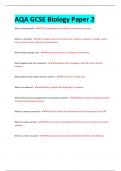
AQA GCSE Biology Paper 2
What is homeostasis? - The maintenance of a constant internal environment. What is a stimulus? - A change in your environment than requires a response. e.g Light, sound, touch, pressure, pain, chemical or temperature. What do the receptors do? - Detect the stimulus or change in environment. What happens after the receptors? - Receptors send messages to the CNS via the sensory neurone. What makes up the central nervous system? - The brain or spinal cord What is an effector? - Muscles or glands that bring about a response. What do the muscles and glands do in response to stimuli? - Muscles contract and glands secrete chemical substances(hormones). What is a sensory neurone? - A neurone that carry information from the receptors to the CNS. What is a relay neurone? - Neurones that carry impulses from the sensory neurone to the motor neurone. What is a motor neurone? - Neurones that carry information from the CNS to the effectors. What is the nervous system? - It is a system that allows you to react to your surroundings. How do signals travel across a synapse? - The chemical or neurotransmitter diffuses across the synapse and binds to a complementary receptor on the neurone (postsynaptic). This causes an electrical impulse to travel down the next neurone. What is a synapse? - A gap between two neurones. What is the thermoregulatory centre of the brain? - Near the hypothalamus, monitors the temperature of blood. Describe the stages in a reflex arc. - Stimulus->Receptor->sensory neurone->CNS (relay neurone) -> motor neurone -> effector -> response Name responses that reduce body temperature. - Hairs lie flat, sweat and blood vessels get wider(vasodilation) What happens during vasodilation? - The blood vessels supplying the skin dilate (widen). This helps to transfer energy to the environment. Name responses that increase body temperature. - Hairs stand up, no sweat, shivering and blood vessels constrict(vasoconstriction) What happens during vasoconstriction? - The blood vessels supplying the skin constrict to close off the skins blood supply. What is the body's core temp? - 37 degrees Celsius What are hormones? - Chemical messengers that travel in the blood to target organs. Compare and Contrast the endocrine (hormone) system and the nervous system. - Nervous is faster acting than the endocrine system. Hormones have longer lasting effects compared to electrical impulses. Nerves act on a very specific area whereas hormones act more general. What does the thyroid gland do? - Produces thyroxine which is involved in regulating metabolism. What do the adrenal glands do? - Produce adrenaline which is used to prepare the body for fight or flight. What is the role of the pancreas? - Produces glucagon and insulin which are involved in regulating glucose levels in the blood. Name the hormone that is released if blood sugar is too high. - Insulin What does insulin do? - It makes the liver convert glucose into glycogen. This causes blood glucose levels to decrease. Name the hormone that is released if blood sugar is too low. - Glucagon What does glucagon do? HINT GLU-COSE-GONE - It makes the liver convert glycogen to glucose. This causes the blood glucose level to increase. What is type I diabetes? - When the pancreas produces little or no insulin.
Escuela, estudio y materia
- Institución
- GCSE
- Grado
- GCSE
Información del documento
- Subido en
- 16 de febrero de 2024
- Número de páginas
- 37
- Escrito en
- 2023/2024
- Tipo
- Examen
- Contiene
- Preguntas y respuestas
Temas
-
aqa gcse biology paper 2

Documento también disponible en un lote