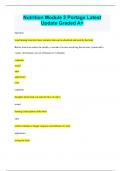
Nutrition Module 2 Portage Latest Update Graded A+
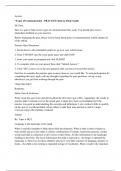
Nutrition Module 2 Portage Latest Update Graded A+ digestion transforming food into basic nutrients that can be absorbed and used by the body Before food even enters the mouth, a cascade of events involving the nervous system and a variety of hormones are set off based on 5 stimulus: cognition sound odor appearance taste cognition thoughts about food can start the flow of saliva sound hearing a description of the meal odor smells stimulate a hunger response and influence its taste appearance seeing the food taste begins as the food enters your mouth and also how it feels We absorb nutrients for... 1) fuel cellular growth 2)fight infections 3)provide energy to our muscles and brain 2 Processes Food is Broken Down 1) mechanical 2) chemical Peristalsis involuntary wavelike contractions that propel food along the digestive tract Enzymes Proteins that speed up chemical reactions Gastrointestinal (GI) tract a long hollow tube consisting of several layers of tissue that begins with the mouth and ends at the anus. Absorption The process by which nutrient molecules pass through the wall of the digestive system into the blood Mucosa (intestinal wall) The innermost layer of the human digestive tract; made of absorptive cells and glands passive diffusion substances move easily in and out of cells without energy, high to low concentrations Circular and longitudinal muscles comprise the outer layers, both of which function to mix and move food along the GI tract. Notably, circular bands of muscle are most often found where one part of the tract connects to another, serving as valves to control the flow of the food particles. facilitated diffusion No energy required, BUT special protein carrier is needed to help substances cross in and out of the cell, high to low concentrations active transport Energy-requiring process that moves material across a cell membrane against a concentration difference, low to high 6 parts of the GI tract 1) Mouth 2) Esophagus 3) Stomach 4) Small Intestine 5) Large intestine 6) Rectum Membrane Transport chart 4 main organs produce and secrete substances that aid in digestion, but they are not part of the GI tract: 1 - salivary glands 2 - liver 3 - gallbladder 4 - pancreas Mouth The function of the mouth is to alter the food particles to prepare them to be swallowed. both mechanical and chemical digestions take place in the mouth. mechanical digestion occurs as the teeth break the food into smaller particles. The salivary glands are then stimulated to secrete saliva. chemical digestion Process by which enzymes break down food into small molecules that the body can use Saliva a watery fluid containing (1) a lubricant (mucus) and (2) enzymes to prepare food for the next step in the GI tract. Epiglottis flap that covers the trachea During swallowing to prevent food from entering the trachea. Mouth Enzymes salivary amylase: break down starches lingual lipase: break down fats
Escuela, estudio y materia
- Institución
- Nutrition Module 2 Portage
- Grado
- Nutrition Module 2 Portage
Información del documento
- Subido en
- 16 de febrero de 2024
- Número de páginas
- 17
- Escrito en
- 2023/2024
- Tipo
- Examen
- Contiene
- Preguntas y respuestas
Temas
-
nutrition module 2 portage latest update graded a

Documento también disponible en un lote