Creative Arts
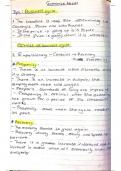
(Study Notes)
Visual arts
Art elements
1. Line
2. Tone + value
3. Texture
4. Shape and form
5. Space
6. Colour
1. Line
A line is a continuous mark.
Direction- All lines have direction. Horizontal/ Vertical/Oblique
, 2. Tone and value
Tone is the range of darkness and lightness of an object/ an area.
Are created by the way light falls on a 3D object
The parts of the object where the light is strongest are called
highlights and the darker areas are called shadows
Lines can be used to create tone.
Shading techniques- stippling/dotting/shading/hatching/cross-
hatching/scribbling
Tone can be used to create:
A contrast between light/dark
An illusion of form
A sense of depth/darkness
A rhythm/pattern within a composition
Value is the degree of darkness/lightness of tones/colours
White is the lightest value & black is the darkest value.
Tonal values are all the shades of grey in between white and black
3. Texture
Visual texture-Textures you can feel not see
Tactile texture- Texture you can feel
Texture refers to the look/feel of objects
4. Shape and form
Shape is a flat, enclosed area which has 2 dimensions, length and
width.
Form is a 3-dimensional object which consists of length, width and
height. (Can be viewed from many sides. Takes up space/volume)
Organic/naturalistic is found in nature
Geometric is man-made (using tools)
5. Space
Used to create the illusion of depth
Includes the background, foreground and the areas around, between
and within things
Positive space is the area that is occupied by an object
(Study Notes)
Visual arts
Art elements
1. Line
2. Tone + value
3. Texture
4. Shape and form
5. Space
6. Colour
1. Line
A line is a continuous mark.
Direction- All lines have direction. Horizontal/ Vertical/Oblique
, 2. Tone and value
Tone is the range of darkness and lightness of an object/ an area.
Are created by the way light falls on a 3D object
The parts of the object where the light is strongest are called
highlights and the darker areas are called shadows
Lines can be used to create tone.
Shading techniques- stippling/dotting/shading/hatching/cross-
hatching/scribbling
Tone can be used to create:
A contrast between light/dark
An illusion of form
A sense of depth/darkness
A rhythm/pattern within a composition
Value is the degree of darkness/lightness of tones/colours
White is the lightest value & black is the darkest value.
Tonal values are all the shades of grey in between white and black
3. Texture
Visual texture-Textures you can feel not see
Tactile texture- Texture you can feel
Texture refers to the look/feel of objects
4. Shape and form
Shape is a flat, enclosed area which has 2 dimensions, length and
width.
Form is a 3-dimensional object which consists of length, width and
height. (Can be viewed from many sides. Takes up space/volume)
Organic/naturalistic is found in nature
Geometric is man-made (using tools)
5. Space
Used to create the illusion of depth
Includes the background, foreground and the areas around, between
and within things
Positive space is the area that is occupied by an object