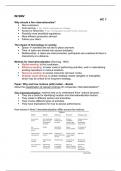
IM SMV
HC 1
Why should a firm internationalize?
New customers.
Cost savings bijv. Polish employees are cheaper.
Access to resources bijv. mining place, but also human resources.
Possibly more beneficial regulations.
More efficient production abroad.
Follow your client.
The impact of technology on society
Space activities are not tied to place anymore.
Time tasks are divided into several subtasks.
Relationships tasks are interconnected, participants are scattered & there is
interactivity at a distance.
Motives for internationalization (Dunning, 1993)
Market-seeking: to find customers.
Efficiency-seeking: to lower costs of performing activities, and/ or rationalizing
existing operations in various locations.
Resource-seeking: to access resources (at lower costs).
Strategic asset-seeking: to obtain strategic assets (tangible or intangible),
which may be critical to for long-term strategy.
Paper: Why and how motives (still) matter – Benito
About the classification of relevant motives for companies’ internationalization^.
Why internationalization: motives help us to understand firms’ actions because…
They are a basis for identifying location and internationalization factors.
They relate to different sectors and industries.
They involve different types of activities.
They have implications for how to assess performance.
How issues in firms’ internationalization differ across the motives:
,Sometimes called FDI-motives (FDI is setting up an organizational unit abroad). But
internationalization is more; also import/ exporting activities. Thus, motives per se do
not provide a sufficient justification, but they clarify the ‘why’ of international business.
Where internationalization = key location factors: developing markets with large
population, high purchasing power, good infrastructure and nearby. Also, resources
are importance since the inequity of resource availability coincides with economic
and political stability issues. Finally, strategic-asset seeking is forward-looking,
developing new resources and capabilities instead of exploiting existing ones. So, a
dynamic and developed environment is the basis for future asset success.
How internationalization = key internationalization factors: finding the most efficient
(cost minimizing) way of operating abroad, for example an FDI, exports, or licensing.
Market-seeking companies own valuable brands for expanding.
Efficiency-seeking companies invest in production and logistic to gain
economies of scale, scope, and time.
Resource-seeking companies supply security and stability because of the
political issues.
Strategic asset-seeking companies prioritize control over their foreign
operations, so they need to be there as first.
Motives are not equally prevalent across different economies, see the table for the
typical industries they are important in. Same holds for their activities and KPI’s.
Companies are not single-minded in their internationalization; they can combine the
motives. Firstly, companies may evolve over time. Secondly, some companies do a
variety of activities abroad (parallel motives), but for different reasons and without a
dominating motive (Benito).
Key point: motives are useful in internationalization theories for 3 reasons:
They are valuable as classificatory device.
They are associated with central aspects in a systematic and differentiated
manner, which makes them relevant variables on firms’ internationalization.
They serve as key markers for the conceptual domains of theories of firms’
internationalization.
Limitation: this analysis is purely conceptual, not substantiated by empirical evidence.
Paper: The state of globalization in 2019, and what it means for strategists –
Ghemawat & Altman
In 2017, the DHL Global Connectedness Index (the flow of information, capital,
people and trade) was at record level. But in 2018, this grow started to slow down
due to Brexit, Trump’s actions, increased tariffs, and blocked acquisitions.
Ghemawat & Altman offer 4 recommendations for business leaders to help them
navigating through this globalization’s turbulence.
How to compete (strategy): focus on long-term and consider whether your company
needs to rebalance across the AAA-strategies.
,Where to compete (presence): depends on where you’re coming from due to the
growing number of trade-agreements between countries, you should focus on CAGE-
distance. But as administrative distances are changing fast, firms cannot reconfigure
their activities by each shift, so now may be the time to invest in supply chains or
planning. Last tip: make profit of trade tensions between other countries.
How to organize (architecture):
• Which structure? Organize by region or employ matrix organizations.
• Who leads? A representative team with national diversity.
• How do we work together? Link relationships, incentives, and information
flows across geographic and functional lines.
How to engage better with society (non-market strategy): emphasize the real benefits
your company brings to the countries, since nationalization feelings. Don’t try to fix
the societal anger about globalization since it’s probably a domestic cause.
All in all: the biggest winners are the firms that embrace globalization’s complexity
rather than their purely local/ global visions of their business environments.
Paper: Reappraising liabilities of foreignness within an integrated perspective
of the costs and benefits of doing business abroad – Sethi & Judge
Hymer’s paper: disadvantages of foreign subsidiary t.o.v. local firms = costs of doing
business abroad (CDBA). Zaheer extended that with the liability of foreignness (LOF)
concept relation between CDBA and LOF not clear. LOF only focuses on the extra
costs a subsidiary makes in the host-country t.o.v. rival firms broader
conceptualization is necessary. Besides that, also benefits should be analyzed.
This paper: CDBA = all costs, so LOF (costs in country) + LOM (costs outside host-
country) & also benefits integrated more comprehensive framework with 11
propositions illustrated by a case study of Ford Motor Company.
• Costs and benefits are all relative to local firms.
• Discriminatory costs = only for foreign firms, to benefit local firms.
, • Benefits = only those that arise from foreignness and multinationalism, not
normal benefits from the firm’s growth and performance.
Propositions about foreign subsidiary:
LOF costs decrease when:
1. Economic liberalization in the host country increases decrease due to
declining ‘discriminatory LOF’.
2. JV and alliances in the host country increase decrease due to declining
‘incidental LOF’ door meer integratie en ervaring.
Both are reducing due to the increasing integration of the global economy.
LOM costs increase when:
3. When a subsidiary’s transactions with its global network increase.
4. When its financial exposure from intra-MNE financial flows increases.
5. When the constraints on a subsidiary’s strategic options from the parent
MNC’s corporate strategy increase.
6. When its direct interactions with economic institutions and NGOs increase.
AOF benefits increase:
7. When the host government’s incentives for inward FDI increase e.g.
incentives to modernize.
8. With superior quality and brand name locals prefer quality/ name of foreigners.
AOM benefits increase as the MNC’s network offers increased opportunities for a
foreign subsidiary for…
9. Scale and scope economies.
10. Multipoint pricing, hedging, and TP-options.
11. Intra-corporate knowledge flow options.
Conclusions:
Studies focused on LOF, but not on LOM/AOF/AOM necessary to investigate.
Research is needed to clarify which costs and benefits grow in importance.
According to this paper: benefits > costs, due to growing size & scope of MNC.
HC 1
Why should a firm internationalize?
New customers.
Cost savings bijv. Polish employees are cheaper.
Access to resources bijv. mining place, but also human resources.
Possibly more beneficial regulations.
More efficient production abroad.
Follow your client.
The impact of technology on society
Space activities are not tied to place anymore.
Time tasks are divided into several subtasks.
Relationships tasks are interconnected, participants are scattered & there is
interactivity at a distance.
Motives for internationalization (Dunning, 1993)
Market-seeking: to find customers.
Efficiency-seeking: to lower costs of performing activities, and/ or rationalizing
existing operations in various locations.
Resource-seeking: to access resources (at lower costs).
Strategic asset-seeking: to obtain strategic assets (tangible or intangible),
which may be critical to for long-term strategy.
Paper: Why and how motives (still) matter – Benito
About the classification of relevant motives for companies’ internationalization^.
Why internationalization: motives help us to understand firms’ actions because…
They are a basis for identifying location and internationalization factors.
They relate to different sectors and industries.
They involve different types of activities.
They have implications for how to assess performance.
How issues in firms’ internationalization differ across the motives:
,Sometimes called FDI-motives (FDI is setting up an organizational unit abroad). But
internationalization is more; also import/ exporting activities. Thus, motives per se do
not provide a sufficient justification, but they clarify the ‘why’ of international business.
Where internationalization = key location factors: developing markets with large
population, high purchasing power, good infrastructure and nearby. Also, resources
are importance since the inequity of resource availability coincides with economic
and political stability issues. Finally, strategic-asset seeking is forward-looking,
developing new resources and capabilities instead of exploiting existing ones. So, a
dynamic and developed environment is the basis for future asset success.
How internationalization = key internationalization factors: finding the most efficient
(cost minimizing) way of operating abroad, for example an FDI, exports, or licensing.
Market-seeking companies own valuable brands for expanding.
Efficiency-seeking companies invest in production and logistic to gain
economies of scale, scope, and time.
Resource-seeking companies supply security and stability because of the
political issues.
Strategic asset-seeking companies prioritize control over their foreign
operations, so they need to be there as first.
Motives are not equally prevalent across different economies, see the table for the
typical industries they are important in. Same holds for their activities and KPI’s.
Companies are not single-minded in their internationalization; they can combine the
motives. Firstly, companies may evolve over time. Secondly, some companies do a
variety of activities abroad (parallel motives), but for different reasons and without a
dominating motive (Benito).
Key point: motives are useful in internationalization theories for 3 reasons:
They are valuable as classificatory device.
They are associated with central aspects in a systematic and differentiated
manner, which makes them relevant variables on firms’ internationalization.
They serve as key markers for the conceptual domains of theories of firms’
internationalization.
Limitation: this analysis is purely conceptual, not substantiated by empirical evidence.
Paper: The state of globalization in 2019, and what it means for strategists –
Ghemawat & Altman
In 2017, the DHL Global Connectedness Index (the flow of information, capital,
people and trade) was at record level. But in 2018, this grow started to slow down
due to Brexit, Trump’s actions, increased tariffs, and blocked acquisitions.
Ghemawat & Altman offer 4 recommendations for business leaders to help them
navigating through this globalization’s turbulence.
How to compete (strategy): focus on long-term and consider whether your company
needs to rebalance across the AAA-strategies.
,Where to compete (presence): depends on where you’re coming from due to the
growing number of trade-agreements between countries, you should focus on CAGE-
distance. But as administrative distances are changing fast, firms cannot reconfigure
their activities by each shift, so now may be the time to invest in supply chains or
planning. Last tip: make profit of trade tensions between other countries.
How to organize (architecture):
• Which structure? Organize by region or employ matrix organizations.
• Who leads? A representative team with national diversity.
• How do we work together? Link relationships, incentives, and information
flows across geographic and functional lines.
How to engage better with society (non-market strategy): emphasize the real benefits
your company brings to the countries, since nationalization feelings. Don’t try to fix
the societal anger about globalization since it’s probably a domestic cause.
All in all: the biggest winners are the firms that embrace globalization’s complexity
rather than their purely local/ global visions of their business environments.
Paper: Reappraising liabilities of foreignness within an integrated perspective
of the costs and benefits of doing business abroad – Sethi & Judge
Hymer’s paper: disadvantages of foreign subsidiary t.o.v. local firms = costs of doing
business abroad (CDBA). Zaheer extended that with the liability of foreignness (LOF)
concept relation between CDBA and LOF not clear. LOF only focuses on the extra
costs a subsidiary makes in the host-country t.o.v. rival firms broader
conceptualization is necessary. Besides that, also benefits should be analyzed.
This paper: CDBA = all costs, so LOF (costs in country) + LOM (costs outside host-
country) & also benefits integrated more comprehensive framework with 11
propositions illustrated by a case study of Ford Motor Company.
• Costs and benefits are all relative to local firms.
• Discriminatory costs = only for foreign firms, to benefit local firms.
, • Benefits = only those that arise from foreignness and multinationalism, not
normal benefits from the firm’s growth and performance.
Propositions about foreign subsidiary:
LOF costs decrease when:
1. Economic liberalization in the host country increases decrease due to
declining ‘discriminatory LOF’.
2. JV and alliances in the host country increase decrease due to declining
‘incidental LOF’ door meer integratie en ervaring.
Both are reducing due to the increasing integration of the global economy.
LOM costs increase when:
3. When a subsidiary’s transactions with its global network increase.
4. When its financial exposure from intra-MNE financial flows increases.
5. When the constraints on a subsidiary’s strategic options from the parent
MNC’s corporate strategy increase.
6. When its direct interactions with economic institutions and NGOs increase.
AOF benefits increase:
7. When the host government’s incentives for inward FDI increase e.g.
incentives to modernize.
8. With superior quality and brand name locals prefer quality/ name of foreigners.
AOM benefits increase as the MNC’s network offers increased opportunities for a
foreign subsidiary for…
9. Scale and scope economies.
10. Multipoint pricing, hedging, and TP-options.
11. Intra-corporate knowledge flow options.
Conclusions:
Studies focused on LOF, but not on LOM/AOF/AOM necessary to investigate.
Research is needed to clarify which costs and benefits grow in importance.
According to this paper: benefits > costs, due to growing size & scope of MNC.