Microbiology Exam #1 (Chapter 1,3,4,5,6) with 100% Solved Solutions
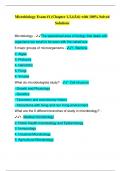
Microbiology - The specialized area of biology that deals with organisms too small to be seen with the naked eye 6 major groups of microorganisms - 1. Bacteria 2. Algae 3. Protozoa 4. Helminths 5. Fungi 6. Viruses What do microbiologists study? - - Cell structure - Growth and Physiology - Genetics - Taxonomy and evolutionary history - Interactions with living and non living environment What are the 6 different branches of study in microbiology? - 1. Medical microbiology 2. Public Health microbiology and Epidemiology 3. Immunology 4. Industrial Microbiology 5. Agricultural Microbiology 6. Environmental Microbiology Medical Microbiology - Study of microbes as they relate to medicine, deals with microbes that causes disease in humans and animals Public Health Microbiology and Epidemiology - Monitor and control the spread of disease in communities. USPHS, CDC, WHO Industrial Microbiology - - Use of microbes to manufacture important compounds - Safeguards our food and water - Also includes biotechnology - Ranges from bread making to gene therapy - Microbes can be used to create large quantities of substances such as amino acids, beer, drugs, enzymes, and vitamins Agricultural Microbiology - - Deals with the relationships between microbes and domesticated plants and animals - Plant specialists focus on plant diseases, soil fertility, and nutritional interactions - Animal specialists work with infectious diseases and other associations animals have with microorganisms Immunology - Studies a diverse areas such as vaccination, blood testing, and allergy. Immunologists investigate the role of the immune system in cancer and autoimmune diseases Environmental Microbiology - Studies the effect of microbes on the earth's diverse habitats. Example- aquatic microbiology, soil microbiology, geomicrobiology, and astrobiology eu-kary means? - true nucleus; cells with a nucleus are classified as eukaryotes Pro-kary means? - Pre-nucleus; bacteria and archaea do not have a nucleus and have been traditionally classified as prokaryotes What is a microbe? - A microorganism How are biology and microbiology different? How are they similar? - Biology is concerned with all the different scales of size that microorganisms exist on, but many fields on biology are concerned with more complex organisms such as mammals. Microbiology is concerned specifically with smaller, individual organisms. Microbiologists might be concerned with something as
Escuela, estudio y materia
- Institución
- Microbiology
- Grado
- Microbiology
Información del documento
- Subido en
- 13 de febrero de 2024
- Número de páginas
- 48
- Escrito en
- 2023/2024
- Tipo
- Examen
- Contiene
- Preguntas y respuestas
Temas
-
microbiology

Documento también disponible en un lote