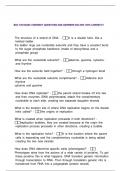
BSC 108 Exam 3 Kennedy The structure of a strand of DNA. - Answer -it is a double helix, like a twisted ladder. the ladder rings are nucleotide subunits and they have a covalent bond to the sugar phosphate backbone (made of deoxyribose and a phosphate group) What are the nucleotide subunits? - Answer -adenine, guanine, cytosine, and thymine How are the subunits held together? - Answer -through a hydrogen bond What are the nucleotide subunits compliments? - Answer -Adenine and thymine cytosine and guanine How does DNA replicate? - Answer -the parent strand breaks off into two and then enzymes (DNA polymerases) attach the complimentary nucleotide to each side, creating two separate daughter strands What is the location site of where DNA replication begins on the double helix called? - Answer -the origins of replication What is created when replication proceeds in both directions? - Answer -replication bubbles, they are created because at the origin the replication process proceeds in other directions, creating a bubble. What is the replication forks? - Answer -It is the location where the parent cells is separating and the complimentary nucleotide is being added creating the two new strands How does DNA determine specific traits (phenotypes)? - Answer -Phenotypes arise from the actions of a wide variety of proteins. To get these proteins this is what happens. DNA transfers genetic information through transcription to RNA. Then through translati on genetic info is transferred from RNA into a polypeptide (protein strand) What is the structure of RNA? - Answer -It is a single -stranded nucleic acid. it is the same as DNA except it uses ribose instead of deoxyribose in the sugar phosphate backbone and it uses uracil instead of thymine tRNA - Answer -transfer RNA: translation of the genetic message carried in the mRNA into the amino acid language of proteins (converts the three -letter words, codons, of nucleic acids to the amino acid words of proteins) What is the function of mRNA? - Answer -Messenger molecules carry the coding sequences for protein synthesis and are called transcripts. rRNA - Answer -ribsosomal RNA makes up ribosomes which are the organelles in the cytoplasm that coordinate the functioning of mRNA and tRNA and actually make polypeptides What two processes do genes code for specific proteins? - Answer -transcription and translation What is transcription and where does it take place? - Answer -Transcription is the synthesis of mRNA under the direction of DNA, nucleus What is translation and where does it take place? - Answer -It is the synthesis of a polypeptide (later becomes a protein) under the direction of mRNA occurs on ribosomes in the cytoplasm What is the structure of tRNA? - Answer -It is made of a single strand of RNA. consisting of about 80 nucleotides. Chain twists and folds upon itself, forming several double -stranded regions in which short stretches of RNA base -pair with other stretches. on e end has a special triplet of bases called anticodons. it is complementary to a codon triplet on mRNA. on the other side there is an amino acid attachment site. What is a mutation? - Answer -It is a change in the genetic material (the nucleotide sequence) of a cell's DNA. What is a point mutation? - Answer -It is a change in once base pair of a gene. What is a plasmid? - Answer -A small ring of self -replicating DNA separate from the larger chromosomes. Plasmids are most frequently derived from bacteria. they can carry any gene and are passed from generation to generation. making them perfect for genetic cloning.
Examen
BSC 108 Exam 3 Kennedy Questions and Answers Solved 100% Correct!!
Puntuación
Vendido
4
Páginas
12
Grado
A+
Subido en
13-02-2024
Escrito en
2023/2024
The structure of a strand of DNA. - Answer-it is a double helix, like a twisted ladder. the ladder rings are nucleotide subunits and they have a covalent bond to the sugar phosphate backbone (made of deoxyribose and a phosphate group) What are the nucleotide subunits? - Answer-adenine, guanine, cytosine, and thymine How are the subunits held together? - Answer-through a hydrogen bond What are the nucleotide subunits compliments? - Answer-Adenine and thymine cytosine and guanine How does DNA replicate? - Answer-the parent strand breaks off into two and then enzymes (DNA polymerases) attach the complimentary nucleotide to each side, creating two separate daughter strands What is the location site of where DNA replication begins on the double helix called? - Answer-the origins of replication What is created when replication proceeds in both directions? - Answer-replication bubbles, they are created because at the origin the replication process proceeds in other directions, creating a bubble. What is the replication forks? - Answer-It is the location where the parent cells is separating and the complimentary nucleotide is being added creating the two new strands How does DNA determine specific traits (phenotypes)? - Answer-Phenotypes arise from the actions of a wide variety of proteins. To get these proteins this is what happens. DNA transfers genetic information through transcription to RNA. Then through translation genetic info is transferred from RNA into a polypeptide (protein strand) What is the structure of RNA? - Answer-It is a single-stranded nucleic acid. it is the same as DNA except it uses ribose instead of deoxyribose in the sugar phosphate backbone and it uses uracil instead of thyminetRNA - Answer-transfer RNA: translation of the genetic message carried in the mRNA into the amino acid language of proteins (converts the three-letter words, codons, of nucleic acids to the amino acid words of proteins) What is the function of mRNA? - Answer-Messenger molecules carry the coding sequences for protein synthesis and are called transcripts.
Mostrar más
Leer menos
Institución
BSC 108 Kennedy
Grado
BSC 108 Kennedy
Ups! No podemos cargar tu documento ahora. Inténtalo de nuevo o contacta con soporte.
Escuela, estudio y materia
- Institución
- BSC 108 Kennedy
- Grado
- BSC 108 Kennedy
Información del documento
- Subido en
- 13 de febrero de 2024
- Número de páginas
- 12
- Escrito en
- 2023/2024
- Tipo
- Examen
- Contiene
- Preguntas y respuestas
Temas
-
bsc 108 kennedy
Vista previa del contenido
$8.99
Accede al documento completo:
100% de satisfacción garantizada
Inmediatamente disponible después del pago
Tanto en línea como en PDF
No estas atado a nada