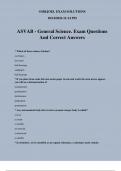
NRNP 6635 Final Exam – Schizophrenia (Graded A) 2024
NRNP 6635 Final Exam – Schizophrenia (Graded A) 2024 Schizophrenia -Answer-a psychological disorder characterized by delusions, hallucinations, disorganized speech, and/or diminished inappropriate emotional expression. signs and symptoms of schizophrenia -Answer-The signs and symptoms of schizophrenia are traditionally separated into 2 groups: positive (delusions, hallucinations, and disorganized speech or behavior) and negative (flat affect, avolition, anhedonia, poor attention, and alogia). Schizophrenia is associated with -Answer-a decline in both cognitive and social functioning that often precedes the development of florid psychosis. Etiology of Schizophrenia -Answer-The exact etiology of schizophrenia is unknown, although it is thought to be linked to an increase in dopaminergic activity. No single etiological factor is responsible for schizophrenia. Treatment of Schizophrenia -Answer-Treatment includes antipsychotics in conjunction with behavioral therapy. Schizophrenia definition -Answer-Schizophrenia is a chronic serious mental disorder characterized by loss of contact with reality and manifested by two main symptoms: hallucinations and delusions. onset of schizophrenia -Answer-Men and women are equally affected, but with a slight difference in the age of onsetMen: average age of onset = 23 years Women: average age of onset = 26 years Etiological factors of schizophrenia -Answer-The disorder manifests when a person with a genetic predisposition is exposed to one of many environmental stressors. - genetic predisposition - environmental stressors Environmental Stressors of Schizophrenia -Answer-Environmental stressors are believed to be triggers of schizophrenia rather than true causes of the disorder. -Childhood trauma - Residence in an urban area - Social isolation -Frequent cannabis use in early adolescence - Migration - Poverty - Stress and psychosocial factors - Birth in late winter or early spring -Advanced paternal age at conception Pathophysiology of schizophrenia part 1 -Answer-Genetic and environmental risk factors appear to act via a common pathway of disrupting the function of 1 or more neurotransmitter components. Dopaminergic theory: Almost all drugs with antipsychotic properties block the dopaminergic D2 receptor. However, antipsychotics are only 70% effective and clozapine, the most effective antipsychotic for treating schizophrenia, is a weak D2 antagonist. Hyperactivity of dopamine D2 receptor neurotransmission in subcortical, and limbic brain regions contribute to the positive symptoms of schizophrenia. Hypo functionality of dopamine D1 receptor neurotransmission in the prefrontal cortex contributes to both negative and cognitive symptoms. Pathophysiology of schizophrenia part 2 -Answer-Other theories: Hypofunction of the N-methyl-D-aspartate (NMDA) glutamate receptor. Dysfunctional gamma-amino-butyric acid (GABA) interneurons. Dysfunctional nicotinic acetylcholine receptors. Physical abnormalities of the brain in schizophrenia -Answer-Patients with schizophrenia also have physical abnormalities of the brain tissue, which can be seen in neuroimaging studies. Loss of cortical tissue volume, including the limb
Escuela, estudio y materia
- Institución
- NRNP 6531
- Grado
- NRNP 6531
Información del documento
- Subido en
- 13 de febrero de 2024
- Número de páginas
- 10
- Escrito en
- 2023/2024
- Tipo
- Examen
- Contiene
- Preguntas y respuestas
Temas
-
nrnp 6635 final exam schizophrenia graded a 20

Documento también disponible en un lote