PSYC 1F90 - Multiple Choice (T1) Exam Questions and Answers 2024
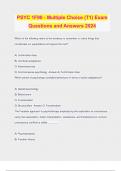
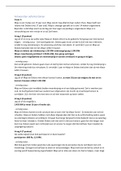
PSYC 1F90 - Multiple Choice (T1) Exam Questions and Answers 2024 Which of the following refers to the tendency to remember or notice things that corroborate our expectations and ignore the rest? A) Confirmation bias B) Uncritical acceptance C) Awareness bias D) Commonsense psychology -Answer-A) Confirmation bias Which school of psychology considers behaviours in terms of active adaptations? A) Gestalt psychology B) Behaviorism C) Functionalism D) Structuralism -Answer-C) Functionalism The Freudian approach to psychotherapy emphasizing the exploration of unconscious using free association, dream interpretation, resistances, and transference to uncover unconscious conflicts is called _______. A) Psychoanalysis B) Freudian theory C) psychodynamic theory D) Neo-Freudianism -Answer-A) Psychoanalysis Biopsychologists and others who study the brain and nervous system, such as biologists and biochemists, comprise the broader field of _______. A) Neuroscience B) Evolution C Pseudoscience D) Psychoanalysis -Answer-A) Neuroscience Which of the following refer(s) to the rules that define acceptable and expected behavior for members of a group? A) Social norms B) Cultural relativity C) Gender bias D) Social bias -Answer-A) Social norms Which is a mental health professional who specializes in helping people with problems that do not involve serious mental disorders? A) Counselor B) Psychologist C) Psychoanalyst D) Consultant -Answer-A) Counselor When an investigator manipulates at least one variable while measuring another, they are conducting ____________. A) An experiment B) A survey C) A research study D) A biased sample -Answer-A) An experiment If a researcher wanted to combine the results of lots of studies together on the same subject, which technique would they use? A) Meta-analysis B) Factor analysis C) Correlational analysis D) Experimental analysis -Answer-A) Meta-analysis Which is a problem in which experimenters see what they expect to see or record only selected details? A) Observer bias B) Anthropomorphic error C) Observer effect D) Participant bias -Answer-A) Observer bias Study of any directly observable action or response—eating, hanging out, sleeping, talking, or sneezing—is referred to as _______. A) Behaviorism B) Determinism C) Evolution D) Humanism -Answer-A) Behaviorism Which of the following is the only difference between experimental and control groups and the only possible cause of a change in the dependent variable? A) Random assignment B) Comparative differences C) Independent variable D) Extraneous variable -Answer-C) Independent variable Janessa is convinced that her favorite purple shirt is lucky. Whenever she wears it, good things happen to her. Except for the one time that she spilled coffee on herself, and another time when she was late for the bus. But Janessa is convinced those events don't have anything to do with her purple shirt—only the luck does. What is this an example of? A) Uncritical acceptance B) Awareness bias C) Confirmation bias D) Critical acceptance -Answer-C) Confirmation bias A yoga class was being offered with a new meditative technique focusing on each individual sense and how each piece of information was interpreted by each person. This relaxation and training technique worked for each person in the class because: A) Everyone had the same thoughts from this training technique since they all learned it at the same time. B) Each individual experienced sensations and perceptions differently than anyone else in the room due to retrospection. C) Everyone had the same experience from this training technique since they all learned it at the same time. D) Each individual experienced sensations and perceptions differently than anyone else in the room due to introspection -Answer-D) Each individual experienced sensations and perceptions differently than anyone else in the room due to introspection Pilar, a new driver, attempted to text her girlfriend while driving. When the car in front of her stopped at a red light, Pilar, distracted, rear-ended the car. Which of the following is the independent variable in this situation?
Escuela, estudio y materia
- Institución
- PSYC 1F90
- Grado
- PSYC 1F90
Información del documento
- Subido en
- 13 de febrero de 2024
- Número de páginas
- 105
- Escrito en
- 2023/2024
- Tipo
- Examen
- Contiene
- Preguntas y respuestas
Temas
-
psyc 1f90 multiple choice t1 exam questions an

Documento también disponible en un lote