Brock PSYC 1F90 Exam 1 Review 2024
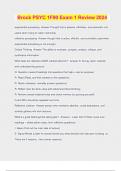
Brock PSYC 1F90 Exam 1 Review 2024 experiential processing -Answer-Thought that is passive, effortless, and automatic (not useful when trying to retain memories) reflective processing -Answer-thought that is active, effortful, and controlled (used when experiential processing is not enough) Critical Thinking -Answer-The ability to evaluate, compare, analyze, critique, and synthesize information What does the reflective SQ4R method stand for? -Answer-S: Survey (skim material and understand big picture) Q: Question (reword headings into questions that help u read w/ purpose) R: Read (Read, and find answers to the questions) R: Recite (rehearse; mentally answer questions) R: Reflect (Can be done using self-reference/critical thinking) R: Review (reread material/notes and check memory by quizzing yourself) Q and 3R's should be repeated over time Reflective Listener -Answer-person who maintains attention, avoid distractions, and actively gathers info from lectures What's a good listening/note-taking plan? -Answer-L: Lead. Don't Follow (Look over readings + slides before class; form reflective questions) I: Ideas (Find out the main idea of lecture) S: Signal Words (Listen for words that tell you what direction the instructor is taking. ex. There are 3 reasons...here comes reasons) A: Actively Listen (stay active, alert, engaged) N: Note Taking (write down only key points) Psychology -Answer-The scientific study of overt and covert behaviour Research Method -Answer-A systematic approach to answering questions (common sense answers can go unchallenged due to lack of research method) What first 2 steps do psychologists take to reach their goals and answer unknown questions? -Answer-1. Description of behaviour; based on making detailed record of observations; also called naming or classifying 2. Next is understanding; achieved when causes of behaviour can be stated (the why) critical thinking -Answer-a type of reflection that involves asking whether a set of beliefs can be supported by scientific explanation and observation What do critical thinkers do? -Answer-1. willing to challenge conventional wisdom by asking hard questions 2. willing to actively reflect on ideas 3. question assumptions and and look for alternative conclusions pseudo-psychology -Answer-any false and unscientific system of beliefs and practices that is offered as an explanation of behaviour; give the appearence of being scientific but is not confirmation bias -Answer-the tendency to remember or notice information thats fits ones expectation, while forgetting discrepancies (creating an illusion of accuracy) scientific method -Answer-a form of critical thinking based on careful measurement and controlled observation In its ideal form, what are the 6 elements of the scientific method? -Answer-1. making observations 2. defining a problem 3. proposing a hypothesis 4. gathering evidence/testing hypothesis 5. building theory 6. publishing results hypothesis -Answer-the predicated outcome of an experiment of an educated guess about the relationship between variables Operational Definition -Answer-defining a scientific concept by stating the specific actions or procedures used to measure it (ex. hunger can be defined based on the number of hours of food deprivation) theory -Answer-a system of ideas designed to interrelate concepts and facts in a way that summarizes existing data and predicts future observations survey -Answer-a public polling technique used to answer questions representative sample -Answer-a small, randomly selected part of a larger population that accurately reflects characteristics of the whole population (good ones should have equal % of men, women, young, old, etc.) What are the limitations of a survey? -Answer-1. Could be representing a biased sample; does not accurately represent pop. 2. people may show courtesy bias (a tendency to give polite/socially desirable answers); like when answering questions about sex, drugs, income observational data -Answer-data that comes from watching participants and recording their behaviour (only provide descriptions of behaviour) What are the two types of observational data? -Answer-1. Naturalistic Observation 2. Structured Observation naturalistic observation -Answer-observing behaviour as it unfolds in natural settings, without interference from researcher structured observation -Answer-observing behaviour in situations that have been set up by the researcher observer effect -Answer-changes in an organisms behaviour caused by awareness of being observed (so observers must keep distance and avoid interacting) observer bias -Answer-the tendency of an observer to see what they expect or to record only selected details; distorts behaviour to match expectations physiological data -Answer-data that comes from participants physiological processes (like measures of brain/heart, muscles, and production of hormones)
Escuela, estudio y materia
- Institución
- PSYC 1F90
- Grado
- PSYC 1F90
Información del documento
- Subido en
- 13 de febrero de 2024
- Número de páginas
- 56
- Escrito en
- 2023/2024
- Tipo
- Examen
- Contiene
- Preguntas y respuestas
Temas
-
brock psyc 1f90 exam 1 review 2024

Documento también disponible en un lote