AS microeconomics notes
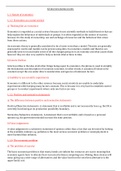
1.1- Nature of economics
1.1.1- Economics as a social science
a) Thinking like an economist
Economics is regarded as a social science because it uses scientific methods to build theories that can
help explain the behaviour of individuals or groups. It is often regarded as the science of scarcity
because it is the study of ownership, use and exchange of resources and the behaviour that arises
from these actions.
An economic theory is generally considered to be a looser term than a model. Theories are generally
expressed in words and models can be proven using data. In economics, models and theories are
generally used to try and make sense of all the changes going on in an economy and what causes them
however they are also very useful to help us decide what actions to take.
b) Ceteris Paribus
Ceteris paribus is the idea of all other things being equal. In economics, the phrase is used to simplify
the formulation and description of economic outcomes. In other words, it assumes all values to be
constant except the one under direct consideration and ignores all unknown factors.
c) Inability to use scientific experiments
Economics is different to the other sciences because social scientists are unable to undertake
experiments while keeping many factors constant. This is because it is very hard to establish control
groups or to conduct experiments where only one factor can vary.
1.1.2- Positive and normative statements
a) The difference between positive and normative statements
Positive/Objective statements- A statement that is verifiable and is not necessarily true e.g. the UK is
currently functioning at its production possibility boundary.
Normative/Subjective statements- A statement that is not verifiable and is based on a personal
opinion e.g. the government should increase the state pension.
b) Value judgements
A value judgement is a subjective statement of opinion rather than a fact that can be tested by looking
at the available evidence e.g. pollution is the most serious economic problem or unemployment is
more harmful than inflation.
1.1.3- The economic problem
a) The problem of scarcity
The basic economic problem is that wants/needs are infinite but resources are scarce meaning that
economic agents have to allocate their resources between competing uses. Making these choices will
mean giving up a wide range of alternatives and the value lost from the next best alternative is the
opportunity cost.
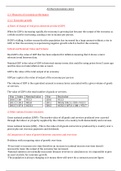
1.1- Nature of economics
1.1.1- Economics as a social science
a) Thinking like an economist
Economics is regarded as a social science because it uses scientific methods to build theories that can
help explain the behaviour of individuals or groups. It is often regarded as the science of scarcity
because it is the study of ownership, use and exchange of resources and the behaviour that arises
from these actions.
An economic theory is generally considered to be a looser term than a model. Theories are generally
expressed in words and models can be proven using data. In economics, models and theories are
generally used to try and make sense of all the changes going on in an economy and what causes them
however they are also very useful to help us decide what actions to take.
b) Ceteris Paribus
Ceteris paribus is the idea of all other things being equal. In economics, the phrase is used to simplify
the formulation and description of economic outcomes. In other words, it assumes all values to be
constant except the one under direct consideration and ignores all unknown factors.
c) Inability to use scientific experiments
Economics is different to the other sciences because social scientists are unable to undertake
experiments while keeping many factors constant. This is because it is very hard to establish control
groups or to conduct experiments where only one factor can vary.
1.1.2- Positive and normative statements
a) The difference between positive and normative statements
Positive/Objective statements- A statement that is verifiable and is not necessarily true e.g. the UK is
currently functioning at its production possibility boundary.
Normative/Subjective statements- A statement that is not verifiable and is based on a personal
opinion e.g. the government should increase the state pension.
b) Value judgements
A value judgement is a subjective statement of opinion rather than a fact that can be tested by looking
at the available evidence e.g. pollution is the most serious economic problem or unemployment is
more harmful than inflation.
1.1.3- The economic problem
a) The problem of scarcity
The basic economic problem is that wants/needs are infinite but resources are scarce meaning that
economic agents have to allocate their resources between competing uses. Making these choices will
mean giving up a wide range of alternatives and the value lost from the next best alternative is the
opportunity cost.