ATI QUESTIONS TO REVIEW BEFORE EXIT & NCLEX VERIFIED SOLUTIONS
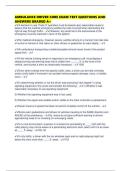
ATI QUESTIONS TO REVIEW BEFORE EXIT & NCLEX VERIFIED SOLUTIONS A nurse is caring for a client with severe peripheral arterial disease of the right lower extremity. Which intervention is appropriate? A.) Apply cold compresses to the affected extremity B.) Apply warm compresses to the affected extremity C.) Keep the affected extremity above the level of the heart D.) Keep the affected extremity below the level of the heart - ANSWER ANSWER--- >D.) Keep the affected extremity below the level of the heart RATIONALE: The nurse should NEVER apply direct heat to the limb. Sensitivity is decreased in the affected limb & burns may result A nurse is providing care for a client with a Jackson-Pratt drain. Which of the following nursing interventions has the highest priority? A.) Securing the tube and drainage bulb to the pt B.) Keeping the drainage bulb depressed to manual suction C.) "Milking" the tubing before emptying the drain D.) Cleansing the insertion site of the tube w/betadine - ANSWER ANSWER-->B.) Keeping the drainage bulb depressed to manual suction RATIONALE: Securing the tubing helps to keep tension from being placed on the tubing & bulb. While this is helpful, maintaining the bulb to suction is the highest priority nursing intervention A client is scheduled for surgery. Which of the following findings should the nurse report to the provider prior to surgery? A.) Serum potassium of 3.8 mEq/L B.) A missing identification band C.) Increased anxiety level D.) A decrease in BP - ANSWER ANSWER-->D.) A decrease in BP RATIONALE: If a missing ID band is noted the nurse can recreate the band prior to proceeding to the operating room. The ID band is a method of properly identifying a pt & necessary for care A client is undergoing cystoscopy. Which of the following interventions should the nurse include in the client's plan of care? A.) Provide education on home urinary catheter care B.) Monitor for infection for 48-72 hours following procedure C.) Increase oral fluid intake to flush contrast dye from system D) Educate pt on the need for anticoagulant therapy - ANSWER ANSWER--->B) Monitor for infection for 48-72 hours following procedure RATIONALE: Cystoscopy does not require administration of contrast dye A nurse is caring for a post-operative client who underwent thoracic surgery 7 hours prior, and now has in place a chest tube for drainage. What finding would require the nurse to contact the provider immediately? A.) Chest tube & tubing become disconnected during pt transfer B) Pt complains of left-sided chest pain of 7 on pain scale when performing incentive spirometry C) Chest tube drainage measures 80 mLs/hr of red blood D) Diminished breath sounds auscultated in left lower lobe - ANSWER ANSWER-->C) Chest tube drainage measures 80mL/hr of red blood RATIONALE: If the tubing separates the RN will ask the pt to exhale as much air as they can to remove air from the pleural space & the nurse would cleanse the tips & reconnect the tubing A nurse is reinforcing teaching with a client who has been recently diagnosed with osteoporosis. Which of the following should be included? A.) Increase intake of dietary calcium b. Walking for one to two hours daily is recommended. c. Eliminate safety hazards in the home d. Long-term estrogen replacement therapy will be required. - ANSWER ANSWER-- >C.) Eliminate safety hazards in the home RATIONALE: Intake of calcium alone is not a treatment for osteoporosis, but calcium is an important part of a prevention program to promote bone health. Most people do not get enough calcium in their diet, and therefore calcium supplements are needed. A nurse is evaluating placement of a nasogastric (NG) tube. Which of the following is the least reliable method to determine correct NG tube placement? a. Aspirate to collect gastric content. b. Test pH of gastric contents c. Ask the client to talk. d. Inject air into tube and listen over abdomen. - ANSWER ANSWER-->D.) Inject air into tube and listen over abdomen RATIONALE: Other than X-ray, aspiration of gastric contents with pH testing is the most reliable method to determine correct NG tube placement. A pH of 4 or less is expected. A nurse is caring for a client with heart failure. Which of the following interventions should the nurse take if the client is experiencing dyspnea? a. Place client in high Fowler's position. b. Place client in the reverse trendelenberg position c. Perform coughing and deep breathing exercises every 8 hours. d. Obtain serial ABGs every 8 hours. - ANSWER ANSWER-->A) Place pt in high fowler's position RATIONALE: Placing the client in reverse trendelenberg would not promote lung expansion and improve oxygenation as well as high Fowler's position. A nurse is providing education to a client with coronary artery disease. Which of the following cholesterol values should the nurse identify as a goal f
Escuela, estudio y materia
- Institución
- ATI QUESTIO
- Grado
- ATI QUESTIO
Información del documento
- Subido en
- 9 de febrero de 2024
- Número de páginas
- 93
- Escrito en
- 2023/2024
- Tipo
- Examen
- Contiene
- Preguntas y respuestas
Temas
-
ati questions to review before exit nclex ver
-
ati questions to review before exit nclex veri