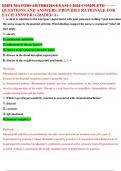
RHEUMATOID ARTHRITIS EXAM 1 2024 COMPLETE QUESTIONS AND ANSWERS (PROVIDES RATIONALE FOR EACH ANSWER) GRADED A+
A client is admitted to the emergency department with joint pain and swelling. Upon assessment the nurse suspects rheumatoid arthritis. Which findings support the nurse's conclusion? Select all that apply. 1. obesity 2. antinuclear antibodies 3. inflammatory disease pattern 4. disease in the bilateral symmetric joints 5. disease in the distal intrapharyngeal joints 6. disease in the weight-bearing joints and hands: 2, 3, 4 Rationale: Rheumatoid arthritis is an autoimmune disorder identified by the presence of an- tinuclear antibodies. Disease in the bilateral symmetric joints is generally seen in rheumatoid arthritis. Rheumatoid arthritis involves inflammation of the joints. Osteoarthritis involves degeneration of the joints. Obesity is a risk factor for os- teoarthritis. Osteoarthritis affects weight-bearing joints and the hands. 2. Which type of hypersensitivity reaction is associated with rheumatoid arthritis? 1. delayed 2. cytotoxic 3. IgE-mediated 4. Immune-complex: 4 Rationale: Rheumatoid arthritis is an autoimmune disorder associated with an immune-com- plex type of hypersensitivity reaction. Contact dermatitis caused by poison ivy is associated with a delayed type of hypersensitivity reaction. Goodpasture's syndrome is associated with a cytotoxic type of hypersensitivity reaction. Asthma is associated with an IgE-mediated type of hypersensitivity reaction. 3. After assessing a client with rheumatoid arthritis, the nurse suspects Sjö- gren's syndrome. Which manifestations are consistent with Sjögren's syn- drome? Select all that apply. 1. iritis 2. scleritis 3. xerostomia 4. baker's cyst 5. keratoconjunctivitis sicca: 3, 5 Rationale: Sjögren's syndrome, commonly associated with advanced rheumatoid arthritis, includes such symptoms as xerostomia (dry mouth) and keratoconjunctivitis sicca (dry eyes). Iritis and scleritis are eye complications and do not indicate Sjögren's syndrome. A Baker's cyst is an enlargement of a popliteal bursa (behind the knee); it is commonly found in people with rheumatoid arthritis but does not indicate Sjögren's syndrome. 4. The nurse is assessing a client with severe nodule-forming rheumatoid arthritis for possible Felty syndrome. Which assessment findings are consis- tent with Felty syndrome? Select all that apply. 1. itchy eyes 2. dry mouth 3. leukopenia 4. splenomegaly 5. photosensitivity: 3, 4 Rationale: Felty syndrome occurs most commonly in clients with severe nodule-forming rheumatoid arthritis; it is characterized by splenomegaly and leukopenia. Itchy eyes, dry mouth, and photosensitivity are all signs of Sjögren syndrome. 5. What is the nurse's primary consideration when caring for a client with rheumatoid arthritis? 1. surgery 2. comfort 3. education 4. motivation: 2 Rationale: Because pain is an all-encompassing and often demoralizing experience, the client should be kept as pain-free as possible. Surgery is used to correct deformities and facilitate movement, which is not the priority. Concentration and motivation are difficult when a client is in severe pain. 6. A client who has been taking ibuprofen for rheumatoid arthritis asks the nurse if acetaminophen can be substituted instead. What is the appropriate nursing response? 1. "acetaminophen is the preferred treatment for rheumatoid arthritis" 2. "acetaminophen irritates the stomach more than ibuprofen does" 3. "ibuprofen has antiinflammatory properties and acetaminophen does not" 4. "yes, both are antipyretics and have the same effect": 3 Rationale: Ibuprofen has an antiinflammatory action that relieves the inflammation and pain associated with arthritis. Acetaminophen is not a nonsteroidal antiinflammatory drug (NSAID). NSAIDs are preferred for the treatment of rheumatoid arthritis. Aceta- minophen does not cause gastritis; this is an effect of aspirin. Ibuprofen is not an antipyretic. 7. A married couple in their 80s is living independently. They have three adult children. The husband, who is alert but forgetful, has an enlarged prostate and at times is incontinent of urine. The wife has diabetes and rheumatoid arthritis and walks with difficulty. Both need assistance with bathing, dressing, and meal preparation. What does the nurse suggest as the most suitable plan for this couple? 1. admit them together to a nursing home 2. place them together in an assisted-living facility 3. keep them in their home with a home health aide 4. encourage them to move in with one of their children: 3 rationale: Care provided in the home is more efficient and cost-effective; this couple can manage with assistance from community resources. There is nothing in the history to demonstrate that skilled nursing care provided by a nursing home is necessary. Because the couple appears able to function with assistance at home, it is not necessary to move them to another setting at this time. 8. A client with rheumatoid arthritis takes aspirin routinely to reduce pain. The client asks whether it is the arthritis, the aspirin, or some other ear problem that causes the bilateral ear buzzing the client is now experiencing. What is an appropriate nursing response? 1. "the ringing in your ears is a sign of an ear infection" 2. "aspirin may have caused some nerve damage in your ear" 3. "accumulation of ear wax causes ringing in the ears" 4. "your symptoms are an expected response to the aging process": 2 rationale: Aspirin may damage the eighth cranial (acoustic) nerve, causing ringing in the ears and impaired hearing. Pain, not ringing in the ears, is a sign of otitis media. Diminished hearing, not ringing, occurs because of mechanical obstruction of the outer ear. Aging may cause decreasing acuity in the extremes of pitch, but it does not cause ringing in the ears. 9. Which medication should the nurse anticipate the healthcare provider will prescribe to relieve the pain experienced by a client with rheumatoid arthritis? 1. aspirin 2. hydromorphone 3. meperidine 4. alprazolam: 1 Rationale: Because of its antiinflammatory effect, acetylsalicylic acid is useful in treating arthri- tis symptoms. Opioids such as hydromorphone and meperidine should be avoided because they promote drug dependency and do not affect the inflammatory process. Alprazolam is an antianxiety, not an antiinflammatory, agent. 10. A client who has severe rheumatoid arthritis becomes depressed and is admitted to the psychiatric unit. The nurse begins to work with the client in one-on-one sessions to help with coping with the depressive episode. What is the best long-term outcome for this client? 1. the client will eat at least two meals per day with other clients 2. the client will maintain self-care and attend structured activities 3. the client will make a positive verbal comment to another client daily 4. the client will decrease negative thinking about self, others, and life: 4 rationale: The best long-term goal is that the client attains a positive attitude about the self, others, and life in general; this indicates that treatment has been effective and the client may be discharged. Eating at least two meals per day with other clients is a short-term goal associated with a therapeutic milieu. Maintaining self-care and attending structured activities is a short-term goal and an expected behavior on an inpatient unit. Making a positive verbal comment to another client daily is an intermediate goal that helps the client focus on others; this goal is a step toward achieving long-term goals. 11. Which joint surgery is used as a prophylactic measure and as a palliative treatment for clients with rheumatoid arthritis (RA)? 1. osteotomy 2. arthrodesis
Escuela, estudio y materia
- Institución
- RHEUMATOID ARTHRITIS
- Grado
- RHEUMATOID ARTHRITIS
Información del documento
- Subido en
- 8 de febrero de 2024
- Número de páginas
- 29
- Escrito en
- 2023/2024
- Tipo
- Examen
- Contiene
- Preguntas y respuestas
Temas
-
rheumatoid arthritis
-
rheumatoid arthritis exam 1 2024 complete question
-
rheumatoid arthritis exam 1 2024
-
rheumatoid arthritis exam 1
-
a client is admitted to the emergency department w