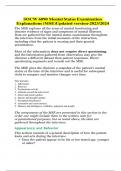
SOCW 6090: Mental Status Examination Explanations (MSE). LATEST VERSION, 2024
The MSE explores all the areas of mental functioning and denotes evidence of signs and symptoms of mental illnesses. Data are gathered for the mental status examination throughout the interview from the initial moments of the interaction, including what the patient is wearing and their general presentation. Most of the information does not require direct questioning, and the information gathered from observation may give the clinician a different dataset than patient responses. Direct questioning augments and rounds out the MSE. The MSE gives the clinician a snapshot of the patient’s mental status at the time of the interview and is useful for subsequent visits to compare and monitor changes over time. Nine domains: 1. Appearance 2. Behavior 3. Psychomotor activity 4. Attitudes toward the interviewer 5. Affect and mood together 6. Speech and thought together 7. Perceptual disturbances, 8. orientation and consciousness, 9. Memory and intelligence, reliability, judgment and insight. The components of the MSE are presented in this section in the order one might include them in the written note for organizational purposes, but as noted above, the data are gathered throughout the interview. Appearance and Behavior This section consists of a general description of how the patient looks and acts during the interview. Does the patient appear to be his or her stated age, younger or older? Is this related to the patient’s style of dress, physical features, or style of interaction? Items to be noted include what the patient is wearing, including body jewelry, and whether it is appropriate for the context. For example, a patient in a hospital gown would be appropriate in the emergency room or inpatient unit but not in an outpatient clinic. Distinguishing features, including disfigurations, scars, and tattoos, are noted. Grooming and hygiene also are included in the overall appearance and can be clues to the patient’s level of functioning. The description of a patient’s behavior includes a general statement about whether he or she is exhibiting acute distress and then a more specific statement about the patient’s approach to the interview. The patient may be described as cooperative, agitated, disinhibited, disinterested, and so forth. Once again, appropriateness is an important factor to consider in the interpretation of the observation. If a patient is brought involuntarily for examination, it may be appropriate, certainly understandable, that he or she is somewhat uncooperative, especially at the beginning of the interview. Motor Activity Motor activity may be described as normal, slowed (bradykinesia), or agitated (hyperkinesia) This can give clues to diagnoses (e.g., depression vs. mania) as well as confounding neurological or medical issues. Gait, freedom of movement, any unusual or sustained postures, pacing, and hand wringing are described. The presence or absence of any tics should be noted, as should be jitteriness, tremor, apparent restlessness, lip-smacking, and tongue protrusions. These can be clues to adverse reactions or side effects of medications such as tardive dyskinesia, akathisia, or parkinsonian features from antipsychotic medications or suggestion of symptoms of illnesses such as attention- deficit/hyperactivity disorder. Speech Evaluation of speech is an important part of the MSE. Elements considered include fluency - can refer to whether the patient has full command of the English language as well as potentially more subtle fluency issues such as • stuttering, • word finding difficulties, or • paraphasic errors. i.e. A Spanish-speaking patient with an interpreter would be considered not fluent in English, but an attempt should be made to establish whether he or she is fluent in Spanish
Escuela, estudio y materia
- Institución
- SOCW 6090
- Grado
- SOCW 6090
Información del documento
- Subido en
- 8 de febrero de 2024
- Número de páginas
- 17
- Escrito en
- 2023/2024
- Tipo
- Examen
- Contiene
- Preguntas y respuestas
Temas
-
socw 6090 mental status examination explanations