ANCC IQ domain 4 Question bank CORRECT ANSWERS latest updated summer 2023/2024
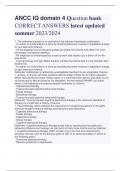
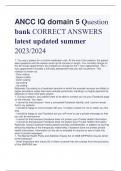
ANCC IQ domain 4 Question bank CORRECT ANSWERS latest updated summer 2023/2024 1. The following scenario is an example of the defense mechanism sublimation: - A mother of a child killed in a drive-by shooting becomes involved in legislative change for gun laws and violence. - A host despises one of the party guests yet greets him warmly and offers him food, beverages, and special attention. - An employee is embarrassed by a boss at work and angrily cuts a driver off on the way home. - A group therapy strongly dislike another member but claims that it is the member who dislikes her. - A mother of a child killed in a drive-by shooting becomes involved in legislative change for gun laws and violence. Rationale: Sublimation is redirecting unacceptable feelings into an acceptable channel. 1. Johnny, an 8-year-old male, presents with his foster mother for an initial evaluation. When interviewing the foster mother alone, it is confirmed that Johnny was taken out of his home due to sexual abuse by his stepfather. As the treating PMHNP, you know which of the following are evidence-based treatments for Johnny: - Interpersonal therapy - Trauma focused cognitive behavioral therapy - Family therapy - Behavioral therapy - Trauma focused cognitive behavioral therapy Rationale: Trauma focused cognitive behavioral therapy is the minimum standard of therapy for a child with a history of trauma. 1. Psychotherapy which stresses the importance of recognizing patterns of thoughts and how thought influence feelings and behaviors best describes: - Cognitive behavioral therapy - Family therapy - Supportive therapy - Group therapy - Cognitive behavioral therapy Rationale: Cognitive behavioral therapy posits that by learning how thoughts and behaviors influence our feelings, we can learn to have more control over our feelings. 1. Cognitive behavioral therapy (CBT) is often one of the first-line treatments for anorexia nervosa. One of the primary goals of CBT is to assist the patient in which of the following ways? - Overcome distorted thinking - Resolve symptoms of depression - Restore weight above 85% of normal - Improve interpersonal relationships - Overcome distorted thinking Rationale: CBT teaches patients to identify, evaluate, and respond to their dysfunctional thoughts and beliefs. 1. In co-leading a group of elementary children divorcing parents, a child shared that his parents were arguing over the weekend and calling each other names. What is the most appropriate intervention at this juncture? - Ask the child how he was affected by the incident and ask other children how they handle similar situations. - Ask the child how he was affected by the incident and facilitate sharing of similar incidents by other children - Ask the other children in the group if they experienced similar situations and how they handled their feelings - Allow the child to finish describing the situation and then ask how he felt about hearing this argument - Ask the child how he was affected by the incident and ask other children how they handle similar situations Rationale: Self-disclosure: Use judgment as to the appropriateness of letting a child go into detail about personal matters in a group. In an elementary school group, you may not want to let a child go into detail about a parental fight. An important intervention is directing the child to express how he was affected by the incident. Children commonly think that they are the cause of parental fights; dispelling this usually erroneous belief is important for the group to address. It would not be helpful to invite other children to disclose details about parental fights, however facilitating sharing of similar feelings, thoughts, and coping strategies by the other children can be one means to help the entire group recognize that they are not responsible for their parents’ arguments, behaviors, thoughts, or feelings. 1. Attachment relationships between infant and mother are considered critical by neurobehavioral researchers because: - Interaction influences development of the brain's limbic system - Attachment to significant relationships facilitates self-regulation of emotions. - Subtle emotional regulatory interactions can transiently or permanently alter brain activity levels - The mother functions as a regulator of the social and emotional environment - Attachment to significant relationships facilitates self-regulation of emotions Rationale: While all of these statements are true, it is through attachment to significant relationships (e.g., mother, father, caregiver) that the young child begins to find ways for regulating and expressing emotions. Self-regulation of emotions is an emotional skill that continues to develop throughout childhood and into adolescence. 1. The literature on group outcomes has revealed that negative group outcomes have been associated with which of the following qualities in group leaders? - Leaders who initiate discussions of feelings - Leaders who reveal too much of their personal experiences - Leaders who are overly confrontational - Leaders with a timid interpersonal style - Leaders who are overly confrontational Rationale: Corey & Corey (2002) acknowledge that forging an effective group requires an appropriate balance between support and challenge. Groups that have either explicit or implicit norms limiting group interactions to supportive ones do not have the power to help people challenge themselves to take significant risks. In contrast, groups that stress confrontation as a requisite for “peeling away the defensive maneuvers of members” are characterized by hostile and increasingly defensive interactions. The reviews of research that describe negative outcomes in group work consistently cite that aggressive confrontation as the leadership style with highest risks. While self-disclosure by a group leader needs to be thoughtful in purpose and timing, in and of itself, it is not associated with negative group outcomes. 1. Which of the following brief intervention statements incorporates the key elements of motivational interviewing to reduce risk related to binge drinking at a college campus? - Mary, you know the risk of STDS from unprotected sex and you know what happens when you drink at frat parties. I can provide free condoms, but the real situation is getting you to cut back on your drinking. Let's discuss some ways to cut back that will work for you. - John, you we
Escuela, estudio y materia
- Institución
- ANCC IQ
- Grado
- ANCC IQ
Información del documento
- Subido en
- 8 de febrero de 2024
- Número de páginas
- 10
- Escrito en
- 2023/2024
- Tipo
- Examen
- Contiene
- Preguntas y respuestas
Temas
-
ancc iq domain 4 question bank correct answ
-
ancc iq domain 4 question bank correct answers la

Documento también disponible en un lote