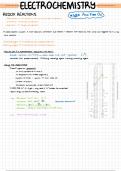
ELECTROCHEMISTRY
REDOX REACTIONS
Redox
reaction
- - A
r eac tion
involving the transfer of
e lectrons
Ano Free Ox
Oxidation - The loss of electrons
Reduction - The
gain o felectrons
A
redox reaction involves I half-reactions (oxidation half-reaction reduction
+
half-reaction) that
when
together
put form a net
ionic reaction
Oxidising agent to a
s ubstance that
accepts electrons
Reducing agent
-> A
substance that donates electrons
How to tell if
a spontaneous reaction will occur:
simple:line from LASERIS have
gradient(P)
I
on redox table must
complex (for proper answers) -
Strong reducing agent strong oxidising agent
+
the redox table:
Using
·
Place fingers on reactants
we re
(if iconic compound ->ions)
(if polyatomic ion ke e p
together) ⑧
(acids -Dionise... put on H and other;o n
(metal atom)
(molecular compounds - break
don't up) 0
·CHECK FOR HT- if
yes
-
only if
react I presentlie acidified)
·
See if they will react
spontaneously
Almetal +
Nitions - v
e.g.
Oxidation: 2Al-A23+ Balance electrons!!
Reduction: 3Ni2t+R --
3Ni
Netionic:2A(s) + 3 Nitag) -
2Al3 3 Ni
+
⑧
Gold metal and silver nitrate
e.g.
, -mea
GALVANIC CELLS
Indirecttransfer of electrons Naee
Anode - the electrode where oxidation takes place
cathode - the electrode where reduction takes place
Electrolyte substance that
can conduct
electricity by forming free ions when molten or dissolved in a solution
InGagi- ~me
wasessence
gasciecrof a
-
an ode cathode
azbridgelmembrane
: ... AND
generates elec
.
mini
·
......i
ions
I
anode is oxidation ->
ereleased -> travel in wire to cathode - reduction -> ions used up Lions - - - salt
bridge)
electrodes will be in
electrolyte has
that their ion equin CuSUn, In in InsOn
un
usually SOn/NOs
- thatcan't
something acidified
reac t
unless
SALT
THE BRIDGE
content:saturated solution of
electrolyte eg KNOz, NaNO3, K(e...
e
both that
Purpose:maintain electrical
neutrality in half-cells r each
won't
complete the circuit
-Be-DO NOT TRAVEL THROUGH SALT BRIDGE
(ifcations form from half-reaction, flow out)
move into salt
bridgetanions
(if half-reaction, anions flow flow
cations used up
in into salt
bridgetcations out)
wider, shorter, more conductive - lower internal resistance higher max current
CELL NOTATION
*
if diffphases -
I
ifsame phases
-,
*
salt bridge
*
to II
anode
*
on left, cathode on
right (solids on outside)
O NLY if asked phases in brackets
(aq, Imoldm -3)
* -
~ - (g,1atm)
a
standard conditions at
end -> (at 25°)
s
If
* I
thing btwn electrode salt bridge of
write in order in ionic reaction
+
they appear net
e.g. Zncsl ZnLaq, (ma.dm) II (n(aq, (mol.dm-3) (cuCs(
CELL POTENTIAL [ions] Imol.dm-3
=
pressure latm
=
emf values on table are
redox under standard conditions temperature:25°C
calculating standard emf:
Ecel:Ecathode -
EPanode -
always LOV for
spontaneous
(SHE)
HYDROGEN ELECTRODE
STANDARD
IEB
- used as reference electrode
-> connected as anode (CHS in
diagram"cell notation) (EPanode OV) (voltmeter
= --
terminall
↳Dif this is ONLY show in half-reactions ionic
not
reality, truth thet
CURRENT+POTENTIAL - RATE+EQUILIBRIUM
↑
rate... current
(bc:T Te produced current)
I
--
current rate brate... I current rate... at anode...
temp:current
constant --
potential difference
v equilibrium
=
position
I =>
rates
REDOX REACTIONS
Redox
reaction
- - A
r eac tion
involving the transfer of
e lectrons
Ano Free Ox
Oxidation - The loss of electrons
Reduction - The
gain o felectrons
A
redox reaction involves I half-reactions (oxidation half-reaction reduction
+
half-reaction) that
when
together
put form a net
ionic reaction
Oxidising agent to a
s ubstance that
accepts electrons
Reducing agent
-> A
substance that donates electrons
How to tell if
a spontaneous reaction will occur:
simple:line from LASERIS have
gradient(P)
I
on redox table must
complex (for proper answers) -
Strong reducing agent strong oxidising agent
+
the redox table:
Using
·
Place fingers on reactants
we re
(if iconic compound ->ions)
(if polyatomic ion ke e p
together) ⑧
(acids -Dionise... put on H and other;o n
(metal atom)
(molecular compounds - break
don't up) 0
·CHECK FOR HT- if
yes
-
only if
react I presentlie acidified)
·
See if they will react
spontaneously
Almetal +
Nitions - v
e.g.
Oxidation: 2Al-A23+ Balance electrons!!
Reduction: 3Ni2t+R --
3Ni
Netionic:2A(s) + 3 Nitag) -
2Al3 3 Ni
+
⑧
Gold metal and silver nitrate
e.g.
, -mea
GALVANIC CELLS
Indirecttransfer of electrons Naee
Anode - the electrode where oxidation takes place
cathode - the electrode where reduction takes place
Electrolyte substance that
can conduct
electricity by forming free ions when molten or dissolved in a solution
InGagi- ~me
wasessence
gasciecrof a
-
an ode cathode
azbridgelmembrane
: ... AND
generates elec
.
mini
·
......i
ions
I
anode is oxidation ->
ereleased -> travel in wire to cathode - reduction -> ions used up Lions - - - salt
bridge)
electrodes will be in
electrolyte has
that their ion equin CuSUn, In in InsOn
un
usually SOn/NOs
- thatcan't
something acidified
reac t
unless
SALT
THE BRIDGE
content:saturated solution of
electrolyte eg KNOz, NaNO3, K(e...
e
both that
Purpose:maintain electrical
neutrality in half-cells r each
won't
complete the circuit
-Be-DO NOT TRAVEL THROUGH SALT BRIDGE
(ifcations form from half-reaction, flow out)
move into salt
bridgetanions
(if half-reaction, anions flow flow
cations used up
in into salt
bridgetcations out)
wider, shorter, more conductive - lower internal resistance higher max current
CELL NOTATION
*
if diffphases -
I
ifsame phases
-,
*
salt bridge
*
to II
anode
*
on left, cathode on
right (solids on outside)
O NLY if asked phases in brackets
(aq, Imoldm -3)
* -
~ - (g,1atm)
a
standard conditions at
end -> (at 25°)
s
If
* I
thing btwn electrode salt bridge of
write in order in ionic reaction
+
they appear net
e.g. Zncsl ZnLaq, (ma.dm) II (n(aq, (mol.dm-3) (cuCs(
CELL POTENTIAL [ions] Imol.dm-3
=
pressure latm
=
emf values on table are
redox under standard conditions temperature:25°C
calculating standard emf:
Ecel:Ecathode -
EPanode -
always LOV for
spontaneous
(SHE)
HYDROGEN ELECTRODE
STANDARD
IEB
- used as reference electrode
-> connected as anode (CHS in
diagram"cell notation) (EPanode OV) (voltmeter
= --
terminall
↳Dif this is ONLY show in half-reactions ionic
not
reality, truth thet
CURRENT+POTENTIAL - RATE+EQUILIBRIUM
↑
rate... current
(bc:T Te produced current)
I
--
current rate brate... I current rate... at anode...
temp:current
constant --
potential difference
v equilibrium
=
position
I =>
rates