PCCN Renal 2023 Questions and Answers
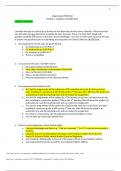
GFR, a good indication of renal function, equals about 180 liters/day or about 125 mL/minute and is a calculated number by many critical care team members to dose drugs. GFR is an excellent measure of current renal function. Renal assessment includes: a. Glomerular filtration rate (GFR) b. Creatinine c. Urine output for 24 hours d. All of the above d. All of the above The best measure of current renal function is to measure 24-hour urine formation, GFR and creatinine. These three focus on the kidney's ability to filter, absorb and secrete. This information is found in he RIFLE study. Blood-urea- nitrogen (BUN) is a reflection of: a. Hydration, catabolic state and presence of blood in the gut b. Hydration, liver function and renal clearance c. Renal absorption of sodium, total parenteral nutrition (TPN) and disseminated intravascular coagulation (DIC) d. Renal excretion of potassium, liver failure and fluid over load a. Hydration, catabolic state and presence of blood in the gut BUN is a reflection of the intravascular volume states of the patient- if intravascularly dehydrated; the BUN will rise without creatinine elevation. If the patient has not had enough protein in the diet, the patient will break down their muscle to make protein and that will release nitrogen in the blood, elevating BUN. Free blood in the gut (GI bleed) will also break down to protein and elevate BUN The RIFLE criteria includes the risk of renal injury. List the criteria for determining renal risk, injury and failure: a. Creatinine, urine output and glomerular filtration rate (GFR) b. Creatinine, blood pressure and heart rate c. Blood pressure, pulse pressure and glomerular filtration rate (GFR) d. Blood pressure, glomerular filtration rate (GFR) and urine output. a. Creatinine, urine output and glomerular filtration rate (GFR) Creatinine, urine output and GFR are the major criteria for the assessment of current renal function according to the RIFLE study. Looking at creatinine alone does not reflect the current status of renal function. Strategies to prevent acute kidney injury include: a. Limiting dehydration b. Limiting and correct hypotension c. Limiting exposure to nephrotoxins d. All of the above d. All of the above Excellent strategies for protecting renal function include: limiting intravascular dehydration, limiting and correcting hypotension and most commonly limiting exposure to nephrotoxins-pharmacokinetic therapy for patients on nephrotoxic drugs, renal protection for those receiving contrast dye would also be included in this function. Preventive measures for the onset of acute kidney injury include: a. Intravenous isotonic hydration before nephrotoxins are administered b. Maintenance of adequate mean arterial pressure (MAP) c. Use of N-acetylcysteine for renal protection d. All of the above d. All of the above Renal protection includes: intravenous (IV) hydration before administering nephrotoxins, such as intravenous contrast dye. Maintenance of an adequate MAP to perfuse the kidneys, use of drugs to further protect the kidneys; the use of N-acetylcysteine before IV contrast dye (this is na oxygen radical scavenger that protects the nephrons from injury that occurs with IV contrast dye). Pre renal failure is caused byL a. Poor cardiac output b. Poor volume status c. Renal artery stenosis d. All of the above d. All of the above The three main causes of pre-renal failure are: poor cardiac function, poor volume status, and renal artery stenosis. All three prevent blood from reaching the kidneys. In oliguric phase of acute renal failure, the urine output a. Is less than 400 mL/24 hours b. Is greater than 500 mL/24 hours c. Totally ceases d. Is not measured a. Is less than 400 mL/24 hours This is the marker of oliguria to the neurologist. If the urine output is less than 400 mL/24 hours, the patient is said to be oliguric. In the diuretic phase of renal failure: a. Urine output does not change b. Oxygenation becomes worse c. Urine output slowly increases d. Electrolytes improve c. Urine output slowly increases In this phase of acute renal failure, urine output begins to improve and the mortality of the patient also improves. The electrolytes are still abnormal and the patient remains with a metabolic acidosis. The oxygenation of the patient should improve since the patient is eliminating extra fluid. In the recovery phase of acute renal failure, the: a. Patient is completely well b. Urine output is normal c. Patient still has a mortality of over 50% d. BUN/Creatinine ration is completely normal b. Urine output is normal Although the patient now has normal urine output, electrolytes may still be abnormal and need to be corrected and watched carefully. The patient's mortality decreases and the BUN/Creatinine ration may still be abnormal due to electrolyte dysfunction. The recovery phase may take 3-12 months.
Escuela, estudio y materia
- Institución
- PCCN
- Grado
- PCCN
Información del documento
- Subido en
- 5 de febrero de 2024
- Número de páginas
- 17
- Escrito en
- 2023/2024
- Tipo
- Examen
- Contiene
- Preguntas y respuestas
Temas
-
pccn renal 2023
-
pccn renal 2023 questions and answers
-
pccn renal 2023 questions and answers