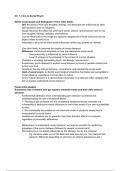
Ch. 1- Intro to Social Psych
Define social psych and distinguish it from other fields.
- Def: the study of how ppl’s thoughts, feelings, and behaviors are influenced by other
ppl’s presence (real or imagined)
- Social influence: the effect that other ppl’s words, actions, and presence have on our
own thoughts, feelings, attitudes, and behavior
- Can be influenced by the imaginary approval/ disapproval of loved ones and how we
expect others to react to us
- Interested in what we do when social influences conflict (eg. parents vs. friends)
- Like other fields, it examines the causes of human behavior
- Difference: social psych emphasis on how ppl interpret the social world
- How personality is influenced by social influence
- Level of analysis is the individual in the context of a social situation
- Overlaps w sociology, personality psych, and biology/ neuroscience
- Evolutionary psych attempts to explain social behavior in terms of genetics factors that
evolve over time
- Construal: the way that ppl perceive, comprehend, and interpret the social world
- Goal of social psych: to identify psychological properties that makes ppl susceptible to
social influence, regardless of social class or culture
- Cross cultural research is to demonstrate universality or to discover other variables that
lets us predict/ understand human behavior
Power of the situation
Summarize why it matters how ppl explain/ interpret events and their own/ others’s
behavior
- Fundamental attribution error: overestimating ppl’s behavior as internal and
underestimating the role of situational factors
- 1. Thinking of ppl as flawed and not considering situational factors increases our
vulnerability to destructive social influences bc we’re less aware of our own susceptibility
to them
- 2. We oversimplify the problem so we blame the victim in situations where they’re
overpowered by social forces
- social/enviro situations are so powerful, they have dramatic effects on everyone
regardless of personality differences
- Behaviorism: to understand human behavior, we need to consider the reinforcing
properties of the enviro (behavior followed by reward vs punishment)
- Ppl’s behavior is not directly influenced by the situation, but by the construal
- Eg. someone slaps you on the back and asks how are you. You interpret that
behavior differently depending on who they are (friend, salesperson, etc.)
, - Gestalt psychology: the importance of studying how an object appears in ppl’s mind
objectively rather than the objective attributes of the object (eg. duck/ rabbit illusion.
Which one do you see first? We are construing it)
- More important to understand how ppl interpret each other’s behavior rather than to
understand its objective properties
- Eg. we should trust that the ceiling will not fall down in general not bc we need it
to be determined by engineers
- The importance of how ppl construe their enviro:
- Ppl react to what they think the other person is thinking/ feeling
- We’re so busy guessing motives and thoughts but we’re usually wrong
- Naive realism: perceiving things as they rly are, underestimating how much we’re
spinning what we see
- Eg. each political side thinks they’re seeing issues clearly and that the other side
is biased
Construals: basic human motives
Explain what happens when ppl’s need to feel good abt themselves conflict w the need
for accuracy
- 2 motives in steering our construals: the need to feel good abt ourselves and the need
for accuracy
- Sometimes, this pulls us in opposite directions where to accurately perceive the world,
we need to admit that we’ve behaved foolishly/ immorally
- But Festinger says this is how we gain our most valuable insights
- Ppl usually prefer feeling good abt themselves over accuracy. They put themselves in
the best possible light so they do things paradoxically
- Self esteem is good but when they justify their bad actions instead of learning from them,
it impedes change and self improvement
- That’s why some ppl prefer suffering instead of ease/ pleasure (eg. Oscar frat example)
- Social cognition: how ppl think abt themselves and use social info to make judgments/
decisions
- We aren’t perfect in interpreting situations
- Eg. granola oat cereal has more fat than Lucky Charms even if we don’t think so
Explain why studying social psych is important
- Bc we’re curious abt how we’re influenced
- Bc we contribute to the solution of social problems (we work to resolve conflicts within
groups, raise children’s intelligence, etc)
Ch. 2- Methodology– how social psychologists do research
How do researchers dev hypotheses and theories.
- Hindsight bias: tendency for ppl to exaggerate how they could’ve predicted it after
knowing that it occurred
, - Inspiration from previous theories and research
- Unhappy w previous theories, revises it, and new hypotheses are formed
- Hypotheses based on personal observations
- Eg. diffusion of responsibility: think someone else will help so they don’t help
- Collects data to test hypotheses
Compare strengths and weaknesses of research designs.
- Observational method: observe ppl and record impressions of their behavior
- Ethnography: trying to understand a culture by observing it from the inside
- Goal: avoid imposing preconceived notions and try to understand the
POV of the ppl being studied
- Must use 2+ judges to ensure observations are not subjective
- Archival analysis: accumulated documents of a culture (diaries, novels)
- Limits: we don’t know the reason behind the behavior, some behaviors are
difficult to observe bc they’re rare or only occur in private
- Correlational method: a technique for predicting 1 variable from another (eg. how well
we can predict ppl’s weight from their height)
- 2 variables are measured and the relationship between them is assessed
- Calculate correlation coefficient
- Closer it is to 1 = the stronger the relationship (height and weight correlation is
0.7)
- Negative correlation: increasing 1 variable means decreasing the other variable
- Surveys: analyze surveys
- Can judge the relationship between variables that are difficult to observe
- Can sample representative segments of the population
- Use random selection for representation
- Limits: correlation does not equal causation
- Tells us that 2 variables are related, but doesn’t identify the causes of the
behavior (can’t say A causes B. Can only say, A is correlated with B)
- Causal relationship can have no correlation and be caused by a 3rd
variable
- Experimental method: randomly assign participants to diff conditions that are all the
sam except for the IV
- The only method to determine causal relationships
- IV: the variable a researcher changes to see if it has an effect on the other variable
- DV: the variable the researcher measures. To see if it’s influenced by the IV
- 1 important determinant of whether ppl helped: # of bystanders they think are present
- Internal validity in experiments: make sure everything abt the situation is the same
amongst all conditions except for the IV (eg. # of bystanders)
- Random assignment to condition: all participants have an equal chance of taking
part in the experiment. Personality differences and bg can be distributed evenly
across conditions
Define social psych and distinguish it from other fields.
- Def: the study of how ppl’s thoughts, feelings, and behaviors are influenced by other
ppl’s presence (real or imagined)
- Social influence: the effect that other ppl’s words, actions, and presence have on our
own thoughts, feelings, attitudes, and behavior
- Can be influenced by the imaginary approval/ disapproval of loved ones and how we
expect others to react to us
- Interested in what we do when social influences conflict (eg. parents vs. friends)
- Like other fields, it examines the causes of human behavior
- Difference: social psych emphasis on how ppl interpret the social world
- How personality is influenced by social influence
- Level of analysis is the individual in the context of a social situation
- Overlaps w sociology, personality psych, and biology/ neuroscience
- Evolutionary psych attempts to explain social behavior in terms of genetics factors that
evolve over time
- Construal: the way that ppl perceive, comprehend, and interpret the social world
- Goal of social psych: to identify psychological properties that makes ppl susceptible to
social influence, regardless of social class or culture
- Cross cultural research is to demonstrate universality or to discover other variables that
lets us predict/ understand human behavior
Power of the situation
Summarize why it matters how ppl explain/ interpret events and their own/ others’s
behavior
- Fundamental attribution error: overestimating ppl’s behavior as internal and
underestimating the role of situational factors
- 1. Thinking of ppl as flawed and not considering situational factors increases our
vulnerability to destructive social influences bc we’re less aware of our own susceptibility
to them
- 2. We oversimplify the problem so we blame the victim in situations where they’re
overpowered by social forces
- social/enviro situations are so powerful, they have dramatic effects on everyone
regardless of personality differences
- Behaviorism: to understand human behavior, we need to consider the reinforcing
properties of the enviro (behavior followed by reward vs punishment)
- Ppl’s behavior is not directly influenced by the situation, but by the construal
- Eg. someone slaps you on the back and asks how are you. You interpret that
behavior differently depending on who they are (friend, salesperson, etc.)
, - Gestalt psychology: the importance of studying how an object appears in ppl’s mind
objectively rather than the objective attributes of the object (eg. duck/ rabbit illusion.
Which one do you see first? We are construing it)
- More important to understand how ppl interpret each other’s behavior rather than to
understand its objective properties
- Eg. we should trust that the ceiling will not fall down in general not bc we need it
to be determined by engineers
- The importance of how ppl construe their enviro:
- Ppl react to what they think the other person is thinking/ feeling
- We’re so busy guessing motives and thoughts but we’re usually wrong
- Naive realism: perceiving things as they rly are, underestimating how much we’re
spinning what we see
- Eg. each political side thinks they’re seeing issues clearly and that the other side
is biased
Construals: basic human motives
Explain what happens when ppl’s need to feel good abt themselves conflict w the need
for accuracy
- 2 motives in steering our construals: the need to feel good abt ourselves and the need
for accuracy
- Sometimes, this pulls us in opposite directions where to accurately perceive the world,
we need to admit that we’ve behaved foolishly/ immorally
- But Festinger says this is how we gain our most valuable insights
- Ppl usually prefer feeling good abt themselves over accuracy. They put themselves in
the best possible light so they do things paradoxically
- Self esteem is good but when they justify their bad actions instead of learning from them,
it impedes change and self improvement
- That’s why some ppl prefer suffering instead of ease/ pleasure (eg. Oscar frat example)
- Social cognition: how ppl think abt themselves and use social info to make judgments/
decisions
- We aren’t perfect in interpreting situations
- Eg. granola oat cereal has more fat than Lucky Charms even if we don’t think so
Explain why studying social psych is important
- Bc we’re curious abt how we’re influenced
- Bc we contribute to the solution of social problems (we work to resolve conflicts within
groups, raise children’s intelligence, etc)
Ch. 2- Methodology– how social psychologists do research
How do researchers dev hypotheses and theories.
- Hindsight bias: tendency for ppl to exaggerate how they could’ve predicted it after
knowing that it occurred
, - Inspiration from previous theories and research
- Unhappy w previous theories, revises it, and new hypotheses are formed
- Hypotheses based on personal observations
- Eg. diffusion of responsibility: think someone else will help so they don’t help
- Collects data to test hypotheses
Compare strengths and weaknesses of research designs.
- Observational method: observe ppl and record impressions of their behavior
- Ethnography: trying to understand a culture by observing it from the inside
- Goal: avoid imposing preconceived notions and try to understand the
POV of the ppl being studied
- Must use 2+ judges to ensure observations are not subjective
- Archival analysis: accumulated documents of a culture (diaries, novels)
- Limits: we don’t know the reason behind the behavior, some behaviors are
difficult to observe bc they’re rare or only occur in private
- Correlational method: a technique for predicting 1 variable from another (eg. how well
we can predict ppl’s weight from their height)
- 2 variables are measured and the relationship between them is assessed
- Calculate correlation coefficient
- Closer it is to 1 = the stronger the relationship (height and weight correlation is
0.7)
- Negative correlation: increasing 1 variable means decreasing the other variable
- Surveys: analyze surveys
- Can judge the relationship between variables that are difficult to observe
- Can sample representative segments of the population
- Use random selection for representation
- Limits: correlation does not equal causation
- Tells us that 2 variables are related, but doesn’t identify the causes of the
behavior (can’t say A causes B. Can only say, A is correlated with B)
- Causal relationship can have no correlation and be caused by a 3rd
variable
- Experimental method: randomly assign participants to diff conditions that are all the
sam except for the IV
- The only method to determine causal relationships
- IV: the variable a researcher changes to see if it has an effect on the other variable
- DV: the variable the researcher measures. To see if it’s influenced by the IV
- 1 important determinant of whether ppl helped: # of bystanders they think are present
- Internal validity in experiments: make sure everything abt the situation is the same
amongst all conditions except for the IV (eg. # of bystanders)
- Random assignment to condition: all participants have an equal chance of taking
part in the experiment. Personality differences and bg can be distributed evenly
across conditions