Child Development; Children with Exceptionalities ALL Chapters| Complete Guide Newest Version
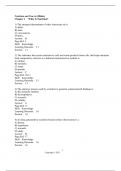
1. Legally recognized categories of exceptionality are defined by a. the Individuals with Disabilities Education Improvement Act (IDEA). b. the laws of individual states. c. No Child Left Behind (NCLB). d. the Council for Exceptional Children (CEC). ANSWER: a POINTS: 1 REFERENCES: The Child with Exceptionalities: An Overview LEARNING OBJECTIVES: EDUC.KIRK.14.01.01 - Who is the child with exceptionalities? KEYWORDS: Blooms: Remembering 2. Which of the following exceptionalities does NOT have its own defined category under IDEA, 2004? a. Autism b. ADHD c. Traumatic Brain Injury d. Emotional Disturbance ANSWER: b POINTS: 1 REFERENCES: The Child with Exceptionalities: An Overview LEARNING OBJECTIVES: EDUC.KIRK.14.01.01 - Who is the child with exceptionalities? KEYWORDS: Blooms: Understanding 3. Children with are the only exceptional children not covered under federal legislation. ANSWER: special gifts and talents POINTS: 1 REFERENCES: The Child with Exceptionalities: An Overview LEARNING OBJECTIVES: EDUC.KIRK.14.01.01 - Who is the child with exceptionalities? KEYWORDS: Blooms: Remembering 4. From an educator's point of view, identification of a student as exceptional is necessary when the student a. has an obvious interindividual difference. b. has an obvious intraindividual difference. c. requires special adaptations in the educational program. d. has a parent who wants services. ANSWER: c POINTS: 1 REFERENCES: The Child With Exceptionalities: An Overview LEARNING OBJECTIVES: EDUC.KIRK.14.01.01 - Who is the child with exceptionalities? KEYWORDS: Blooms: Understanding lOMoARcPSD| 5. In defining the term children with exceptionalities, which characteristic is most central? a. The child deviates from the normal population in intellectual ability. b. The child is from a lower socioeconomic background. c. The child shows evidence of multiple disabilities. d. The child's deviation is extensive enough to warrant modification of educational services or practices. ANSWER: d POINTS: 1 REFERENCES: The Child with Exceptionalities: An Overview LEARNING OBJECTIVES: EDUC.KIRK.14.01.01 - Who is the child with exceptionalities? KEYWORDS: Blooms: Understanding 6. Intraindividual differences a. consider how a child compares to other children. b. are not useful in developing individual plans of instruction. c. are the differences in abilities within the same child. d. are stable as the child ages. ANSWER: c POINTS: 1 REFERENCES: The Child with Exceptionalities: An Overview LEARNING OBJECTIVES: EDUC.KIRK.14.01.01 - Who is the child with exceptionalities? KEYWORDS: Blooms: Understanding 7. Shannon, who is 10 years old, has the intelligence of a 12-year-old and the social behavior of a 8-year-old. This discrepancy is referred to by the authors of your text as an a. aberration. b. anomaly. c. interindividual difference. d. intraindividual difference. ANSWER: d POINTS: 1 REFERENCES: The Child with Exceptionalities: An Overview LEARNING OBJECTIVES: EDUC.KIRK.14.01.01 - Who is the child with exceptionalities? KEYWORDS: Blooms: Understanding lOMoARcPSD|
Libro relacionado
- 2013
- 9780133112153
- Desconocido
Escuela, estudio y materia
- Institución
- Child Development; Children with Exception
- Grado
- Child Development; Children with Exception
Información del documento
- Subido en
- 3 de febrero de 2024
- Número de páginas
- 238
- Escrito en
- 2023/2024
- Tipo
- Examen
- Contiene
- Preguntas y respuestas
Temas
-
siittyy child development children with exception
-
1 legally recognized categories of exceptionality
-
2 which of the following exceptionalities does no
-
3 children with are the only exceptional children