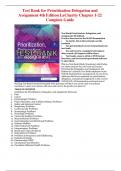
Test Bank Prioritization, Delegation, and Assignment 4th Edition. Practice Exercises for the NCLEX Examination • To clarify, this is the test bank, not the textbook. • You get immediate access to download your test bank. • You will receive a complete test bank; in other words, all chapters will be there. • Test banks come in ePub or PDF format; therefore, you do not need specialized software to open them. This is a Test Bank (Study Questions) which helps you better prepare for your tests and exams. Prioritization Delegation and Assignment 4th Edition by LaCh arity Test Bank emphasis on the NCLEX Examination’s management -of-care focus addresses the heavy emphasis on prioritization, delegation, and patient assignment in the current NCLEX -RN¬Æ Examination and much more! Nursing Test Bank Download instantly after purchase will have you on the road to academic excellence to pass your classes with ease and receive the grades you deserve! TABLE OF CONTENTS Guidelines for Prioritization, Delegation, and Assignment Decisions 1. Pain 2. Cancer 3. Immunologic Problems 4. Fluid, Elect rolyte, and Acid -Base Balance Problems 5. Safety and Infection Control 6. Respiratory Problems 7. Cardiovascular Problems 8. Hematologic Problems 9. Neurologic Problems 10. Visual and Auditory Problems 11. Musculoskeletal Problems 12. Gastrointestinal and Nutritional Problems 13. Diabet es Mellitus 14. Other Endocrine Problems 15. Integumentary Problems 16. Renal and Urinary Problems 17. Reproductive Problems 18. Problems in Pregnancy and Childbearing 19. Pediatric Problems 20. Pharmacology NEW! 21. Emergencies and Disasters 22. Psychiatric‚ÄìMental Health Problems ... Prioritization Delegation and Assignment 4th Edition LaCharity Test Bank Chapter 1. Pain MULTIPLE CHOICE 1.A client tells the nurse that she rarely experiences pain, but when she does, she seeks medical attention. The nurse realizes this client understands that pain is important because it: 1. is a protective system. 2. includes the automatic withdrawal reflex. 3. creates sensitivity to pain. 4. helps with healing. ANS: 1 Pain is a protective system that includes protection from unsafe behaviors by use of reflexes, memory, and avoidance. Even though the automatic withdrawal reflex is a part of the pain response, it does not explain why pain is important. Pain does not creat e sensitivity to pain. Pain does not help with healing. PTS: 1 DIF: Analyze REF: Definitions and Implications of Pain 2.A client complains that the bed sheets touching his skin are extremely painful. The nurse realizes this client is experiencing: 1. allodynia. 2. modulation. 3. kinesthesia. 4. proprioception. ANS: 1 Allodynia or hyperalgesia is a state where a slight or nonpainful stimulus is interpreted as very painful. Kinesthesia is the awareness of movement. Proprioception is the awareness of body position. Modulation is an influencing factor in the perception of pain. PTS: 1 DIF: Analyze REF: Peripheral Nervous System 3.A client is complaining of severe abdom en pain. The nurse realizes this client is experiencing which type of pain? 1. Neuralgia 2. Pathological 3. Somatic 4. Visceral ANS: 4 Visceral pain is pain arising from the body organs or gastrointestinal tract. Somatic pain is pain that originates from the bone, joints, muscles, skin, or connective pain. Neuralgia and pathological pain are both types of pain that result from injury to a nerve or malfunction of the neuronal transmission process or due to impaired regulation. PTS:1DIF:AnalyzeREF:Types of Pain 4.A client, diagnosed with acute appendicitis, is experiencing abdominal pain. The best way for the nurse to describe this clients pain would be: 1. chronic. 2. neuropathic. 3. referred. 4. acute. ANS: 4 Acute pain onset is sudden and of short duration. Chronic pain is a sudden or slow onset of mild to severe pain that lasts longer than 6 months. Referred pain is the result of the transfer of visceral pain sensations to a body surface at a distance from the actual origin. Neuropathic pain is paroxysmal pain that occurs along the branches of a nerve. PTS:1DIF:ApplyREF:Types of Pain 5.A client is observed holding a pillow over the abdominal region with both knees flexed in a side-lying position. Vital signs assessment reveals an elevated blood pressure and heart rate. Which of the following should the nurse say to this client? 1. Can I get you anything? 2. Would you like something for pain? 3. You look comfortable. 4. Your blood pressure is up. ANS: 2 Sympathetic responses to pain include elevated blood pressure and heart rate. And since the client is hugging a pillow over the abdominal region with both knees flexed in a side -lying position, the best thing for the nurse to say to this client is Would you like something for pain? The other responses are incorrect because they do not acknowledge that the client is experiencing pain. PTS: 1 DIF: Apply REF: Assessing the Clinical Manifestations of Pain 6.A client experiencing chronic pain asks the nurse why she is not prescribed Demerol like she received when she had a total knee rep lacement. Which of the following should the nurse respond to this client? 1. You dont need something that strong. 2. That medication does not exist anymore. 3. That medication does not last very long. 4. It can cause you have high blood pressure. ANS: 3 Meperidine is no longer a major drug for acute or chronic pain due to its short analgesic duration of 2 to 3 hours and the potential for accumulative toxic effects of its metabolite, normeperidine. The best response for the nurse to m ake to the client would be that medication does not last very long. The other responses are inaccurate. PTS:1DIF:ApplyREF:Opioid Analgesics 7.A client is informed that a tricyclic antidepressant medication is going to help control his chronic pain. The nurse would expect the physician to prescribe: 1. Amitriptyline. 2. Baclofen. 3. Gabapentin. 4. Diazepam. ANS: 1 Amitriptyline is an antidepressant. Gabapentin is an anticonvulsant. Baclofen is a muscle relaxant. Diazepam is a benzodiazepine. PTS: 1 DIF: Analyze REF: Adjuvant Medications 8.A client receiving around -the-clock medication for terminal cancer experiences additional pain when performing activities of daily living. The nurse realizes this client is experiencing: 1. breakthrough pain. 2. intractable pain. 3. psychosomatic pain. 4. acute pain. ANS: 1 Breakthrough pain is commonly seen in the advanced stages of cancer. It is spontaneous, unpredictable, and can be initiated by certain activities such as during activities of daily living. Intractable pain is resistant to some or all forms of therapy. Psychosomatic pain is that which has a psychological origin. The client is diagnosed with te rminal cancer. Acute pain has a sudden onset and resolves within 6 months. PTS:1DIF:AnalyzeREF:Breakthrough Pain 9.A client recovering from surgery tells the nurse that she is nauseated and is experiencing an increase in pain. Which of the following does this clients symptoms suggest to the nurse? 1 . The client is becoming dependent upon the pain medication. 2 . The clients pain threshold is lower when experiencing nausea. 3 . The client is experiencing withdrawal symptoms from pain medication.
Examen
Test Bank Prioritization, Delegation, and Assignment 5th Edition. Practice Exercises for the NCLEX Examination (With A New Update) 2024
Puntuación
Vendido
1
Páginas
147
Grado
A+
Subido en
02-02-2024
Escrito en
2023/2024
Test Bank Prioritization, Delegation, and Assignment 5th Edition. Practice Exercises for the NCLEX Examination////Test Bank Prioritization, Delegation, and Assignment 5th Edition. Practice Exercises for the NCLEX Examination
Institución
Grado
Ups! No podemos cargar tu documento ahora. Inténtalo de nuevo o contacta con soporte.
Libro relacionado
Prioritization, Delegation, and Assignment
- Desconocido
- 9780323683166
- Desconocido
Escuela, estudio y materia
- Institución
- Chamberlain College Of Nursing
- Grado
- Course Prioritization, Delegation 5th Edition
Todos documentos para esta materia (2)
Información del documento
- Subido en
- 2 de febrero de 2024
- Número de páginas
- 147
- Escrito en
- 2023/2024
- Tipo
- Examen
- Contiene
- Preguntas y respuestas
Temas
-
isbn 9780323683166
Vista previa del contenido
$14.50
Accede al documento completo:
100% de satisfacción garantizada
Inmediatamente disponible después del pago
Tanto en línea como en PDF
No estas atado a nada