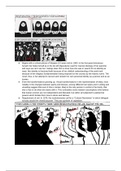
● Begins with a school picture of Marjane (10 years old) in 1980. In the first panel introduces
herself, but hides herself as in the far-left (figuratively used for marxist ideology of her parents)
and says we can’t see her- Satrapi does this to show how she was in search for an identity as
marji. Her identity is fractured both because of her childish understanding of the world and
because of the religious fundamentalism being imposed on the country by the Islamic rulers. The
novel, thus, is her attempt to recount and reclaim her own personal identity as a person and as an
Iranian.
● Even the transformations growing up. Visual transformations in the representation of Marji, most
notably in the changes between pants and dresses, among different hair styles and in veiling and
unveiling suggest that even if she is Iranian, Marji is the only person in control of her body, that
she is free to do what she wants with it. This contradicts some western assumptions who believe
that Iranian women are not independent and liberated, but rather all subjected to patriarchal
powers which dictate them how to dress and behave.
● Requirement of veil. In 1979, the revolutionaries call for a “Cultural Revolution” in which bilingual
schools should be closed because “They are symbols of capitalism.”
herself, but hides herself as in the far-left (figuratively used for marxist ideology of her parents)
and says we can’t see her- Satrapi does this to show how she was in search for an identity as
marji. Her identity is fractured both because of her childish understanding of the world and
because of the religious fundamentalism being imposed on the country by the Islamic rulers. The
novel, thus, is her attempt to recount and reclaim her own personal identity as a person and as an
Iranian.
● Even the transformations growing up. Visual transformations in the representation of Marji, most
notably in the changes between pants and dresses, among different hair styles and in veiling and
unveiling suggest that even if she is Iranian, Marji is the only person in control of her body, that
she is free to do what she wants with it. This contradicts some western assumptions who believe
that Iranian women are not independent and liberated, but rather all subjected to patriarchal
powers which dictate them how to dress and behave.
● Requirement of veil. In 1979, the revolutionaries call for a “Cultural Revolution” in which bilingual
schools should be closed because “They are symbols of capitalism.”