Table of contents
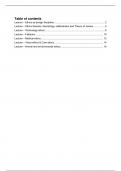
Lecture – Ethics as design discipline .......................................................................... 2
Lecture – Ethics theories: deontology, utilitarianism and Theory of Justice ................ 5
Lecture – Technology ethics ....................................................................................... 8
Lecture – Fallacies ................................................................................................... 10
Lecture – Medical ethics ........................................................................................... 12
Lecture – Virtue ethics & Care ethics........................................................................ 14
Lecture – Animal and environmental ethics .............................................................. 16
,Lecture – Ethics as design discipline
Science, technology, and innovation can help solve problems and be valuable in
many ways – but can also cause (new) problems.
Ethics can be a facilitator or even a driver of research, technology and innovation for
good. This minimally requires prevention of future harm.
For this, theoretical knowledge and practical instruments for and hands-on practice in
moral deliberation are very valuable.
The direct and indirect, intended and unintended influences of
scientists on the moral states of others is large.
Societal needs and problems should be the starting point of science, technology, and
innovation.
Moral values should be placed at the heart of science, technology, and innovation.
Ethics is all about translating values into actions, weighing (different stakeholders’ or
individual actors’) values against each other, and morally justifying one’s judgements
and actions.
Ethics is the practical study of deciding how we ought to act.
• The branch of philosophy that deals with morality and values.
o Systematic reflection on morality (values, norms, beliefs)
o Providing reasons to justify our decisions.
Why ethics? (to overcome human shortcomings?); famous answers:
• Thomas Hobbes
“Because acting in accordance with only our self-interest will lead us into a war of
all against all, and our lives will be brutish, nasty, and short. Moral action implies
accepting “the state” (the “Leviathan”)”.
• Immanuel Kant
“Moral behavior has nothing to do with self-interest. It is an intrinsic desire of
mankind, tied in with man’s rational nature, to act morally correct”.
• John Dewey
“We cannot escape being moral, because morality evolved to be an integrated
part of human nature and conduct”.
Moral problems arise when the values, rights, interests, desires of “an other” are at
stake or harmed.
2
, • Ethical reasoning is needed whenever we are confronted with a moral
problem.
Values refer to what is or is perceived as good and can be translated into norms.
• Concepts or beliefs, about desirable end states or behavior, that transcend
specific situations, guide selection or evaluation of behavior and events, and are
ordered by relative importance.
• Intermediate step: conceptualization and analysis.
Moral spheres: morally problematic issues in different contexts, different values
(can be more pertinent) and hence different norms guide our actions in different
situations.
• Personal sphere
Loyalty (V) à ‘One always helps one’s friends’ (N).
➔ Rules for your relations in your personal sphere, with family and friends.
• Business sphere
Sustainability (V) à ‘One has to reduce waste and minimize energy usage’ (N).
Human dignity & autonomy (V) à ‘Don’t use slave labor’ (N).
➔ Rules for business identity
• Professional sphere
Integrity of animals, objectivity, disinterestedness, … (V) à ‘One always has to
prevent conflicts of interest’ (N).
➔ Rules for, e.g., the scientific community.
• Public sphere
Justice, equality (V) à ‘thou shalt not kill’ (N).
➔ Rules for a just society.
“morally problematic” isn’t the same as “morally rejectable”
Morally problematic issues are everywhere where the values, rights, interests,
desires of “an other” are at stake or harmed.
Taking a moral stance means carefully considering and subsequently deciding
whether or not a morally problematic issue is morally objectionable.
Feeling engages us in a moral problem.
Critical reflection challenges feelings, enables understanding.
Ethical thinking = thinking beyond one’s inclinations and prejudices.
Localize the problem Personal, professional, business, public sphere
Consider everything • Values, rights interest desires
that’s relevant • Relevant actors
• Actions – their nature and their (potential) consequences
• Moral principles
Ethical thinking Critical reasoning, balancing arguments
3
Lecture – Ethics as design discipline .......................................................................... 2
Lecture – Ethics theories: deontology, utilitarianism and Theory of Justice ................ 5
Lecture – Technology ethics ....................................................................................... 8
Lecture – Fallacies ................................................................................................... 10
Lecture – Medical ethics ........................................................................................... 12
Lecture – Virtue ethics & Care ethics........................................................................ 14
Lecture – Animal and environmental ethics .............................................................. 16
,Lecture – Ethics as design discipline
Science, technology, and innovation can help solve problems and be valuable in
many ways – but can also cause (new) problems.
Ethics can be a facilitator or even a driver of research, technology and innovation for
good. This minimally requires prevention of future harm.
For this, theoretical knowledge and practical instruments for and hands-on practice in
moral deliberation are very valuable.
The direct and indirect, intended and unintended influences of
scientists on the moral states of others is large.
Societal needs and problems should be the starting point of science, technology, and
innovation.
Moral values should be placed at the heart of science, technology, and innovation.
Ethics is all about translating values into actions, weighing (different stakeholders’ or
individual actors’) values against each other, and morally justifying one’s judgements
and actions.
Ethics is the practical study of deciding how we ought to act.
• The branch of philosophy that deals with morality and values.
o Systematic reflection on morality (values, norms, beliefs)
o Providing reasons to justify our decisions.
Why ethics? (to overcome human shortcomings?); famous answers:
• Thomas Hobbes
“Because acting in accordance with only our self-interest will lead us into a war of
all against all, and our lives will be brutish, nasty, and short. Moral action implies
accepting “the state” (the “Leviathan”)”.
• Immanuel Kant
“Moral behavior has nothing to do with self-interest. It is an intrinsic desire of
mankind, tied in with man’s rational nature, to act morally correct”.
• John Dewey
“We cannot escape being moral, because morality evolved to be an integrated
part of human nature and conduct”.
Moral problems arise when the values, rights, interests, desires of “an other” are at
stake or harmed.
2
, • Ethical reasoning is needed whenever we are confronted with a moral
problem.
Values refer to what is or is perceived as good and can be translated into norms.
• Concepts or beliefs, about desirable end states or behavior, that transcend
specific situations, guide selection or evaluation of behavior and events, and are
ordered by relative importance.
• Intermediate step: conceptualization and analysis.
Moral spheres: morally problematic issues in different contexts, different values
(can be more pertinent) and hence different norms guide our actions in different
situations.
• Personal sphere
Loyalty (V) à ‘One always helps one’s friends’ (N).
➔ Rules for your relations in your personal sphere, with family and friends.
• Business sphere
Sustainability (V) à ‘One has to reduce waste and minimize energy usage’ (N).
Human dignity & autonomy (V) à ‘Don’t use slave labor’ (N).
➔ Rules for business identity
• Professional sphere
Integrity of animals, objectivity, disinterestedness, … (V) à ‘One always has to
prevent conflicts of interest’ (N).
➔ Rules for, e.g., the scientific community.
• Public sphere
Justice, equality (V) à ‘thou shalt not kill’ (N).
➔ Rules for a just society.
“morally problematic” isn’t the same as “morally rejectable”
Morally problematic issues are everywhere where the values, rights, interests,
desires of “an other” are at stake or harmed.
Taking a moral stance means carefully considering and subsequently deciding
whether or not a morally problematic issue is morally objectionable.
Feeling engages us in a moral problem.
Critical reflection challenges feelings, enables understanding.
Ethical thinking = thinking beyond one’s inclinations and prejudices.
Localize the problem Personal, professional, business, public sphere
Consider everything • Values, rights interest desires
that’s relevant • Relevant actors
• Actions – their nature and their (potential) consequences
• Moral principles
Ethical thinking Critical reasoning, balancing arguments
3