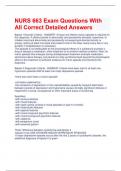
NURS 663 Exam Questions With All Correct Detailed Answers
NURS 663 Exam Questions With All Correct Detailed Answers Bipolar I Disorder Criteria - ANSWER- At least one lifetime manic episode is required for this diagnosis. A distinct period of abnormally and persistently elevated, expensive, or irritable mood and abnormally and persistently increased goal directed activity or energy, lasting at least one week and present most of the days nearly every day or any duration if hospitalization is necessary. The episode is not attributable to the physiological effects of a substance example a drug of abused a medication, other treatment or to another medical condition. Note; for manic episode that emerges during antidepressant treatment example medication, electroconvulsive therapy, but persist at a fully syndromal level beyond the physiological effect of the treatment is sufficient evidence for manic episode And therefore this diagnosis. Bipolar II Diagnostic Criteria - ANSWER- Criteria have been met for at least one hypomanic episode AND at least one major depressive episode *there has never been a manic episode* -not better explained by... -the symptoms of depression or the unpredictability caused by frequent alternation between periods of depression and hypomania causes clinically significant distress or impairment in social, occupational or other important areas of functioning Specifiers: -with anxious distress -with mixed features -with rapid cycling (at least 4 mood episodes in past 12 months) -with melancholic features -with atypical features -with mood-congruent psychotic features -with mood-incongruent psychotic features -with catatonia -with peripartum onset -with seasonal pattern *Note* difference between cyclothymia and bipolar II -bipolar II has ONE OR MORE MAJOR DEPRESSIVE EPISODES -if major depressive episode occurs after the first 2 years of cyclothymic disorder, the additional diagnosis of bipolar II is given cyclothymic disorder - ANSWER- This diagnosis is given to adults who experience at least two years or for children one year of both hypo manic and depressive periods without fulfilling the criteria for an episode of mania, hypo mania, or major depression. Bipolar I disorder - ANSWER- must meet criteria for a manic episode. A distinct period of abnormally and persistently elevated, expansive, or irritable mood and abnormally and persistently increased goal directed activity or energy lasting at least one week. During the mood disturbance three other symptoms must be present, or four if the mood is only irritable. Bipolar I disorder symptoms - ANSWER- Manic symptoms along with: Increased self-esteem or grandiosity Decrease need for sleep; feels rested after only three hours. More talkative than usual or pressure to keep talking Flights of ideas or subjective experience that thoughts are racing. Distractibility; attention too easily drawn to unimportant or irrelevant external stimuli as reported or observed. Increased in goal directed activity; either socially, at work or school or sexually or psycho motor agitation; purposeless non-goal directed activity. Excessive involvement in activities that have a high potential for painful consequences such as, engaging in unrestrained buying spree's, sexual indiscretion or foolish business investments. Marked mood disturbance with impairment in social or occupational functioning. Hospitalization due to their threat to hurt self or others, or other psychotic features. The symptoms are not attributed to physiological effects of a substance, or other medical condition. Bipolar II Disorder - ANSWER- For diagnosis of this disorder it is necessary to meet the following criteria for a current or past hypo manic episode and the following criteria for occurring or past depressive episode. Hypo manic episode criteria - ANSWER- A. A distinct. Of abnormally or persistently elevated, expansive, or irritable mood and abnormally and persistently increased activity or energy, lasting at least four consecutive days and present most of the day, nearly every day. Be. During the period of mood disturbance and increase energy and activity, three or more of the following symptoms have persisted for if the mood is only irritable. 1. Inflated self-esteem or grandiosity 2. Decreased need for sleep; feels rested after only three hours of sleep 3. More talkative than usual or pressure to keep talking. 4. Flight of ideas or subjective experience that thoughts are racing. 5. Distractibility; attention too easily drawn to unimportant or irrelevant external stimuli, as reported or observed. 6. Increase in goal directed activity; either socially, at work or school, or sexually, or psycho motor agitation. 7. Excessive involvement in activities that have a high potential for painful consequences example; in unrestrained fines freeze, sexual indiscretions, or foolish business investments. * The episode is not severe enough to cause marked impairment in social or occupational functioning or to necessitate hospitalization. If there are psychotic features the episode is by definition manic. * The episode is not attributable to the physiological effects of a substance example a drug of abuse, medication or another medical condition. major depressive episode - ANSWER- Five or more of the following symptoms have been present during the same two week period and represent a change from previous functioning, at least one of the symptoms is either a depressed mood or loss of interest or pleasure. Major depressive episode Symptoms - ANSWER- 1) depressed mood for the majority of each day for at least *2 weeks* 2) *5+* of... -- anhedonia -- lack of motivation -- less active, Psychomotor agitation/retardation -- low self-esteem -- daily fatigue, Insomnia or hypersomnia -- abnormal eating habits; weight loss/gain -- abnormal sleeping habits -- lack of concentration -- daily guilt, Sense of worthlessness -- suicidal thoughts -- decreased academic performance Or ability to concentrate, indecisiveness -- fewer friendships/social withdrawal -- EXTREME CASES: psychotic symptoms (delusions, hallucinations) 3) Significant distress or impairment
Escuela, estudio y materia
- Institución
- NURS 663 Exa
- Grado
- NURS 663 Exa
Información del documento
- Subido en
- 31 de enero de 2024
- Número de páginas
- 13
- Escrito en
- 2023/2024
- Tipo
- Examen
- Contiene
- Preguntas y respuestas
Temas
-
nurs 663 exam questions with all correct
-
nurs 663 exam questions with all correct detailed

Documento también disponible en un lote