Chapter 11 Fundamentals of Organizing
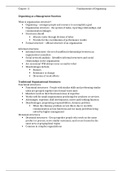
Organizing as a Management Function
What is organization structure?
Organizing – arranges people and resource to accomplish a goal
Organization structure - the system of tasks, reporting relationships, and
communication linkages
Structures should
Allocate tasks through division of labor
Provide for the coordination of performance results
Formal structure – official structure of an organization
Informal structures
Informal structures- the set of unofficial relationships between an
organization’s members
Social network analysis - Identifies informal structures and social
relationships in the organization
Are necessary! Will always occur no matter what
Disadvantages include;
Rumors
Resistance to change
Diversion of work efforts
Traditional Organizational Structures
Functional structures
Functional structures - People with similar skills and performing similar
tasks are grouped together into formal work units
Members work in their functional areas of expertise
Works well for small organizations producing few products or services
Advantages: expertise, skill development, career path withing function
Disadvantages: pinpointing responsibilities, chimney problem
When the chimney problem occurs this is due to too little
communication across functions and too many problems being
solved by higher management
Divisional structures
Divisional structures - Group together people who work on the same
product or process, serve similar customers, and/or are located in the
same area or geographical region
Common in complex organizations
Organizing as a Management Function
What is organization structure?
Organizing – arranges people and resource to accomplish a goal
Organization structure - the system of tasks, reporting relationships, and
communication linkages
Structures should
Allocate tasks through division of labor
Provide for the coordination of performance results
Formal structure – official structure of an organization
Informal structures
Informal structures- the set of unofficial relationships between an
organization’s members
Social network analysis - Identifies informal structures and social
relationships in the organization
Are necessary! Will always occur no matter what
Disadvantages include;
Rumors
Resistance to change
Diversion of work efforts
Traditional Organizational Structures
Functional structures
Functional structures - People with similar skills and performing similar
tasks are grouped together into formal work units
Members work in their functional areas of expertise
Works well for small organizations producing few products or services
Advantages: expertise, skill development, career path withing function
Disadvantages: pinpointing responsibilities, chimney problem
When the chimney problem occurs this is due to too little
communication across functions and too many problems being
solved by higher management
Divisional structures
Divisional structures - Group together people who work on the same
product or process, serve similar customers, and/or are located in the
same area or geographical region
Common in complex organizations