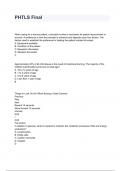
PHTLS Final Exam Questions And Answers All Verified
PHTLS Final Exam Questions And Answers All Verified When caring for a trauma patient, a principle is what is necessary for patient improvement or survival. A preference is how the principle is achieved and depends upon four factors. The factors used to establish the preference in treating the patient include all except: A. Equipment available B. Condition of the patient C. Research information D. Situation that exists C Approximately 20% of all child abuse is the result of intentional burning. The majority of the children intentionally burned are of what age? A. 10 to 12 years of age B. 1 to 2 years of age C. 5 to 6 years of age D. Less than 1 year of age B Things to Look Out for When Buying a Used Caravan Previous Play Next Rewind 10 seconds Move forward 10 seconds Unmute 0:00 / 0:00 Full screen In addition to glucose, what is required to maintain the metabolic processes of life and energy production? A. Lymphocytes B. Krebs cells C. Carbon monoxide D. Oxygen D You respond to a patient who has sustained a stab wound to the left upper thorax. She is barely responsive, pale and diaphoretic. Which of the following is the most appropriate for transport? A. Long board with spinal motion restriction B. Stair chair C. Short immobilization device D. Scoop stretcher D Units responding to a motor vehicle accident on the highway should consider which of the following as part of their pre-arrival assessment? A. Calling for more units to respond B. The need for immediate transport C. Weather conditions D. Post-exposure prophylaxis C The most appropriate airway maneuver in the initial management of a trauma patient is which of the following? A. Oropharyngeal airway B. Trauma jaw thrust C. Supraglottic airway D. Head tilt, chin lift B When verifying ET tube placement on a perfusing patient, the "gold standard" of monitoring is considered to be? A. Pulse oximetry B. Colorimetric carbon dioxide detector C. Listening to lung sounds D. Waveform capnography D A patient presents with a blunt trauma injury to the chest. On exam, he has absent breath sounds on one side of his chest and respiratory distress. Which additional sign would indicate that the patient has a tension pneumothorax? A. Tracheal deviation towards the side of injury B. Distended neck veins C. Inspiratory wheezing D. narrowed pulse pressure B Hemostatic agents should be used for excessive bleeding when direct pressure alone does not work. The proper way to use most hemostatic agents is which of the following? A. Hemostatic agents should never be used unless you have a fall in blood pressure B. Placing the agent properly into the wound and holding direct pressure C. Placing the agent around the edges of the wound D. Only using it after a tourniquet has been applied for 10 minutes B Of the following, which is a preventable cause of secondary brain injury addressable during the transport phase? A. Herniation syndromes B. Systemic hypoxia C. Intracranial hematomas D. Intraparenchymal hemorrhage B
Escuela, estudio y materia
- Institución
- PHTLS
- Grado
- PHTLS
Información del documento
- Subido en
- 24 de enero de 2024
- Número de páginas
- 11
- Escrito en
- 2023/2024
- Tipo
- Examen
- Contiene
- Preguntas y respuestas
Temas
-
phtls final

Documento también disponible en un lote