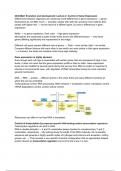
22/3/2022: Evolution and development: Lecture 2: Control of Gene Expression
Differences between organisms are caused by small differences in gene expression → genes
themselves do not differ much → example: people with dark skin produce more melanin than
people with lighter skin → not the result of a different gene, but due to differences in gene
expression.
White → no gene expression. Dark color → high gene expression
Most genes are expressed at quite similar levels across the different tissues → only those
genes differing significantly are represented in the image.
Different cell types express different sets of genes → Dark = more similar, light = not similar.
Compare different tissues with each other to see which are most similar in their gene expression
→ in humans: the testis and cerebral cortex have high similarity.
Gene expression is highly dynamic
Even though each cell type is associated with certain genes that are expressed at high or low
levels, it does not mean that the gene expression profile is fixed or static. Gene expression
levels can be modified at several points during the journey from DNA to protein in response to
internal or environmental cues, with regulation of RNA transcription being the most important
general mechanism.
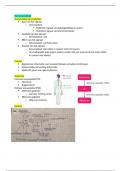
DNA → RNA → protein → different points in this chain there are many different moments at
which this can be controlled:
Transcriptional control, RNA processing, RNA transport + localization control, translation control,
mRNA degradation control, protein activity control.
Ribosomes can differ in how fast RNA is translated.
Control of transcription by sequence-specific DNA-binding proteins (transcription regulators).
Transcription regulators can bind to DNA.
DNA is double-stranded → A and G nucleotides always bonded to complementary T and C
nucleotides, respectively → By looking along the length of the DNA molecule, the nucleotide
sequence will generate a highly specific series of hydrogen bond donors and acceptors, methyl
groups, etc. → This provides a very specific chemical configuration that an appropriate shaped
protein (known as transcription regulator) can bind to like a key in a lock.
, Transcription regulator binding sites are vague
However, the transcription regulator is a vague key and lock instead of a highly specific one.
The vagueness of a transcription regulator binding site is illustrated in the graph below. This
represents a binding site of eleven nucleotides in length for the transcription factor known as
CEBPB.
The height of the letter reflects the affinity of CEBPB for that specific nucleotide at that location.
For example, CEBPB will only bind to a nucleotide sequence if T is present at sites 3 and 4, C is
at site 6 and A is at site 10. CEBPB is more flexible at other locations and will accept, for
example, either an A or a C at site 9.
This means that some DNA sequences, like TATTGCACAAT, would bind very readily with
CEBPB, but other sequences, like CCTTACCACAG, would bind much less frequently.
Transcription regulator binding sites are located near genes:
Approximately 10% of the protein-coding genes in most organisms produce transcription
regulators, and they control many features of cells. The short stretches of DNA that they
recognize (transcription regulator binding sites, or also known as cis-regulatory sequences)
exist near all genes, allowing transcription factors to bind near genes and regulate their activity.
Cis = located on the same chromosome as the gene being regulated.
Transcription regulators often work as dimers → heterodimer: has diverse binding sites.
The length of a typical transcription regulator binding site is around 5-10 nucleotides. This
means that transcription would bind to many different locations in the genome purely by chance
(for example by random chance we would expect a “vague” binding of a transcription factor to
some location every 1000 nucleotides throughout the genome). Hence transcription regulators
often work in pairs as “dimers”. This increases the length of the cis-regulatory binding site from
5-10 to 10-20 nucleotides in length, with far more specificity!
Differences between organisms are caused by small differences in gene expression → genes
themselves do not differ much → example: people with dark skin produce more melanin than
people with lighter skin → not the result of a different gene, but due to differences in gene
expression.
White → no gene expression. Dark color → high gene expression
Most genes are expressed at quite similar levels across the different tissues → only those
genes differing significantly are represented in the image.
Different cell types express different sets of genes → Dark = more similar, light = not similar.
Compare different tissues with each other to see which are most similar in their gene expression
→ in humans: the testis and cerebral cortex have high similarity.
Gene expression is highly dynamic
Even though each cell type is associated with certain genes that are expressed at high or low
levels, it does not mean that the gene expression profile is fixed or static. Gene expression
levels can be modified at several points during the journey from DNA to protein in response to
internal or environmental cues, with regulation of RNA transcription being the most important
general mechanism.
DNA → RNA → protein → different points in this chain there are many different moments at
which this can be controlled:
Transcriptional control, RNA processing, RNA transport + localization control, translation control,
mRNA degradation control, protein activity control.
Ribosomes can differ in how fast RNA is translated.
Control of transcription by sequence-specific DNA-binding proteins (transcription regulators).
Transcription regulators can bind to DNA.
DNA is double-stranded → A and G nucleotides always bonded to complementary T and C
nucleotides, respectively → By looking along the length of the DNA molecule, the nucleotide
sequence will generate a highly specific series of hydrogen bond donors and acceptors, methyl
groups, etc. → This provides a very specific chemical configuration that an appropriate shaped
protein (known as transcription regulator) can bind to like a key in a lock.
, Transcription regulator binding sites are vague
However, the transcription regulator is a vague key and lock instead of a highly specific one.
The vagueness of a transcription regulator binding site is illustrated in the graph below. This
represents a binding site of eleven nucleotides in length for the transcription factor known as
CEBPB.
The height of the letter reflects the affinity of CEBPB for that specific nucleotide at that location.
For example, CEBPB will only bind to a nucleotide sequence if T is present at sites 3 and 4, C is
at site 6 and A is at site 10. CEBPB is more flexible at other locations and will accept, for
example, either an A or a C at site 9.
This means that some DNA sequences, like TATTGCACAAT, would bind very readily with
CEBPB, but other sequences, like CCTTACCACAG, would bind much less frequently.
Transcription regulator binding sites are located near genes:
Approximately 10% of the protein-coding genes in most organisms produce transcription
regulators, and they control many features of cells. The short stretches of DNA that they
recognize (transcription regulator binding sites, or also known as cis-regulatory sequences)
exist near all genes, allowing transcription factors to bind near genes and regulate their activity.
Cis = located on the same chromosome as the gene being regulated.
Transcription regulators often work as dimers → heterodimer: has diverse binding sites.
The length of a typical transcription regulator binding site is around 5-10 nucleotides. This
means that transcription would bind to many different locations in the genome purely by chance
(for example by random chance we would expect a “vague” binding of a transcription factor to
some location every 1000 nucleotides throughout the genome). Hence transcription regulators
often work in pairs as “dimers”. This increases the length of the cis-regulatory binding site from
5-10 to 10-20 nucleotides in length, with far more specificity!